
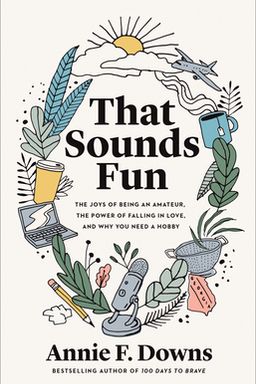
That Sounds Fun cover

That Sounds Fun

by Annie F Downs

That Sounds Fun explores how simple joys and love can counterbalance life''s challenges. Annie F. Downs invites readers to rediscover the spiritual benefits of fun, embrace their inner amateur, and find happiness in the present moment.

Rediscovering the Joy of Fun

When was the last time you did something purely for the joy of it—without checking your email, worrying about productivity, or turning it into a to-do list item? Annie F. Downs, in her heartfelt book That Sounds Fun, invites you to ask yourself this question. She argues that fun isn’t childish, frivolous, or optional—it’s sacred. It connects us to our truest selves, to others, and even to God. Through stories from her life and reflections on faith, adulthood, and play, Downs makes a case for reclaiming fun as a vital spiritual practice.

Downs contends that we live in a culture obsessed with hustle, perfection, and achievement—qualities that often squeeze out the space for joy. Many of us treat fun like a reward we haven’t quite earned or something that belongs to children. Yet, she insists that fun is intrinsic to the human experience and essential for emotional and spiritual well-being. Whether you’re snapping green beans on a front porch, playing chess with your dad, or finally taking that trip you’ve been putting off, these small moments of delight ground you in the present and remind you of what truly matters.

Fun as a Spiritual Practice

At its core, That Sounds Fun is a gentle manifesto about finding joy in the ordinary. Downs sees fun not as escapism but as engagement—a way of living fully awake. She argues that God made us to live not just with purpose, but with pleasure. When we allow ourselves to have fun, we reconnect with the divine rhythm that was present in Eden: simplicity, connection, and belonging. Fun becomes a reminder that life is not all about striving; it’s about savoring.

Her stories—from the COVID-19 lockdowns that forced her to rediscover simple joys, to the spiritual lessons she learned at a retreat in Colorado—show that fun is available even in seasons of loss and limitation. She reminds readers that delight isn’t about distraction; it’s about invitation. We’re invited back into the fullness of life, even in small ways.

From Performance to Presence

A recurring thread in the book is Downs’s resistance to the idea that adulthood equals seriousness. Many adults, she notes, have traded their childhood hobbies and spontaneous joy for busyness and burnout. We believe we have to earn happiness or look impressive while having fun. Downs dismantles this idea, encouraging us to become “amateurs” again—people who do things purely for the love of them. The word “amateur,” she reminds us, comes from the Latin amare, meaning “to love.” Being an amateur is not about incompetence; it’s about intimacy with joy.

Whether she’s fumbling through a chess game or awkwardly learning to discuss racial justice as a white woman, Downs embraces her imperfection. Her honesty is refreshing: fun, growth, and vulnerability often coexist. You don’t need to be good at something to find joy in it—you just need to show up with openness and curiosity. This theme aligns with the ideas of Brené Brown in The Gifts of Imperfection, who also argues that wholehearted living requires embracing vulnerability and play.

Choosing the Present over the Perfect Future

One of the most poignant insights in the book is Downs’s realization that she had been postponing her happiness. Like many people, she imagined fun as something that would come later—after marriage, after buying a house, after meeting certain milestones. But when a promising relationship ended suddenly, Downs recognized that waiting for happiness was costing her the life she already had. So she stopped waiting. She bought her own home—aptly named “Harvest House”—as a celebration of learning to reap joy from the present instead of endlessly sowing for the future.

Her story challenges the common narrative that happiness is tied to external circumstances. Downs shows that true fun—and true faith—come when you stop waiting for perfect conditions and start enjoying what’s already here. As she puts it, fun is not a destination; it’s a way of being fully alive in the ordinary moments.

Vulnerability: The Gateway to Real Joy

Interestingly, Downs argues that authentic fun sometimes begins with admitting we’re not okay. In one story, she recounts going on a dream vacation to a scenic Christian retreat, expecting joy to come easily. Instead, she realized she was carrying emotional pain she couldn’t shake. When she admitted to the retreat leader that she wasn’t feeling fine, she learned that pretending to be okay prevents us from experiencing the joy of authenticity. The lesson is simple: being honest about where you are emotionally isn’t the opposite of fun—it’s the foundation for it.

In a culture that measures happiness through performance and appearance, Downs’s vulnerability is an act of rebellion. She teaches that you can’t fake your way to joy; you have to feel your way toward it. Fun and sadness can coexist, and sometimes the most joyful people are those who have made peace with their imperfections.

Why Fun Matters—More Than You Think

Ultimately, That Sounds Fun is more than a collection of lighthearted reflections—it’s an invitation to reimagine your relationship with joy. Downs wants you to remember what it’s like to live curiously, to embrace simplicity, and to trust that fun isn’t an escape from your real life but a doorway into it. Through her stories of bean-snapping rituals, chess lessons, missed vacations, and spiritual renewals, she offers a philosophy that is both timely and timeless: life is short, but joy is infinite if you stay open to it.

“Fun doesn’t have to be big, flashy, or public. Sometimes it’s just snapping beans on the porch and remembering that Eden lives in simple moments.”

Across its chapters, the book explores how to find simple pleasures when life feels small, why being an amateur brings freedom, how to stop waiting for the future, how hobbies restore connection, and why it’s okay not to be okay. It’s a personal, spiritual, and deeply human reminder that the path to joy often runs through the most ordinary corners of our lives. Fun isn’t the extra—it’s the essence. And as Annie F. Downs insists, recovering that truth might just change everything.


Finding Joy in Simple Pleasures

In the opening chapter, Annie F. Downs reflects on what “fun” really means, especially in seasons when our lives have become smaller—like during the COVID-19 pandemic. She notes that when the world shut down, we all lost access to our usual sources of excitement: travel, restaurants, events, and gatherings. Yet our longing for joy didn’t go away. This forced us to answer an uncomfortable question: what does fun look like when life feels limited?

For Downs, the answer is simplicity. True fun isn’t dependent on grand gestures or expensive adventures; it often lives in ordinary acts that ground us in the present moment. She recalls her childhood in Georgia, sitting on a porch with her mother and grandmother, snapping green beans as the sun dipped below the horizon. To her younger self, those moments seemed ordinary. But as an adult, she recognizes that they were glimpses of Eden—pure presence, connection, and peace.

The Eden Within Ordinary Life

Downs’s reflection on those porch evenings becomes a theological meditation. Scripture describes Eden as a place without hurry, shame, or striving—only love, presence, and abundance. While modern life feels far from paradise, she believes we can still experience fragments of it through simple joys. Whether it’s sharing laughter with a friend, reading a good book, or cooking a meal from scratch, these are micro-Edens that remind us of our spiritual design for delight.

(This perspective resonates with writers like C.S. Lewis and G.K. Chesterton, who saw joy and wonder as signs pointing back to divine reality. Downs’s version of that message is relational and grounded in everyday life.)

Why We Resist Simplicity

Many of us underestimate simple pleasures because they seem too small to count. We’ve internalized a belief that fun should be spectacular—that a great time must be Instagram-worthy. But Downs suggests that this kind of pressure actually distances us from authentic joy. Fun isn’t performative; it’s embodied. It doesn’t demand an audience, only attention. When you slow down enough to notice your senses—the feel of beans snapping, the warmth of sunlight, the rhythm of conversation—you reconnect with yourself and with God.

“Fun, in its simplest form, is peace—a few moments when the weight of the world lifts, and you can simply be.”

Rediscovering Low-Key Fun

To re-engage with joy, Downs encourages readers to seek out low-key fun—activities that don’t require planning or pressure. It could be baking cookies, calling an old friend, or going on a walk without your phone. These moments might not change the world, but they change how you inhabit it. They help you return to the essence of life before screens, deadlines, and expectations.

In rediscovering these forms of simple pleasure, you’re reminded that joy isn’t something to earn; it’s something to notice. It’s the oldest truth of all—a garden waiting quietly at the center of your ordinary days.


Embrace Your Inner Amateur

Downs devotes one chapter to reframing a misunderstood word: amateur. In today’s culture, being an amateur is often an insult—it implies incompetence or lack of professionalism. But the word’s roots tell a different story. Derived from the Latin amator, meaning “lover,” an amateur is someone who does something for love rather than profit. And that, Downs argues, is the heart of fun: doing things because they delight you, not because they prove your worth.

The Joy of Doing Without Performing

Downs observes that our culture tends to commercialize anything we enjoy. Bake a great cake? Someone will tell you to start a business. Enjoy photography? People will encourage you to sell your shots online. The implication is that doing something for its own sake isn’t enough—it must become profitable or productive. Yet, when we turn our passions into performance, we often lose the very joy that drew us to them. Downs warns that monetizing your hobbies can rob them of their meaning.

(This insight echoes ideas from writer Elizabeth Gilbert in Big Magic, who urges creatives to protect their passions from the pressure of professional success. Downs makes the same case through the lens of everyday spirituality.)

Learning Through Imperfection

Being an amateur also means accepting that you will make mistakes—and that’s okay. Downs shares how this attitude became crucial during the racial justice conversations following the Black Lives Matter movement. She felt inexperienced and uncertain about what to say, but silence was worse than stumbling. By embracing her amateur status, she learned that imperfect action can still bring growth and connection. Her message is liberating: you don’t have to master something before participating in it. Growth is the reward of showing up, not the result of having already arrived.

Fun, Downs insists, is about reclaiming the freedom to try, fail, laugh, and keep going—simply because it feels right. When you embrace your inner amateur, you stop living for applause and start living for joy. That’s when fun becomes not only possible but transformational.


Stop Waiting for Your Real Life to Begin

For years, Annie F. Downs delayed joy because she was waiting for her “real life” to start—the one she envisioned with a husband, children, and the milestones she assumed would make her whole. But after yet another relationship disappointment, she realized that this mindset had robbed her of the present. So she stopped waiting. She went on that long-postponed trip, bought her first home, and named it “Harvest House.” This was more than just a property purchase—it was a declaration that she deserved to live fully now, not someday.

The Trap of the Deferred Dream

Downs’s story mirrors a trap many fall into: the habit of deferring joy. We tell ourselves we’ll travel after the promotion, rest after the kids grow up, or pursue hobbies after retirement. In doing so, we miss the life unfolding in front of us. Downs writes that while the future is uncertain, the present is a gift—one waiting to be opened through gratitude and courage. Her message recalls the wisdom of authors like Eckhart Tolle in The Power of Now, who teach that the only real moment we ever have is the present one.

Harvesting What’s Already Yours

Naming her home “Harvest House” was deeply symbolic. After years of planting dreams, she was finally harvesting joy from her own life. This act of claiming agency over her happiness became a turning point in her spiritual and emotional growth. By celebrating what she had instead of longing for what might be, Downs discovered that contentment and fun are less about circumstance and more about perspective.

Her story challenges you to consider: What are you postponing until “someday?” What would happen if you decided to live as though joy were available now? Downs’s answer is both simple and profound—life doesn’t start later; it starts as soon as you stop waiting.


Keep Your Hobbies—They Keep You Whole

One of the most relatable sections in That Sounds Fun addresses how we lose hobbies in adulthood. Downs notices that at some point, most of us trade play for productivity. Hobbies—those things we loved for no reason other than enjoyment—get pushed aside by the serious business of growing up. But she argues that giving up hobbies doesn’t just take away fun; it disconnects us from our most human need for rest, creativity, and connection.

The Power of Shared Hobbies

Downs’s father loved chess as a child but abandoned it when adult responsibilities took over. Years later, when Downs learned to play, she reconnected with him in a way she hadn’t before. Through their games, she glimpsed the playful boy inside the man she knew as disciplined and steady. Chess became a bridge between generations, a reminder that fun can heal old distances and reveal hidden tenderness. Similarly, when Downs played chess with her friend Tim, who lives with ALS, the game became an uplifting miracle—a shared language that still connected them despite his physical limitations.

Defining Your Own Fun

Downs also tells how she gave up the French horn in high school because her peers thought it wasn’t “cool.” Looking back, she regrets letting social pressure dictate her joy. Her story reminds readers that your hobbies are sacred spaces—no one else gets to define what counts as fun for you. Whether your joy comes from painting, gardening, gaming, or stargazing, it’s valid. What matters is that it brings you alive.

So if you’ve lost touch with your hobbies, it’s time to pick them up again. Not because they’re useful, but because they make you feel fully you. Fun, Downs concludes, is not an accessory to life—it’s the soul’s oxygen.


It’s Okay Not to Be Okay

In one of the book’s most vulnerable chapters, Downs explores the paradox of fun: sometimes the path to joy runs through pain. While on what should have been a beautiful retreat in Colorado, she realized that despite the stunning landscape and peaceful setting, she couldn’t force herself to have fun. Her emotional baggage had followed her there, and pretending everything was fine only made her feel more disconnected. The turning point came when the retreat leader noticed her façade and told her to drop it—to stop performing and start being real.

Vulnerability as a Precursor to Joy

Downs learned that true joy requires vulnerability. Fun isn’t about escaping what hurts; it’s about creating space where you can be honest and still present. By admitting that she wasn’t okay, she found deeper freedom—not the manufactured happiness she came for, but something more authentic. This echoes psychologist Brené Brown’s findings that joy and vulnerability are inseparable; openness makes us more capable of connection and wonder.

Faith and the Honesty of Emotions

For Downs, this realization is also spiritual. Christianity sometimes teaches believers to “rejoice always,” but she reminds us that genuine rejoicing doesn’t mean pretending. God isn’t looking for happy masks—He meets us in truth. When she stopped pretending, Downs found she could finally encounter God’s comfort and joy more deeply. In her view, emotional honesty is a form of worship; it’s saying, “Here’s where I really am,” and letting grace meet you there.

By accepting that it’s okay not to be okay, Downs redefines fun as something far more holistic. It’s not just laughter—it’s life lived with authenticity, where tears and joy coexist, and where the truest fun comes from being fully human.


Fun as a Way Back to Wholeness

At the heart of That Sounds Fun lies one resounding truth: fun isn’t an escape from reality—it’s a way back to it. Annie F. Downs reminds us that the world is not always a fun place, but even in hardship, moments of joy are possible. They help us remember that life is worth loving, people are worth knowing, and the small things are worth cherishing. Fun is the spiritual art of noticing, of letting what’s good in the world reach you again.

From Curiosity to Connection

Downs encourages cultivating curiosity—the childlike willingness to explore what brings life back into focus. When you follow what sounds fun, you rediscover delight as a guidepost. It could lead you to heal a relationship, pick up a neglected skill, or simply breathe again. Fun reconnects you to the parts of yourself you’ve ignored in the name of responsibility.

The Circular Nature of Fun and Faith

In the end, Downs weaves fun, faith, and self-discovery into a single circle: the more fun you allow yourself to have, the closer you feel to God and others; and the closer you feel to God and others, the more fun life becomes. Joy, in her telling, is not a pause from meaning—it deepens it.

Downs leaves us with a challenge that feels like an invitation: find something that simply sounds fun—and do it. Not because it will change the world, but because it might just change you. In those joyful glimpses, no matter how fleeting, we catch a piece of eternity. And that, she says, truly sounds fun.

Dig Deeper

Get personalized prompts to apply these lessons to your life and deepen your understanding.

Go Deeper

Get the Full Experience

Download Insight Books for AI-powered reflections, quizzes, and more.