
Idea 1
Living with Courage: Musonius Rufus’s Call to Disdain Hardships
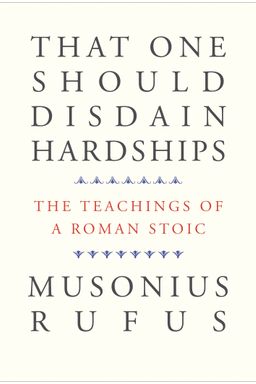
What does it mean to live well when life feels hard? Musonius Rufus, the Roman Stoic often dubbed the “Roman Socrates,” argues that a good life is not one free of pain or hardship but one defined by virtue, reason, and practice. In That One Should Disdain Hardships: The Teachings of a Roman Stoic, he challenges our deeply rooted assumptions about comfort, happiness, and purpose. He asks you to consider: if acrobats risk death for applause, and lovers, merchants, or soldiers suffer for fleeting pleasure or gain, why shouldn’t you accept hardship in the pursuit of wisdom and moral excellence?
Through simple yet penetrating discourses, Musonius teaches that philosophy is not an abstract pastime but a discipline of life. His teachings—recorded by his followers and revived through Cora E. Lutz’s translation—draw from Stoic principles but reshape them with a moral and practical edge. Virtue, not theory, defines wisdom. Both men and women possess the same capacity for reason and moral strength. And one should live in harmony with nature—through simplicity in food, marriage, labor, and even clothing.
A Life Grounded in Action, Not Words
For Musonius, philosophy unites knowledge with practice. Like a doctor who must heal, not merely talk about healing, the philosopher must live by his principles rather than debate them endlessly. True philosophy is an art of living. He insists that training the soul and body is inseparable: the soul learns self-control, justice, courage, and wisdom, while the body learns to endure heat, cold, hunger, labor, and pain without complaint. This belief in active discipline forms the foundation of his Stoicism and continues to influence his student, Epictetus.
Virtue as the Only Good
Musonius shares the classic Stoic conviction that virtue is the only true good, and vice the only true evil. External circumstances—wealth, health, exile, or reputation—are indifferent. What matters is how you use your reason to respond to them. This perspective frees you from craving outcomes you cannot control and encourages an inner stability resilient to misfortune. As he puts it: to perfect reason is to live like the divine, acting with justice and benevolence despite life's turbulence.
Equality and Social Duty
Remarkably ahead of his time, Musonius insists that women possess the same rational capacity as men and should study philosophy, govern their impulses, and develop virtue equally. His lectures on marriage and family life build on this vision of ethical partnership: the true marriage is grounded not in wealth or beauty but in mutual love, companionship, and the pursuit of virtue. He even extends Stoic ethics to rulers and kings, claiming that a good ruler must be a philosopher—just as philosophy itself is the most “kingly” art, governing the soul toward justice and wisdom.
The Stoic Life in Practice
Across his lectures—from attitudes toward food, work, sexuality, and exile—Musonius offers a continuous call to simplify and refine your life. Eat simply to nourish rather than indulge. Work with your hands; manual labor, especially farming, is noble and natural. Live modestly, with no need for luxury in clothes, houses, or furniture. Even exile, often considered a tragedy, cannot rob a philosopher of contentment, because true freedom lies in how one thinks, not where one lives.
A Model of Stoic Humanity
What makes Musonius stand out among the Roman Stoics is not only his clarity but his compassion. Unlike the aloof sage popularized in caricature, his philosophy is devoted to social harmony and moral community. To perfect yourself is not to withdraw but to serve better—your family, your city, and the broader cosmopolis of gods and humankind. He embodied this ideal personally: when exiled to the barren island of Gyara, he taught locals, found water in the desert, and continued to practice philosophy unbroken. In his quiet rebuke of comfort and his faith in moral self-mastery, Musonius offers a timeless message: endure with purpose, and hardship becomes the path to happiness.