
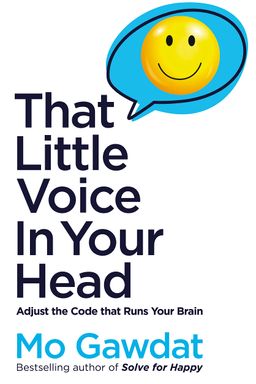
That Little Voice in Your Head cover

That Little Voice in Your Head

by Mo Gawdat

Unlock the secrets of your mind with Mo Gawdat''s ''That Little Voice in Your Head.'' By merging computer science with neuroscience, Gawdat offers practical exercises to reprogram your brain, control thoughts, and enhance happiness. Transform your mental processes and positively affect those around you in this engaging guide.

Debugging the Human Code for Happiness

Why do you suffer even when life seems fine? In his book, Mo Gawdat treats unhappiness as a system error — not a moral flaw, not bad luck, but faulty programming. As an engineer turned entrepreneur, he insists that your brain runs like complex software governed by inputs, algorithms and output habits. When you debug that code, happiness emerges as the default state rather than a rare luck event.

Gawdat’s central argument is simple and revolutionary: unhappiness is the result of four wrong inputs, three defensive reactions, two polarities out of balance, and one malignant habit of thought. He compresses all of that into the 4‑3‑2‑1 Model of Unhappiness — a diagnostic device to trace where mental suffering originates. The journey begins by realizing that you are not your thoughts, progresses through cleaning up inputs, regulating emotion, retraining neural habits, and ends in a flow‑based, giving existence where happiness becomes not just an experience but a social mission.

The 4‑3‑2‑1 Operating System

Mo’s model works like a software architecture diagram. The four wrong inputs — false observations, cultural conditioning, recycled painful stories, and hidden triggers (like media fear-feeds) — contaminate perception. Those inputs, combined with the three exaggerated defences (Aversion, Attachment, and All‑pervasive dissatisfaction), generate behavioral loops rooted in evolutionary survival brain layers. The two polarities — ‘Be’ and ‘Do’, or right‑brain vs. left‑brain operation — often tilt toward imbalance. Finally, the one malignant habit — rumination — repeats painful thoughts and hardwires misery. Debugging begins by identifying which component is currently active.

From Machine Code to Conscious Agency

To fix these loops, Mo reframes cognition itself: the voice in your head is not you. Through personal epiphanies (like hearing Pink Floyd’s lyric “There’s someone in my head but it’s not me”), Gawdat learned to separate the author from the narrator. Neuroscience supports him: thoughts are post-processed linguistic outputs of neural computation, not your conscious identity. Once you see thoughts as external scripts, you can decline to run them — effectively gaining freedom. (Note: Viktor Frankl made a similar distinction between stimulus and response, where awareness is the space of freedom.)

Emotion as Predictive Feedback

After cognition, Gawdat moves to emotion mechanics. Emotions, he argues, are predictable outputs of thought plus physiological signatures. Fear, anger, and joy follow formulas — measurable shifts in perceived safety, time, or reward. That reframing transforms emotions into diagnostic data. Instead of treating feelings as storms, you can track their origins, analyze triggers, and respond constructively. Exercises like Observe the Drama show cause and effect: each thought regenerates or dissolves emotion, proving predictability.

Neuroplasticity and Habit Reprogramming

The engineering metaphor continues through neuroplasticity. Your brain rewires itself based on whatever you practice. Repeated rumination strengthens unhappiness networks, while gratitude and attention strengthen joy pathways. “Practice makes miserable” unless you consciously retrain responses. Using Hebbian learning (“neurons that fire together wire together”), Mo teaches how repetition — even five-minute daily drills — alters default states. You become what you rehearse, so he prescribes a deliberate mental gym: repetition of being present, gratitude lists, detachment rituals, attention games, and flow tasks.

From Survival Algorithms to Flow

He then rebuilds the emotional system into four capabilities: Experience, Solve, Flow, Give. You experience each moment attentively, solve what can be solved, enter flow where doing merges with being, and give generously. These four modes form productive thought — eliminating unnecessary noise by filling mental capacity with purposeful activity. Flow brings biochemical harmony; giving activates reward circuits and reconnects you to others. When sustained, this loop becomes not just personal happiness but micro-societal repair — underpinning Mo’s “One Billion Happy” movement.

The Core Formula for Debugging

4‑3‑2‑1 at a glance

4 wrong inputs → 3 exaggerated defences → 2 polarities out of balance → 1 malicious thought. Practice makes miserable.

Throughout, Gawdat insists that your task is to audit, balance, and reprogram. Observe inputs; clean triggers; rebalance brain hemispheres; track emotions like data; practice gratitude and focus; interrupt rumination with the Becky Contract (“Ask your brain for joyful or useful alternatives”). The Happiness Flow Chart translates the philosophy into algorithmic clarity — six questions that convert suffering into comprehension and action.

Ultimately, this book reframes happiness as a technical craft. You, the human engineer, debug thoughts, balance brain polarities, regulate emotional chemistry, and use attention like light to dissolve darkness. The goal is not perfection; it’s maintenance. Each day, you check code and run updates: inputs clean, emotions valid, thoughts useful, body calm, brain flexible, and life directed toward giving. When those systems align, happiness isn’t an achievement—it’s restored functionality.


Audit Your Inputs

The first layer of mental debugging begins with inspecting what you let into your mind. Mo calls much of modern information flow 'hidden triggers' — sources that masquerade as neutral but inject fear, outrage, and comparison. From 24‑hour news to social feeds, these inputs shape your expectations and emotional defaults. The engineering metaphor here is straightforward: garbage in = garbage out.

Identify hidden triggers

Hidden triggers may be media headlines emphasizing threat, films glorifying violence, cultural proverbs about scarcity, or friends repeating cynical stories. Mo’s detox challenge asks you to list every input that changed your mood last week — then remove what corrupts clarity. Examples include refusing violent content, muting notifications, and limiting social media time. As Mo discovered, skipping the news for weeks restored calm; the world didn’t end, but his clarity returned.

Selective consumption, not isolation

This is not about withdrawal from reality. Instead, it’s about deliberate curation. Opting out where the input damages your clarity is an act of wisdom. You keep observation (direct sensory data) and remove conditioning, recycled stories, and borrowed triggers. When your attention is no longer hijacked, decision-making improves, and emotional volatility drops. (Compare Cal Newport’s 'Digital Minimalism'—same principle applied to cognitive hygiene.)

Practical detox protocol

  • Schedule two-week news breaks and measure your clarity.
  • Eliminate violent or exploitative entertainment that normalizes harm.
  • Question inherited cultural proverbs—ask when they were true and whether they still are.
  • Use accountability partners to track emotional changes after each detox.

Key takeaway

Every thought is fed by an input. Audit the sources and choose only those that feed clarity, compassion, and truth. Happiness begins with good data.

Inputs are the raw materials of your mental reality. When you clean them, all deeper work — balancing defences, emotions, and attention — becomes exponentially easier. You teach your brain to stop recycling garbage and start processing truth.


Tame Your Brain’s Defences

Your second step is understanding the mechanisms that evolved to keep you alive but now sabotage peace. Mo compresses these into the AAA: Aversion, Attachment, and All‑pervasive dissatisfaction. Each emerges from one layer of the triune brain model and produces a predictable distortion when exaggerated.

Aversion: Fear and avoidance

Rooted in the reptilian brain, aversion manifests as the fight–flight–freeze alarm. It is reactive and math-blind. You worry about catastrophes that are statistically improbable. Mo’s Are You Safe? exercise teaches basic probability: if you haven’t been attacked today and have resources to protect yourself, the danger is near-zero. Doing that arithmetic shrinks anxiety dramatically.

Attachment: Clinging and possession

The limbic, mammalian brain generates reward and bonding but also hoarding. Loss hits it like physical pain. When Mo’s family lost his son Ali, they chose to give away his possessions — transforming grief into service. That act broke the loop of attachment without dishonoring love. To practise detachment, start small: release ten items per week, echoing Mo’s habit. Joy often returns as freedom.

All‑pervasive dissatisfaction: The endless more

Your rational brain constantly compares outcomes, leading to restlessness. Mo’s BMW story illustrates it — happiness lasted hours before comparison killed it. Gratitude reverses this. Listing three blessings every night retrains cortical filters to notice sufficiency instead of lack. (Note: Barbara Fredrickson’s positive psychology research confirms gratitude expands attention and well-being.)

Practice summary

Audit fear mathematically, give away items regularly, and practise daily gratitude. These rebalance survival architectures into peace architectures.

Each layer—reptilian, limbic, neocortical—was designed for protection, not contentment. Once you rebalance them consciously, your brain stops manufacturing needless terror, clinging, and dissatisfaction. You calm the survival code and make space for joy.


Balance Be and Do

Your brain hosts two complementary operating systems: the analytical left hemisphere ('Do') and the intuitive right hemisphere ('Be'). Modern culture has overclocked 'Do' — endless goals, productivity metrics, and busyness — at the expense of 'Be', the systems for empathy, creativity, and presence. Mo’s corrective sequence, Be → Learn → Do, restores integration.

Meet Lefty and Righty

Mo personifies the two sides as Lefty (planner, executor) and Righty (creator, feeler). Neuroscientist Jill Bolte Taylor’s stroke and recovery provided a glimpse of pure Righty consciousness — oneness without chatter. His son Ali embodied it naturally: deep empathy for suffering. Balancing both modes lets you feel the world’s pain without paralysis and act intelligently without harshness.

Practising the Be–Learn–Do rhythm

Challenges follow three stages: Be (observe), Learn (gather data), Do (act). Mo’s flow chart and related drills like “Trading Places” and “Both of You” formalize this rhythm. Before reacting to stress, pause to Be; once grounded, Learn what’s true; finally, Do what’s constructive. This sequence prevents reactive mistakes and reduces suffering cycles.

Core rule

Be before you learn, learn before you do. Awareness precedes wisdom; wisdom precedes action.

To operationalize balance, schedule sessions for both hemispheres: right-brain mindfulness, left-brain planning. Practical repetition builds flexibility through neuroplasticity. When both sides cooperate, flow emerges — the state where doing becomes being, and happiness arises naturally.


Reprogram Thought and Emotion

Mo’s engineering background drives the next insight: thought and emotion are code you can rewrite. You suffer mainly because your brain reruns old stories — subroutines looping without resolution. The antidote is deliberate interrupt and retraining. His metaphorical colleague 'Becky' represents that looping mind: instruct her properly and the noise recedes.

Interrupting loops

When a thought repeats painfully, respond aloud, “Give me a useful or joyful alternative.” This Becky Contract transforms self-talk. For example, Mo reprogrammed grief — when Becky said “Ali died,” he countered “Ali also lived.” That slight syntactic flip rewired emotion toward gratitude. Adding visual cues (“Are you happy?” sticky notes) reinforces the interrupt pattern.

Emotional training through practice

You become emotionally skilled through repetition. Gratitude, compassion, and patience strengthen their circuits like muscles. Exercises include listing blessings, performing acts of kindness, and delaying impulses (sit with the urge without acting). Each repetition shifts connectivity. Over months, these habits become automatic calm instead of automatic reactivity.

Attention as the master switch

Focused attention disables rumination. The Blank Brain Test proves it: solving an external puzzle silences internal chatter because your Default Mode Network cannot co‑activate with task attention. Therefore, short attention drills (“Wish You Were Here”) become happiness workouts. Count colors, read backward, or track small motions — five minutes, several times daily, to strengthen presence.

Key insight

Your thoughts are not commands. Observe, rename, interrupt, and redirect. Each act of attention rewires emotion from drama toward peace.

In time, you train a cooperative mind. The looping subroutines quiet; emotions flow and dissipate instead of combusting. What once seemed uncontrollable—fear, anger, regret—becomes programmable through conscious repetition.


Harness Neurochemistry and Flow

Your happiness also resides in chemistry. The autonomic nervous system and neurochemicals shape emotional quality. When the sympathetic system (stress engine) runs continuously, tension dominates. Activating the parasympathetic ('chill' system) restores calm. Mo calls this “body debugging”: adjusting posture, breath, and muscle tone to influence neurochemistry.

Sympathetic vs parasympathetic balance

Deep breathing, smiling, or stretching send signals that you are safe, turning off cortisol and adrenaline cascades. Experiments like the 'chopstick smile' confirm the physiological feedback loop. This is why meditation and physical exercise help regulate emotion — they aren’t mystical; they’re mechanical reset buttons.

Flow chemistry

In flow, doing and being merge. Dopamine, serotonin, and anandamide build energy and calm simultaneously. Mo recreates flow through micro-task challenges — turning dishwashing into focus training by targeting perfection for each item. Flow states mute the inner critic (transient hypofrontality) and deliver joy through presence.

Give as chemistry booster

Acts of generosity trigger oxytocin and dopamine. Studies cited by Mo (like Michael Norton’s work) show giving increases happiness more than self-spending. Weekly rituals — gifting objects, helping strangers — maintain neurochemical balance and purpose. Giving becomes therapeutic and contagious.

Simple hack

Move your body into relaxation; your chemistry will follow. Smile, exhale, stretch, and give — each one signals safety and triggers neural calm.

When body and intention align, happiness stabilizes biologically. Flow and generosity aren't abstract; they are neurochemical precision tools for emotional resilience.

Dig Deeper

Get personalized prompts to apply these lessons to your life and deepen your understanding.

Go Deeper

Get the Full Experience

Download Insight Books for AI-powered reflections, quizzes, and more.