
Idea 1
Making Feedback Work for Growth
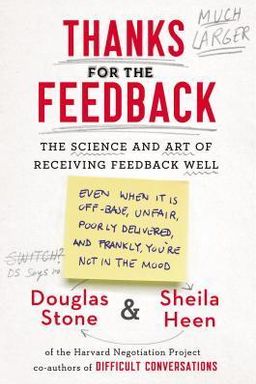
Why does feedback so often sting, get ignored, or go nowhere? In Thanks for the Feedback, Douglas Stone and Sheila Heen argue that most conversations about feedback fail not because of poor delivery but because of how we receive it. Their central insight: you are the key variable in your own learning. When you stop waiting for others to push better feedback toward you and instead create pull—actively drawing information in, asking clarifying questions, and experimenting with small changes—you transform feedback from a source of dread into one of your most reliable engines of growth.
The book reframes feedback as a learning relationship. It is not about fixing givers or teaching politeness; it is about equipping receivers with skills to understand, contain, and use what comes their way. The authors emphasize practical mental habits and conversational tools that make difference between resentment and resilience: recognizing triggers, separating three distinct kinds of feedback (appreciation, coaching, and evaluation), seeing blind spots, and holding your identity with flexibility instead of fragility.
The feedback dilemma
Feedback offers the promise of improvement but also the threat of criticism. Many organizational efforts focus on improving feedback delivery—teaching managers how to phrase comments or soften tone. Stone and Heen point out that this helps only up to a point. If receivers feel threatened, misunderstood, or defensive, more eloquent critiques still fail. Growth depends on learning to receive feedback skillfully, even when it’s clumsy, unfair, or painful.
Take Rodrigo, who read his 360-degree report and felt only awkwardness with colleagues rather than insight. He waited for the report to change him. But learning requires pull: asking, interpreting, and adapting—actions only he can take.
Three triggers that block feedback
You shut down feedback when one of three predictable triggers fire. Truth triggers make you think the feedback is wrong. Relationship triggers make you bristle at the giver. Identity triggers make you feel personally attacked. Learning begins when you can name which trigger fired and choose tools to manage it—asking for data if truth is in question, separating relationship from content if trust is low, and practicing containment if identity feels shaken.
For example, Kip initially rejected Nancy’s feedback about bias because he thought she was wrong. After asking for specifics—what did she observe?—he discovered usable coaching. Recognizing the trigger let him turn push into pull.
Understanding feedback types
Every feedback conversation hides three different human needs. Sometimes you want appreciation—thanks and recognition. Sometimes you want coaching—ideas for improving. Sometimes you need evaluation—clarity on where you stand. When these get mixed, confusion reigns. April wants appreciation and gets coaching; Cody wants coaching and gets evaluation. The result is frustration, not learning. Clarifying intention on both sides—“Are you offering advice or evaluation?”—makes conversations safer and clearer.
From labels to data
Most feedback arrives as shorthand labels (“Be assertive,” “Too enmeshed”) that are vague or distorted. The authors teach you to unpack feedback into two parts: the giver’s data (what they saw) and their interpretation (the meaning they assigned). Once you separate them, feedback becomes usable evidence. Paul’s conversation with Monisha after a climate survey showed this: he resisted quick dismissal and asked for examples, uncovering valuable insight hidden under generalities.
Managing identity and blind spots
Some feedback shakes confidence because it touches self-image. The book explores the emotional mechanics of identity triggers—how wiring shapes sensitivity to praise or criticism. Alita’s slow recovery from patient critiques contrasts with Krista’s quick bounce-back. Their swings reveal how baseline temperament drives reaction. You can stabilize identity by practicing containment (mapping what feedback is and isn’t about), building a growth identity (seeing abilities as changeable), and cultivating honest mirrors who reflect you accurately rather than comfortingly.
Pull habits for real learning
Creating pull means asking targeted questions and practicing small experiments. Ask “Help me understand what you see—can you show me an example and what you wish I did differently?” Try one change, measure results, and report back. This iterative approach—used by Margie after receiving a “Meets Expectations” rating—turns evaluation into development.
Culture and systems matter
Even in organizations, feedback usually fails for reasons of system design and fear. Stone and Heen describe dual tracks for organizational learning: one formal and evaluative, one informal and coaching-oriented. Leaders who separate these create safety for experimentation while maintaining accountability. The receiver remains the pivot—your willingness to ask, interpret, and apply feedback determines whether the system actually produces growth.
Core message
Feedback is less about fixing the sender than about empowering the receiver. Learn to create pull—to ask, sort, contain, and apply—and you’ll turn every piece of criticism, praise, or evaluation into a roadmap for growth.
By shifting from defensive listening to proactive learning, you gain control of your development. The book’s underlying theme is both practical and philosophical: to mature as a learner, you must claim ownership of what you take in and how you change.