
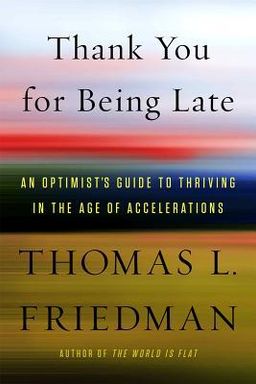
Thank You for Being Late cover

Thank You for Being Late

by Thomas L Friedman

Thank You for Being Late explores the rapid accelerations in technology, markets, and climate that are reshaping our world. Thomas L. Friedman provides insights into adapting to these changes, emphasizing the importance of dynamic stability and collaboration in thriving amidst uncertainty.

Thriving in the Age of Accelerations

Thriving in the Age of Accelerations

How can you stay balanced when everything around you speeds up—technology, markets, and the climate itself? In Thank You for Being Late, Thomas L. Friedman argues that the defining challenge of our century is adapting to an era of simultaneous accelerations: digital technology (Moore’s Law), globalization (the Market), and environmental change (Mother Nature). These three forces together form what he calls a supernova—a self-reinforcing explosion of data, connectivity, and complexity that amplifies both opportunity and disruption.

Friedman insists that while these forces are transforming every institution, they do not render humans obsolete. They require you to reinvent stability—through reflection, community, education, and moral innovation. His main argument is deceptively optimistic: humanity can thrive amid these accelerations, but only if we learn how to pause, retool our skills, rebuild social trust, and align our ethics with the pace of technology.

The pause that started everything

The book itself was born from a pause. Friedman discovered, by accident, that waiting for late guests gave him time to think; those unscheduled minutes became a metaphor for sanity in the digital storm. When you press the pause button on a human being, he writes, you start—not stop. You start to reconnect patterns, reflect on assumptions, and reimagine possibilities. This simple mental discipline, taught through his story of mentoring Ethiopian blogger Ayele Bojia, anchors the book: reflection is both a cognitive tool and a civic virtue.

The inflection point of modern life

Friedman identifies 2007 as the pivotal year when the supernova truly ignited. In that single year, the iPhone debuted, Hadoop and GitHub opened big data and collaborative coding to the world, Kindle reshaped media, Airbnb was conceived, and Android accelerated mobile scalability. These innovations converged with cheap storage and sensors to make complexity invisible and affordability universal. From that moment, individuals could scale globally overnight, and institutions began lagging behind exponential change.

Understanding the supernova

At the heart of Friedman’s analysis is the idea that five technological streams—microchips, sensors, storage, software, and networks—have fused into a single, planetary computing platform. When chips get faster, sensors turn the physical world digital, storage captures that data cheaply, software mines patterns, and networks share insights instantly, humanity enters a new mode of existence: complexity is no longer scarce; it becomes free. That shift powers everything from IBM’s Watson diagnosing cancer to makerspaces in Turkey selling global tools.

The three accelerations: Moore’s Law, the Market, and Mother Nature

Friedman integrates all his material into one conceptual frame: the “three accelerations.” Each is exponential. Moore’s Law pushes technology faster; the Market moves goods, capital, and people at unprecedented speed; Mother Nature responds with climate disruptions as feedback loops intensify. Together they form an ecosystem of risk and possibility. If you run a business, these accelerations determine your competitiveness; if you run a country, they test your resilience; if you’re a citizen, they shape the conditions of your learning, work, and ethics.

The human solution: reflection and inclusion

Friedman argues that adaptation begins at human scale—with pause, community, and learning. Resilience is not only technical (fiber optics and data centers) but personal and civic: your ability to reflect, connect, and trust others is itself infrastructure. That is why he ends where he began—in his hometown of St. Louis Park, Minnesota—an ecosystem of schools, civic groups, and businesses that nurture social capital and “topsoil,” the invisible nutrient of democracy and innovation. Communities like that form “eyes of calm in the hurricane,” where citizens can absorb shocks and adapt together.

A moral and political compass

Finally, Friedman reminds you that speed requires ethics. In cyberspace, freedom from control is easy; freedom to build trust and peace is hard. The question “Is God in cyberspace?” becomes a test for our age: can we upload decency and restraint into our networks? The book’s answer is yes—but only if we design platforms, education, and governance consciously around moral innovation. In short, the book invites you not to hide from accelerations but to engage them with curiosity, empathy, and reflection. Pause, adapt, and build community—that is how you thrive, not just survive, in the age of accelerations.


The Moment the World Went Exponential

Friedman calls 2007 the year the world crossed an invisible threshold. It’s when technology maturity aligned with ubiquity—creating a quantum leap in connected capacity. If 2000 wired the world (via dot-com and the internet), 2007 made that wiring invisible, mobile, and scalable. You live with the consequences daily: smartphones, apps, big data, social platforms, and cloud services that shape how you work, learn, and even love.

Technologies that converged

Within months, Steve Jobs launched the iPhone, Google released its key Hadoop papers, and GitHub formed to democratize software collaboration. Amazon revealed the Kindle, Airbnb was conceived on an air mattress, and Android hit the market. These weren’t isolated breakthroughs—they built a lattice of connectivity allowing individuals and startups to scale at near-zero marginal cost. The cost of access to computation, collaboration, and distribution plummeted, spawning the supernova Friedman describes.

The three accelerations ignite

By 2007, Moore’s Law reached its second half of the chessboard; globalization deepened through digital flows; and environmental strain compounded. These accelerations fed into each other: more sensors meant more climate data; climate stress drove economic migration; migration affected geopolitics; and geopolitics required faster technology for monitoring and coordination. Exponential cause meets exponential effect.

Friedman’s warning

Human adaptation follows a linear curve; technological advance does not. When those curves diverge, institutions fall behind the pace of change, creating turbulence in economics, politics, and education.

The message is practical: if you want to understand the 21st century’s volatility—from financial shocks to viral memes—trace it back to the technologies that matured together in 2007. They gave birth to a world where speed, transparency, and complexity are normal—demanding new reflexes of resilience and reasoning.


Inside the Supernova

To grasp the depth of change after 2007, Friedman invites you to visualize a cosmic explosion—the supernova. It’s not a metaphor for chaos but for amplification: when computing power, sensors, storage, software, and networks expand together, they form an ecosystem that magnifies human ability on an unprecedented scale. The supernova is both a furnace and a spotlight, heating old problems and illuminating new possibilities.

Moore’s law and the machine’s heartbeat

At its core is Moore’s Law—the doubling of transistor density every two years, first articulated by Gordon Moore in 1965. Friedman’s conversations with Intel veterans reveal an industry that repeatedly defied predicted ceilings by inventing new materials and architectures. Cheap, fast chips became the general-purpose fuel powering AI, robotics, and data analytics.

Sensors and datafication of reality

Sensors turned the world into a data stream. A GE engineer’s phrase captures it: sensors are the nervous system of the industrial internet. From a Bigbelly trash can that tweets when full to Fujitsu’s connected cows with pedometers measuring estrus, everything physical gained a digital twin. When observation becomes cheap, insight becomes actionable for agriculture, health, and energy management.

Software, APIs, and collaborative intelligence

Software—especially open-source frameworks and APIs—turned isolated functions into interlinked services. GitHub enabled code-sharing at planetary scale; API connectivity (e.g., Google Maps powering Uber) democratized innovation. In Friedman’s words, software no longer just serves hardware; it compounds it.

Networks and fiber optics: making complexity invisible

Finally, networks distribute this intelligence globally. Cities like Chattanooga proved that high-bandwidth fiber isn’t luxury but necessity. AT&T’s decision to virtualize its network for the iPhone era mirrored a structural truth: bandwidth is the nervous system of globalization. Once you combine chips, sensors, data, and networks, innovation cost collapses—and barriers between local and global disappear.

The supernova thus democratizes creation. It enables cloud-based AI (Watson aiding oncologists), rapid prototyping (GE’s 3-D printed engines), and distributed trust platforms (Airbnb). Complexity, once expensive, becomes free—and your capacity to adapt becomes the only scarce resource.


Flows, Makers, and Global Connection

Once technology lit the supernova, data began to flow—and with it, globalization morphed. Friedman’s most forward-looking argument is that the Market is now defined less by goods and capital, and more by digital flows of information, culture, and trust. Small actors can operate globally from day one; connectivity itself is now the competitive advantage.

How flows reshape globalization

Through examples like Kayvon Beykpour’s Periscope, you see empathy and commerce traveling together. A live-stream from a ferry can humanize distant strangers. Platforms like Alibaba, Amazon, and WeChat integrate transactions directly into communication. McKinsey’s data on cross-border bandwidth illustrates how globalization has shifted—value moves in streams, not stocks.

Makers and distributed creativity

Friedman introduces “makerspaces” as the laboratories of the new economy—places where 3-D printing and generative software compress innovation from years to days. GE’s Luana Iorio calls it the age where complexity is free. Platforms for trust, such as Airbnb, exemplify distributed entrepreneurship: millions of ordinary people become global service providers.

The inclusive promise

When flows reach “the last person” (Friedman’s phrase for marginal users in India or Africa), they convert spectators of globalization into participants. But inclusion demands infrastructure—education, digital IDs, and mobile payments that translate connectivity into livelihoods.

The new market thus depends not on geography but on capability. The winners will be those who use flows creatively—blending innovation, ethics, and empathy to connect people rather than exploit velocity.


Nature’s Feedback and Humanity’s Boundaries

The third acceleration—Mother Nature—turns out to be the most urgent. While technology and markets race forward, nature responds with its own acceleration: climate disruption, biodiversity loss, and resource stress. Friedman presents this as not merely an environmental story but a systems crisis—the planet itself pushing back against human speed.

Planetary boundaries

Drawing from scientists Will Steffen and Johan Rockström, Friedman explains the Great Acceleration: spikes since 1950 across CO₂ levels, population, ocean acidity, and deforestation. Several boundaries—climate stability, nitrogen cycles, biodiversity—are already breached. Greenland alone loses hundreds of billions of tons of ice annually; atmospheric CO₂ exceeds 400 ppm.

Black elephants and the Anthropocene

Friedman merges two metaphors: the “black swan” (unexpected event) and the “elephant in the room” (obvious problem). A “black elephant” is the crisis everyone can see coming yet ignores until catastrophe strikes. Climate change and mass migration are classic black elephants. The term “Anthropocene” adds a sobering layer—you now live in a geological era defined by human impact.

The remedy, Friedman insists, is stewardship aligned with the same technologies that caused the damage: data-driven conservation, precision agriculture, solar energy, and female education. The same supernova that heats the planet can illuminate a path to sustain it—if humanity updates its incentives and conscience.

In policy terms, this is not optional: you must design economies that operate within ecological limits. Otherwise Mother Nature, indifferent to politics, will impose balance violently through drought, migration, and disaster.


Work and Learning in the Machine Age

The supernova doesn’t just change markets and climate—it rewires work. Friedman urges you to see automation not as apocalypse but as invitation: redefine jobs around Intelligent Assistance (IA) rather than Artificial Intelligence (AI). Machines should complement, not replace, human capability.

Reskilling and institutional agility

Inside AT&T, CEO Randall Stephenson’s reskilling program demonstrates adaptation at scale. By virtualizing networks and retraining tens of thousands of employees via university partnerships, AT&T proves large firms can pivot rapidly. Education platforms like Udacity, Khan Academy, LearnUp, and LaunchCode make mastery measurable, not dependent on pedigree.

Stempathy and lifelong learning

The future belongs to “stempathy” workers—those who pair STEM skills with empathy and collaboration. Technical proficiency must fuse with distinctly human skills like curiosity and emotional intelligence. Institutions must build this hybrid literacy through flexible curricula and portable credentials.

Friedman’s practical message

Don’t fear automation—design social contracts that let the average worker use machine intelligence as an assistant, not a rival.

In practice, this means you must cultivate curiosity, build adaptive institutions, and treat education as a lifelong process. The more machines learn, the faster you must learn how to work alongside them.


Politics Inspired by Nature

One of Friedman’s most creative turns is to look to Mother Nature for governance advice. Nature’s evolutionary “killer apps”—adaptability, diversity, decentralization, and renewal—offer a blueprint for resilient societies. If ecosystems can survive shock through diversity and feedback, why can’t democracies?

Adaptability and learning

Just as species mutate and adapt, human institutions must foster constant learning. Lifelong retraining is civic survival. Rigid bureaucracies are the human version of extinct species.

Diversity and polyculture

Nature thrives on biodiversity. Societies thrive on pluralism. Friedman compares monoculture political systems to fragile monocrops—easily overcome by pests or extremists. The golden age of Islamic civilization, rich in language and exchange, proves that diversity drives innovation.

Nested systems and bottom-up federalism

Resilience comes from nested governance—cities and states empowered within national frameworks. Local problem-solving, Friedman argues, absorbs shocks better than command hierarchies. You see this in Minnesota’s municipal partnerships and neighborhood experiments.

By mirroring ecological principles, politics becomes less brittle and more organic. Failures become fertilizer for innovation; civic topsoil—education, trust, stewardship—feeds long-term renewal. The lesson: study nature not just to save it but to emulate it.


Moral Innovation in Cyberspace

As technology permeates everything, Friedman returns to an ancient question: Is God in cyberspace? His answer reframes morality for the digital realm. The internet magnifies both virtue and vice; justice and truth do not upload automatically—they must be programmed through design and civic effort.

Freedom and responsibility online

Drawing on Dov Seidman and Wael Ghonim, Friedman distinguishes “freedom from” (breaking constraints via social media revolutions) and “freedom to” (building enduring democratic institutions). Egypt’s 2011 revolution showed how platforms can topple regimes but fail to sustain order when moral consensus lags behind technical empowerment.

Design ethics: algorithms and accountability

Platforms built for engagement rather than truth incentivize outrage. YouTube ads before extremist videos, Uber’s surge pricing during crises, encrypted apps aiding terrorists—all represent design that neglects moral feedback. Friedman argues that ethical architecture must evolve alongside technical architecture.

The critical insight

Technological power without moral calibration risks turning humanity into its own extinction event.

Therefore, you must teach and enforce online norms—verification, empathy, humility—and support laws balancing privacy with safety (as in the Apple–FBI case). The horse of technology has bolted; our task is to invent a moral bridle sturdy enough to steer it.


Community as the Eye in the Hurricane

Friedman’s conclusions return to home ground. In a world whirling with accelerations, the most reliable shelter is a strong, inclusive community—the eye of calm within the hurricane. He uses his hometown, St. Louis Park, Minnesota, as a case study of civic resilience built on trust and cooperation.

Minnesota’s model of social capital

This midwestern city combined public schools, local neighborhood associations, and business-led initiatives like the Itasca Project and the Five Percent Club. Leaders convened around dining-room tables—literally—to solve problems. Their social norm: civic responsibility is part of the license to operate. Such micro-level coordination mirrors ecology’s adaptive loops.

The practical template

Neighborhood coordinators, small civic grants, and cradle-to-career programs like Children First or the Northside Achievement Zone show how minimal funding can yield exponential civic trust. Business partnerships align education with workforce needs (Real Time Talent). Festivals and shared spaces maintain community topsoil—the daily habit of connection.

The lesson is simple but profound: global adaptation is always local in practice. You cannot control the hurricane, but you can build the eye—by investing in community institutions, everyday civic rituals, and shared responsibility. In that eye, reflection and innovation thrive together.

Dig Deeper

Get personalized prompts to apply these lessons to your life and deepen your understanding.

Go Deeper

Get the Full Experience

Download Insight Books for AI-powered reflections, quizzes, and more.