
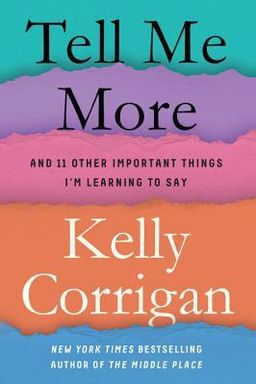
Tell Me More cover

Tell Me More

by Kelly Corrigan

In ''Tell Me More'', Kelly Corrigan weaves personal essays into a tapestry of wisdom, exploring the phrases that help us express love and connect authentically. Delve into stories of life''s joys and frustrations, gaining insights into death, friendship, parenthood, and love with humor and unflinching honesty.

The Power of the Right Words

When was the last time a simple phrase changed everything for you? In Tell Me More, Kelly Corrigan invites you to reflect on the twelve hardest things she’s learning to say—phrases that make life richer, relationships more authentic, and adulthood more bearable. Through personal stories of parenting, grief, friendship, and marriage, Corrigan shows how language can be a tool for healing, clarity, and connection—when we choose the words that matter most.

Corrigan argues that personal growth and intimacy hinge on our capacity to say certain things, even when they’re uncomfortable: the humble admission, “I was wrong,” the open-hearted “Tell me more,” the steadfast “I know,” or the radical “No.” Each of these phrases, deceptively simple, serves as an emotional waypoint—a marker of maturity that helps us navigate relationships with compassion and grace.

From Small Moments to Big Truths

The book’s structure mirrors life itself, alternating between humor and heartbreak. Corrigan begins with the beautifully ordinary—a morning quarrel about borrowed shirts—and cascades into meditations on friendship, parenting, marriage, and loss. Through laughter and tears, she argues that language—the right phrases at the right time—can transform daily frustrations into opportunities for empathy and reflection. You’ll find yourself laughing at her argument with a telemarketer one minute and crying alongside her as she describes holding her dying father’s hand the next.

Across twelve essays, Corrigan’s stories explore grief through her father’s death and her best friend Liz’s illness, parenthood through the chaos of adolescence, and partnership through the rhythms of long marriage. The “hard things to say” evolve from moments of control (“It’s Like This”) to moments of surrender (“No Words at All”), showing how language reflects the process of acceptance.

Why These Words Matter

Corrigan’s point is clear: being an adult means learning to communicate well, not perfectly. To say “Tell me more” rather than “Here’s my advice”; to admit “I was wrong” instead of retreating behind excuses; to tell loved ones “I love you” even after pain has frayed intimacy. Each phrase is a spiritual practice, sharpening our capacity for grace and forgiveness.

Corrigan writes, “This book is about things we say to people we love (including ourselves) that make things better.” She reminds us that life’s magic lies in these sentences we dare to say—the ones that connect us when everything else falls apart.

Why does this matter? Because communication is how we demonstrate respect, sympathy, courage, and love. Corrigan’s stories prove that mastering the art of saying difficult things doesn’t just mend relationships—it gives meaning to the messy, unpredictable ride of being human. Like in Brené Brown’s Daring Greatly, Corrigan shows that vulnerability begins with language. The right words don’t fix life, but they make it livable. By daring to say more, to listen better, to admit fault, or even to be silent, we close the distance between us and the people we most want to reach.


Tell Me More: Listening Into Connection

Corrigan’s signature phrase, “Tell me more,” becomes a beacon for genuine connection. Instead of jumping to fix problems or offer advice, Corrigan learns—often painfully—to let people expand their stories. This phrase, taught to her by her college roommate Tracy, shifts interactions from transactional to transformational. It’s not about guiding the conversation but creating space for others to be fully heard.

Learning to Listen

When Corrigan’s daughter Georgia calls crying about middle school drama, Tracy coaches her to stay quiet, mirror Georgia’s words, and prompt her gently to elaborate: “That must feel so unfair.” The effect is profound. Georgia steadies, calms, and feels seen—not managed. Corrigan realizes how empathy begins not with clever counsel but with curiosity. “Tell me more” is how you honor another’s experience without solving it.

Corrigan also observes how this approach transforms parenting and friendships. Listening deeply is a discipline—a form of mindfulness that stops you from rushing toward resolution. (Compare this to Stephen Covey’s idea in The 7 Habits of Highly Effective People: “Seek first to understand, then to be understood.” Corrigan’s version is warmer, messier, and more human.)

Empathy Over Expertise

In her father’s final days, Corrigan used “Tell me more” to uncover his regrets and joys. When he admits he “blew it” for not naming his coach’s influence, she probes, lovingly—“Tell me more, Green Man.” What emerges is not confession but connection. The phrase reveals the dignity of storytelling in the face of mortality; it lets Greenie complete his life narrative with grace.

To ask “Tell me more” is to relinquish control—and to practice faith that every story will lead somewhere true if you just stay.

The hardest part, Corrigan admits, is resisting the urge to fix. In a world obsessed with certainty, listening feels passive. But “Tell me more” teaches humility: you don’t know what someone needs until they finish their story. As Corrigan learns from her travels, motherhood, and losses, listening can be the most radical act of love there is.


I Don’t Know: The Beauty of Uncertainty

When Corrigan writes “I don’t know,” she’s not confessing ignorance—it’s an act of courage. Those three words symbolize acceptance: of mystery, loss, and the limits of our control. Through stories of her cancer, her friend MH’s infertility, her father’s recovery, and the deaths of loved ones, Corrigan learns that certainty—our need to explain everything—is a trap. “I don’t know” frees us to live fully despite the unknown.

Facing the Unanswerable

Corrigan recounts her friend MH’s years of fertility treatments—three miscarriages, endless questions. Relief finally comes when a doctor says, “You have permission to stop.” Permission not to know why. That surrender opens space for new beginnings—a miraculous adoption that changed MH’s life. For Corrigan, it’s a lesson in letting go: resolution often arrives when we stop forcing answers.

This humility echoes her pediatrician friend Sarah’s practice: she tells anxious parents, “I don’t know yet,” refusing to diagnose prematurely. In a world where Google offers instant certainty, Sarah’s words are radical. Real wisdom isn’t about being right—it’s about staying curious when comfort would be easier.

Faith, Doubt, and Acceptance

Corrigan’s reflections on God deepen this essay. Raised Catholic, she’s wrestled with faith and skepticism, especially after surviving cancer and watching her father’s improbable recovery. Her parents credited prayer; Corrigan credited medicine. Between them lies mystery. “Maybe both are right,” she concedes, quoting Voltaire: “Doubt is not a pleasant condition, but certainty is absurd.”

In embracing the unknown, she realizes life isn’t a puzzle to solve but “a mystery to be lived.”

“I don’t know” becomes a way to honor complexity—to let stories breathe without forcing meaning. Like Viktor Frankl’s reminder that meaning arises from suffering, Corrigan’s uncertainty births compassion. You can’t control the chaos, but you can stay tender amid it. In that space, she discovers wisdom: not all mysteries are problems. Some are invitations to wonder.


No: The Courage to Set Boundaries

For Corrigan, saying “No” isn’t rebellion—it's self-respect. The essay explores how women, mothers, and partners often equate love with acceptance, overextending themselves until they vanish. Learning to say “No” becomes an act of self-preservation and maturity.

Inherited Patterns

Corrigan’s mother, Mary, modeled the healthiest “no” Corrigan had ever seen. Mary stopped doing things she didn’t enjoy—watching sports, socializing at noisy events, traveling at night—and did it unapologetically. When family questioned her independence, she’d shrug, In French, “Chacun à son goût.” To each their own. Her refusal wasn’t rejection; it was authenticity.

In contrast, Corrigan struggles to say no—to friends, children, even mall salespeople—because she craves approval. The result? Exhaustion and resentment. Through humor and reflection, she reveals how cultural conditioning makes women fear disappointment more than depletion.

No Without Guilt

Her husband Edward teaches her that “no” can be an act of clarity. When Corrigan longs for another child despite health risks, Edward calmly but firmly refuses. He doesn’t dismiss her emotion, but knows his limit. In hindsight, she recognizes his “no” saved their marriage; it maintained integrity when sentiment threatened partnership. As in Henry Cloud’s Boundaries, Corrigan learns that saying no protects love from chaos.

“No makes room for yes,” Corrigan concludes. Without it, we smother ourselves and suffocate those we love.

No becomes an assertion of agency. Corrigan learns to decline invitations, curtail people-pleasing, and reject self-punishment. In doing so, she finds peace—the paradoxical freedom that comes from limits. It’s adulthood rewritten as an art form: the graceful refusal.


I Was Wrong: The Humility of Accountability

Few sentences are harder—or more transformative—than “I was wrong.” Corrigan traces this lesson from small domestic quarrels to deep regrets. Whether yelling at her kids or neglecting an elderly grandmother, she discovers how accountability rebuilds love.

Owning the Mess

After screaming at her daughters over spilled dog food, Corrigan realizes she’s modeling the very impatience she despises in them. Later, she confesses: “I was wrong.” That vulnerability disarms conflict more powerfully than a generic “I’m sorry.” In this moment, she learns what psychologists often note—that true apologies name the harm without excuse or self-defense.

She extends this insight backward, recalling her neglect of her aging grandmother Cleta. When Greenie admonishes her—“You should have gone more”—she admits the selfishness that kept her away. Yet her father forgives her, teaching that imperfection is inherent to love. Recognition, not perfection, is what bonds families.

Forgiveness as Reciprocity

In Corrigan’s world, apology is cyclical. Parents, partners, and children share an ongoing amnesty—each forgiving as they are forgiven. Her stories echo moral philosophers like David Whyte and Cheryl Strayed: our wrongs are portals to intimacy. Greenie reminded her, “Now you know.” Knowing becomes redemption.

To say “I was wrong” is not to collapse—it’s to rise, visible and fallible, but capable of change.

Corrigan’s version of humility transcends guilt. It’s an active self-correction—a commitment to grow from each misstep. “I was wrong” becomes the cornerstone of authentic adulthood, proof that imperfection, owned aloud, binds hearts better than perfection ever could.


Good Enough: Redeeming Imperfection

In “Good Enough,” Corrigan dismantles the myth of excellence that haunts modern life. Through her chaotic parenting and career, she redefines adequacy—not as settling but as sanity. You don’t need to be flawless to be worthy; you only need to show up, keep trying, and keep loving.

The Trap of Perfection

From her teenage disasters (getting fired from Villanova Pizza) to her motherhood mishaps, Corrigan charts how striving for A+ performance alienates us from real life. Greenie’s gentle mantra—“You’re good enough”—became her saving grace. He saw her failures not as evidence of weakness but signs of persistence.

When Corrigan’s mother visits and observes her multitasking chaos, she doesn’t offer praise or critique—just one perfect sentence: “You’re nothing if not competent.” It lands like confession turned compliment. For Corrigan, grace resides not in brilliance but in showing up and doing your imperfect best.

Redefining Success

Corrigan’s stories tell us that self-worth grows through effort, not outcome. Like Anne Lamott’s Bird by Bird, she reminds readers that progress beats perfection. “Good enough” mothers, partners, and creators aren’t quitting—they’re choosing balance over burnout, compassion over control.

Corrigan’s revelation: “You don't need to get it right every time. A couple wins here and there is plenty.”

That ethos makes the chapter feel like a relief cry for anyone drowning in self-criticism. Life isn’t a scorecard—it’s a practice. “Good enough” becomes an act of faith: believing that our messy love, repeated daily, is exactly what keeps the world turning.


I Love You: Forgiveness and Continuity

Corrigan turns a universal phrase into a study of endurance. “I love you,” she argues, is weightier with time—it survives misunderstandings, disappointments, and mortality. She dissects how love persists even when relationships wobble.

Beyond Romance

In adulthood, “I love you” means recognizing flaws and loving anyway. Whether toward children rolling their eyes or partners snoring beside you, love becomes an act of forgiveness. Corrigan writes that enduring love isn’t about shared interests—it’s about shared acceptance of imperfection. Her examples—from forgiving a teen’s mood swings to enduring her dying father’s silence—show that tenderness trumps compatibility.

The emotional honesty here rivals Joan Didion’s The Year of Magical Thinking; Corrigan’s prose glows with affection untainted by sentimentality.

Love as Respect

Love in Corrigan’s world asks for endurance. We forgive our parents for being wrong, our children for outgrowing us, ourselves for not being the heroes we imagined. “We love and are loved anyway,” she writes. It’s the humblest and deepest definition of family.

Love, after all, is what makes forgiveness possible—and keeps the story going long after the last goodbye.

Her depiction of final love, saying goodbye to her father, captures the entire arc: “Even though you left anyway, and I can’t find you anywhere except on my answering machine… I love you.” This is Corrigan’s thesis in miniature: the words we say, again and again, sanctify the ordinary and make it eternal.


No Words at All: The Language of Presence

Sometimes the most powerful communication is silence. Corrigan’s chapter “No Words at All” explores grief and connection beyond language. After her friend Liz’s death, Corrigan finds that speech fails; only quiet presence heals.

Silence After Loss

Words like “She fought hard” or “At least she’s no longer in pain” feel empty. Corrigan refuses cliché. She sits in stillness, acknowledging that tragedy is too vast for tidy phrasing. This becomes the emotional core of the book: some feelings must simply be felt. As she writes, “Despair defies description.”

Her work at a children’s hospital crystallizes the lesson. Holding fragile infants in the NICU teaches her the value of “close silence”—human warmth beyond words. In those quiet hours, she unlearns productivity and learns grace.

Listening With Presence

That same silence reshapes her parenting. When her daughter Georgia asks to skip conversation, Corrigan understands: sometimes love is conveyed without speaking. “Two people can hold each other without touching,” she writes, “and cheer each other without saying a word.”

This chapter closes a circle begun with 'Tell Me More'—it starts with listening and ends with knowing when to stop speaking.

Silence becomes communion, not absence. It’s how sorrow breathes, and how love lasts. Corrigan’s “no words at all” invites you to trust presence over persuasion: to let your being say what your language never can.

Dig Deeper

Get personalized prompts to apply these lessons to your life and deepen your understanding.

Go Deeper

Get the Full Experience

Download Insight Books for AI-powered reflections, quizzes, and more.