
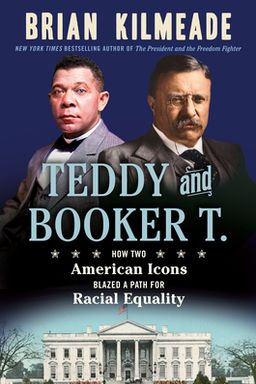
Teddy And Booker T. cover

Teddy And Booker T.

by Brian Kilmeade

The Fox News host gives an account of the relationship between President Theodore Roosevelt and Booker T. Washington.

Two Leaders, One Project

How do you make change inside a hostile system? In Teddy and Booker T., Brian Kilmeade argues that national progress often comes from unlikely partnerships between different kinds of leaders who attack the same problem from opposite directions. He pairs Booker T. Washington and Theodore Roosevelt to show you how institution-building and direct-action reform, patience and publicity, survival and spectacle, can work in tandem to push a country forward—especially on race—without collapsing the very gains just made.

Kilmeade contends that both men are forged by early loss and hard mentors, then channel those scars into divergent but complementary playbooks. Washington, born enslaved in Hale’s Ford, Virginia, learns to prize literacy, labor, and safety; he builds Tuskegee into a living argument that Black competence and industry demand opportunity. Roosevelt, a frail New York child with asthma, willed himself into vitality, then into reformer and soldier; he makes a presidency that treats publicity as a lever and the state as a referee. You see their arcs intersect—from a White House dinner that ignites a firestorm to federal appointments that test power in the Jim Crow South—and you watch both men discover the limits of symbolism when law and violence defend a caste order.

Origins that explain methods

You meet Washington as a boy who covets “ginger cakes” and a spelling book more than toys, molded by his mother Jane, by Mrs. Viola Knapp Ruffner’s discipline, and by General Samuel Chapman Armstrong’s Hampton regimen. You meet Roosevelt as “Teedie,” a taxidermy-obsessed asthmatic who vows to “make my body,” then loses his mother and wife the same day in 1884 and remakes himself on the Dakota frontier. Those beginnings matter: you can trace Washington’s cautious accommodation and Roosevelt’s appetite for action to the griefs and mentors that formed them (Note: this echoes the Lincoln–Douglass dynamic—moral suasion plus statecraft—as a two-part American reform tradition).

Education as social technology

Education is not just knowledge here; it’s strategy. Hampton drills students in etiquette, bathing, sheets, rhetoric (Miss Nathalie Lord), and trades; Tuskegee fuses classrooms with a brickyard and barns. Washington even pawns his watch to fire a fourth kiln after three failures—an investment that births Porter Hall and a campus economy. Roosevelt’s education is different: Harvard classics, voracious reading, and administrative apprenticeship in reform agencies. Both men treat schooling as a way to make character visible to skeptics and to create leverage in the marketplace of power.

Two playbooks, one aim

You watch Washington guard Tuskegee’s survival with public caution and private aid (e.g., the Thomas Harris incident), while Roosevelt hunts reform in the open—naming names at the Civil Service Commission, riding midnight beats with Jacob Riis at the NYPD, and resigning his Navy post to charge San Juan Hill with the Rough Riders. One model says: build quietly, prove value, negotiate. The other says: move fast, use the spotlight, force change.

Race, rhetoric, and risk

The Atlanta Exposition speech (“cast down your bucket”) crystallizes Washington’s line: economic opportunity now, social equality later—separate as the fingers socially, one hand for progress. It wins white applause and Black criticism (Du Bois’s “Of Mr. Washington and Others”), but it funds Tuskegee and buys time under lynch law. Roosevelt’s White House dinner with Washington (October 16, 1901) shows the price of crossing codes: Southern outrage explodes, and the president learns how a private meal can become a public referendum on hierarchy.

Appointments and the hard floor of power

Federal appointments—William D. Crum in Charleston, Minnie Cox in Indianola—become stress tests for the limits of reform. Roosevelt stands firm with recess appointments and even shuts a post office, yet local elites weaponize custom and violence. The Brownsville affair (1906) exposes the federal state’s own susceptibility to prejudice: mass dishonorable discharges, no court-martial, exoneration only in 1972. Pair that with Wilmington’s 1898 coup and the lynching of Sam Hose, and you grasp why Washington goes quiet at times and why Roosevelt’s gestures can backfire politically.

Core takeaway

You need both styles—durable institutions that can outlast storms and bold interventions that reset norms. Neither alone suffices in a country where violence polices status and law can sanctify exclusion.

Legacies and the unfinished arc

Washington dies in 1915 amid rumors and respect; Roosevelt in 1919 with reform laurels and racial blind spots. Wilson’s segregated federal offices and The Birth of a Nation’s popularity remind you that progress reverses. Yet Tuskegee’s graduates, Roosevelt’s conservation and antitrust precedents, and Du Bois’s NAACP trajectory show how layered strategies build over time (Note: you can read this as prelude to Brown v. Board and the mid-century civil-rights movement). The book leaves you with a template: pair institution-building with strategic confrontation, expect backlash, and plan for progress as a relay, not a sprint.


Loss, Mentors, Self-Making

Kilmeade shows you that leaders seldom emerge fully formed; they are built from grief, guidance, and grit. Booker T. Washington and Theodore Roosevelt illustrate how early deprivation and decisive mentors can imprint lifelong methods. When you link their childhoods to their adult choices, their seemingly different temperaments make sense: Washington’s incrementalism and Roosevelt’s immediacy grow from the same soil—trauma transmuted into purpose.

Booker T.: hunger for letters and stability

Born enslaved in Hale’s Ford, Virginia, Washington learns freedom as emotion before alphabet. In Kanawha Salines, he labors in salt furnaces and covets Noah Webster’s Spelling Book. Mrs. Viola Knapp Ruffner’s exacting household becomes a finishing school in discipline and dignity—cleanliness, punctuality, standards. At Hampton Institute, General Samuel Chapman Armstrong turns rigor into a creed: character through work, respect through skill. Miss Nathalie Lord hones Washington’s voice for the pulpit and platform. Each mentor arms him for a South where respectability can be shield and passport.

Loss also stalks him. He watches his mother Jane weep at emancipation’s hope, later buries wives Fanny and Olivia, and mourns mentors. That pattern trains him to prioritize Tuskegee’s survival over hot-blooded protest. You see it in his private aid/public restraint during the Thomas Harris crisis—courage channeled into tactics that won’t burn down what he is building (Note: if you compare to modern nonprofit leaders in hostile regimes, the logic will feel familiar).

Roosevelt: “make my body,” remake my life

Roosevelt’s childhood asthma feels like a cage he refuses to accept. He lifts weights, studies natural history (even on the Nile), and absorbs his parents’ model of civic duty—Theodore Sr. co-founds the American Museum of Natural History. Family stories from the Bulloch side give him Southern texture, even as he is rooted in Manhattan privilege. Then comes 1884: his mother Mittie and wife Alice die hours apart. Roosevelt heads to the Dakota Territory, runsched at Elkhorn, and forges a cowboy-politician persona that valorizes action, danger, and decisiveness.

Mentors and losses teach Roosevelt to trust muscle and motion. He moves from Harvard to the Civil Service Commission, then the NYPD, then the Navy, always pushing the limits of his office. Where Washington treats danger as a signal to shelter his institution, Roosevelt reads danger as a summons to lean in—resign a safe post, lead a charge, make a spectacle that rewrites what is possible.

Why it matters for you

If you’ve known loss, ask how to alchemize it: Washington makes endurance a strategy; Roosevelt turns urgency into momentum. Your temperament—and your mentors—should shape your leadership lane, not excuse you from the work.

Complementary heirs to a larger cause

Kilmeade frames both as heirs to a Reconstruction project left unfinished. Washington’s line runs cabin → Ruffner → Hampton → Tuskegee; Roosevelt’s runs sickbed → Harvard → Dakota → San Juan Hill. One path teaches you to compound small gains; the other to seize moments that won’t return. Both matter when a nation’s racial order resists change because each path compensates for the other’s blind spots—Washington’s quiet gains need Roosevelt’s megaphone, Roosevelt’s bursts of justice need Washington’s ballast.


Education as Strategy

In this story, “education” isn’t a syllabus; it’s a social technology you design to build credibility, competence, and community power. Hampton Institute and Tuskegee are laboratories where Booker T. Washington tests the idea that habits and hands-on work can rehabilitate dignity and create markets. Theodore Roosevelt’s schooling takes a different route—intellectual breadth and administrative apprenticeship—but it’s deployed toward the same end: shaping institutions that can bend society.

Hampton: character through regimen

Under General Samuel Chapman Armstrong, Hampton makes formation tangible. Students master reading and arithmetic, but also sheets, bathing, dining etiquette, and trades. Miss Nathalie Lord trains rhetoric so graduates can teach and persuade. Washington enters as a janitor and leaves as an evangelist for a modern creed: fix the “deficiency of character” through routine, then pair it with skill. The proof? Hampton graduates seed Black schools across the South, exporting both curriculum and conduct.

Tuskegee: teach by doing, earn by building

Tuskegee begins in a shanty and scales through sweat. Students clear fields, mend fences, raise chickens, and, crucially, build a brickyard. After three failed firings, Washington pawns his gold watch to bankroll a fourth kiln; it works. Those bricks birth Porter Hall and a campus that, by the time Roosevelt visits in 1905, boasts dozens of buildings and 1,500 students. The campus becomes a public argument: if Black students can make an institution from clay and timber, they can run farms, shops, and towns. Local merchants buy Tuskegee bricks; skeptics become customers.

Washington’s travel north showcases another lesson: polish matters. The manners Mrs. Ruffner drilled and Olivia Davidson refined help him win donors like Collis Huntington, the Merriam sisters, and John D. Rockefeller. He uses speeches, honorary degrees, and later his memoir Up from Slavery to make a business case for uplift. Dollars follow demonstrable results—a loop he perfects.

Roosevelt: knowledge as public leverage

Roosevelt’s Harvard classics and omnivorous reading translate into action posts: Civil Service Commission, NYPD, Navy. He absorbs Alfred Thayer Mahan’s sea power theory and uses it to modernize the fleet; he studies urban poverty with Jacob Riis and turns those insights into police reform. Where Washington’s pedagogy is vocational and communal, Roosevelt’s is administrative and national—different, but both treat learning as pipeline to influence (Note: think of Washington as land-grant pragmatic, Roosevelt as liberal-arts reformer).

Actionable takeaway

Design education to solve current constraints. If your community needs jobs and credibility, build work-learn programs that pay for themselves. If your society needs policy change, cultivate analytic breadth and media fluency to steer institutions.

Why this still resonates

You live in an era asking similar questions about skills, dignity, and mobility. Tuskegee’s model looks like a prototype for community colleges and apprenticeship programs tied to regional economies. Roosevelt’s model looks like a primer for data-driven governance and communications-savvy leadership. Both remind you: don’t romanticize education; engineer it to shift power.


Roosevelt’s Road to Power

Theodore Roosevelt’s ascent is a case study in how competence plus theater creates political capital. He leverages reform posts to build a “gets-things-done” brand, then converts wartime heroics into executive authority. You see a formula unfold: administrative wins → public trust → battlefield myth → electoral mandate—culminating in a presidency that enlarges the federal role at home and prestige abroad.

Reform as audition

As Civil Service commissioner, Roosevelt doesn’t just nod at the Pendleton Act; he names names and cleans house at the New York Customs House. As NYPD commissioner, he walks midnight beats with Jacob Riis, fires derelict cops, creates a police academy, and even puts officers on bicycles—visible, measurable reforms. These roles make enemies (party bosses, corrupt officials) but prime the public to see him as a fearless fixer.

Navy, Mahan, and the path to war

As Assistant Secretary of the Navy, Roosevelt applies Alfred Thayer Mahan’s sea-power gospel: build ships, reposition squadrons, paint hulls battle gray, and be ready. When the USS Maine explodes, he’s hawkish. Secretary John Long is cautious, but Roosevelt moves pieces so the Navy can strike if called. Then he resigns to join the fight—an audacious bet that blends patriotism with brand-building.

Making a myth at San Juan Hill

At Las Guásimas and San Juan Hill, Roosevelt leads from the front—polka-dot bandana, “Little Texas” wounded under him—amid a motley unit of cowboys, Ivy Leaguers, Native Americans, and nearby Buffalo Soldiers. Correspondents like Richard Harding Davis amplify the spectacle, turning a tactical episode into national lore. The Rough Rider persona travels; so does Roosevelt.

From governor to president

Back home, he rides fame to Albany, pushing taxes on electric franchises, creating the Tenement House Commission, and reserving forests in the Adirondacks and Catskills. Boss Thomas C. Platt, irritated by Roosevelt’s independence, helps bump him to the vice presidency in 1900—supposedly a political cul-de-sac. Then Leon Czolgosz assassinates McKinley. Contingency meets readiness; Roosevelt becomes president in 1901 and defines an activist executive.

Square Deal and conservation

Roosevelt’s first Annual Message sets the tone: mediate among capital, labor, and the public—“a Square Deal.” He sues Northern Securities to check railroad consolidation, signaling that even titans bow to law. He also locks up millions of acres for future generations, becoming America’s conservation president. He invites reporters to regular briefings, opting for transparent theatrics: “I’d rather play on the table than under it.”

Leadership lesson

Create momentum with visible wins, then use the bully pulpit to reset expectations for what your office can do. But know that spectacle cuts both ways—especially on race, where symbols trigger systemic backlash.

Roosevelt’s road to power matters for you because it shows how credibility compounds. If you want authority, stack practical reforms, curate narrative moments, and be ready when history opens a door. Just remember: the same tools that break corruption can also inflame culture war if you misread the terrain.


Two Leadership Playbooks

Kilmeade sets Washington and Roosevelt side by side so you can compare two archetypes that often talk past each other but need each other. One preserves and scales institutions through caution and coalition; the other confronts and accelerates change through publicity and moral suasion. Understanding when to use which playbook is the book’s most practical gift.

Washington’s cautious power

Washington’s prime directive: keep Tuskegee alive and expanding. He calibrates words for audiences that can shut down his school—or lynch his students. In the Thomas Harris incident, with a wounded Black lawyer chased by a masked mob, Washington publicly distances himself to avoid white retaliation, then privately arranges aid. That duality—prudence outside, protection inside—lets him build a brickyard, staff schools with Hampton-trained teachers, and win donors who might otherwise recoil. The Atlanta Exposition speech is his highest-wire act: “separate as the fingers” socially but one hand economically, a line crafted to soothe white fear and unlock capital.

Roosevelt’s direct action

Roosevelt runs the opposite play: force the issue, own the headlines, set a standard. He names corrupt Civil Service violators; he rides at night to catch truant policemen; he resigns his Navy post to fight in Cuba. As president, he sues Northern Securities and briefs the press twice daily. His actions are performative by design: he believes visible action alters institutions and public norms faster than quiet negotiation.

Strengths and limits

Washington’s method compounds gains safely but risks moral compromise; it can look like capitulation in moments that beg for protest (Du Bois’s critique). Roosevelt’s method breaks logjams but can spark backlash and collateral damage (see the White House dinner fallout and Brownsville). Put simply: when survival and relationship management are paramount, you lean Washington; when corruption or inertia is entrenched and time matters, you lean Roosevelt.

Practical calibration

Ask three questions before choosing a style: 1) What’s the risk to my people and institution today? 2) What visible act could unlock a stuck system? 3) Which allies will I lose—or gain—by choosing speed over safety (or vice versa)?

The genius of pairing Teddy and Booker T. is that you can stop romanticizing a single leadership ideal. Both styles are situational tools. The real craft is blending them over time: build the school and the coalition; also seize the microphone at the right moment. That’s how you move a world that doesn’t want to budge.


Atlanta Speech, High Stakes

Washington’s 1895 Atlanta Exposition address is a hinge you can’t skip. He has three weeks to speak to former Confederates, Northern investors, and Black Southerners—an audience ready to punish missteps. He threads the needle with “cast down your bucket where you are,” urging Black Southerners to seize work in agriculture, mechanics, and commerce, and White Southerners to rely on loyal Black labor. Then comes the metaphor that will follow him forever: in “purely social” matters, races can be “separate as the fingers,” yet “one as the hand” for mutual progress.

Applause and alarm

The speech lands. White listeners, including “the fairest women of Georgia,” applaud; Northern donors take note. The talk becomes Washington’s passport to parlors and platform. But Black critics hear a concession too far. W. E. B. Du Bois will later sharpen this into a generational indictment in The Souls of Black Folk (1903), arguing that Washington trades political rights for industrial education—a bargain Du Bois deems unacceptable.

Context of terror

To judge the speech, you must factor in risk. The 1890s teem with violence: Wilmington’s 1898 coup d’état murders and banishes Black citizens; lynchings like Sam Hose’s 1899 torture draw excursion crowds. Plessy v. Ferguson (1896) codifies “separate but equal.” In that world, Washington’s prudence reads as survival calculus for an institution inside the blast radius. He chooses growth, jobs, and local peace over prophetic denunciation—knowing that one wrong line could cost lives and buildings.

Consequences that compound

Immediately, Atlanta makes fundraising easier and sightseeing persuasive: Tuskegee’s student-made carriage, brickyard, and marching bands become exhibits for dignitaries. Long-term, Atlanta becomes a target on Washington’s back; every silence on lynching, every private compromise, is filtered through that frame. The debate you inherit—economic self-help first or rights agitation first—takes shape here, and it will define the next generation’s strategy (Note: this foreshadows the Du Bois–Washington split and the NAACP’s birth).

Reading the moment

If you lead under threat, ask whether the words that win safety today might limit justice tomorrow—and whether your institution’s survival could seed the power to speak bolder later.

The Atlanta speech is not a tidy victory or failure; it’s a bet. It buys Washington leverage and time. It also mortgages some moral standing. Whether you endorse that bet depends on how you weigh lives saved and schools built against rights deferred and dignity deferred. The book invites you to hold both truths at once.


Symbols, Power, Backlash

In a caste system, symbols are weapons. Roosevelt’s dinner with Washington, federal appointments of Black officials, and even mail routes become proxy wars over hierarchy. Kilmeade maps how high-visibility gestures can galvanize allies, enrage opponents, and expose the limits of federal will when local custom and violence rule.

A dinner that detonates

On October 16, 1901, Roosevelt hosts Booker T. Washington for supper at the White House—family setting, casual intent. An AP item at 2:00 a.m. turns it into national news. Southern papers erupt: the Memphis News-Scimitar calls it “the greatest outrage”; Senator “Pitchfork Ben” Tillman threatens that “we will have to kill a thousand n——s” to enforce the racial order. Roosevelt later concedes political cost—“What I did was a mistake”—even as he insists on his right to choose guests. The lesson: private acts become public detonations when they trespass taboo.

Appointments as battlegrounds

William D. Crum, a Howard-educated Black physician, is nominated as Collector at Charleston in 1902 on Washington’s recommendation. Local elites object “first” because he is Black. Tillman invokes senatorial courtesy to block him. Roosevelt counters with recess appointments; Crum improves receipts and facilities—performance that still can’t pierce the color line. In Indianola, Mississippi, Minnie Cox, a competent Black postmistress, is driven out under white-supremacist agitation. Roosevelt closes the post office on January 2, 1903, reroutes mail, and protects her salary—an assertive federal flex that still can’t force local acceptance. Cox pivots to founding a bank.

Violence and legal choke points

The Wilmington massacre (1898) shows organized overthrow: armed whites depose a biracial city government, kill scores (likely hundreds), and entrench disenfranchisement. Lynchings—85 Black men in 1899 alone, with Sam Hose’s torture as civic spectacle—terrorize communities. Laws—grandfather clauses and literacy tests—cement exclusion. Against this, federal gestures feel fragile. In Brownsville (1906), the administration dishonorably discharges Black soldiers en masse (Special Order No. 266) without court-martial; exoneration comes only in 1972.

Operational insight

Symbolic wins need structural follow-through. Without legal infrastructure and local enforcement, bold gestures can stall—or invite punitive backlash that chills future action.

For you, the thread is sobering: courageous acts by prominent leaders cannot, by themselves, dismantle a system defended by mobs, courts, and customs. Symbols matter, yes; they also demand strategic sequencing—pair the spectacle with policy, sustain pressure long enough to normalize the change, and shield your people while you do it.


Debate, Deaths, Legacy

The book closes by widening the frame: Washington and Roosevelt alter America, but neither can finish the work. Their era births a debate—Du Bois versus Washington—that will shape the twentieth century, and their deaths mark a handoff to institutions and movements that continue the fight. You leave with a layered legacy: real gains, deep costs, and a roadmap for how plural strategies build change across generations.

Du Bois’s counter-strategy

W. E. B. Du Bois rejects accommodation. In The Souls of Black Folk (1903), he elevates the “Talented Tenth,” demands higher education, and calls out Washington for conceding rights for safety—branding him “the most distinguished Southerner since Jefferson Davis.” In 1906 at Harper’s Ferry, the Niagara Movement gathers beneath John Brown’s memory to insist on political equality. Though Niagara doesn’t scale, it seeds the NAACP, which will later drive courtroom strategies toward Brown v. Board. Du Bois organizes outrage into law.

Final chapters

Washington collapses in 1915 from malignant hypertension. He rushes home and dies at Tuskegee on November 14; twenty thousand mourners pass his bier; a memorial fund crosses a million dollars. Roosevelt calls him “one of the distinguished citizens of the United States,” while Du Bois’s obituary in The Crisis mixes homage with indictment for enabling disenfranchisement. Roosevelt, after a third-party run in 1912 and a Milwaukee assassination attempt he famously shrugs off, dies in 1919. He leaves trust-busting and conservation laurels—and a racial record of mixed courage and paternalism.

Aftershocks and reversals

Woodrow Wilson’s administration segregates federal departments, erasing some gains. The Birth of a Nation (1915) glamorizes the Klan and hardens prejudice in popular culture. Yet Tuskegee continues, turning out teachers, artisans, and leaders; federal conservation and antitrust precedents endure; the NAACP scales its legal campaign. History doesn’t move in straight lines; it spirals through advances and retreats.

Long-arc lesson

Pair institution-building with rights-claiming. Expect backlash. Design for endurance. That is the composite legacy of Teddy and Booker T.—and the baton they pass to Du Bois, the NAACP, and, later, the civil-rights movement.

For your own work, the takeaway is strategic humility. You may not finish the job in your time. Build platforms that can carry the next wave; choose when to shout and when to scaffold; and judge leaders not only by their courage but by their context and the durability of what they leave behind.

Dig Deeper

Get personalized prompts to apply these lessons to your life and deepen your understanding.

Go Deeper

Get the Full Experience

Download Insight Books for AI-powered reflections, quizzes, and more.