
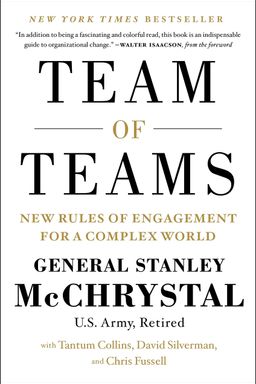
Team of Teams cover

Team of Teams

by General Stanley McChrystal with Tantum Collins, David Silverman and Chris Fussel

In ''Team of Teams,'' General Stanley McChrystal reveals how organizations can thrive in a complex world by rethinking traditional hierarchies. By fostering small, interconnected teams, companies can enhance agility, resilience, and decision-making, turning challenges into opportunities for growth.

Adapting to the Age of Complexity

How can an organization built for control and efficiency survive when the world moves faster than its command chain can respond? In Team of Teams, General Stanley McChrystal argues that the 21st century demands a fundamental shift—from predictive control to adaptive collaboration. His experience leading the Joint Special Operations Task Force in Iraq revealed that traditional hierarchies, however precise, crumble in complex, fast-moving environments. The core argument: if your enemy or competitor behaves like a network, only a networked organization—united by trust and shared purpose—can match it.

McChrystal’s story begins with AQI—Al Qaeda in Iraq—led by Abu Musab al‑Zarqawi, a small force that constantly changed form, using local knowledge, digital propaganda, and fluid alliances to evade a far better‑equipped U.S. Task Force. The old rules didn’t work; when one cell was destroyed, another appeared. This was the Proteus problem: the foe that never holds still. The Task Force’s whiteboards—replacing conventional maps—revealed not hierarchies, but webs of relationships, a visual metaphor for what every modern organization now faces: constant recomposition.

From Complication to Complexity

You live and work in systems that are not just complicated but complex—dense with interdependencies, unpredictable feedbacks, and instant connections. Edward Lorenz’s “butterfly effect”—a flap that sparks a storm—captures the problem. Tiny local actions (like a vendor’s tweet or a small protest) can cascade into massive disruptions. McChrystal shows that global interconnection, like AQI’s communications or social media activism, amplifies these effects. You can’t plan for every possibility; you must build the capacity to adapt.

The Failure of Clockwork Management

The 20th century’s secret weapon—efficiency—became a liability. Taylorism broke tasks into steps and hierarchies into silos; it gave rise to breathtaking productivity but brittle organizations. The U.S. Task Force was an “awesome machine” calibrated for synchronized strikes and predictable workflows. Yet in Iraq, efficiency led to paralysis. As McChrystal puts it, “doing things right” isn’t enough when you’re no longer “doing the right thing.” The Maginot Line and corporate silos illustrate the same error: optimizing yesterday’s model for tomorrow’s chaos.

What It Takes to Adapt

The answer isn’t more control but more connectivity. Just as AQI functioned as a resilient, fast‑learning network, McChrystal’s Task Force had to become one—a team of teams. The transformation began by connecting elite operational units with intelligence cells, diplomats, and partner agencies through daily video hubs, open briefs, and shared rituals. Information stopped trickling and began circulating. The effect was cultural as much as technical: people saw the whole system rather than just their piece of it.

Eventually, the Task Force mirrored what complexity science already suggests: resilience emerges from autonomous nodes that share context. Trust and purpose replaced micromanagement. Authority moved downward, but understanding moved everywhere. The model subsequently inspired corporate, civic, and even humanitarian organizations that face rapid turbulence.

The Core Transition

The transformation McChrystal describes applies to any organization confronting volatility. You begin with control and information scarcity; you end with shared consciousness and empowerment. Between those poles lies the work of leadership—redesigning structures, spaces, and mindsets so that information flows freely, collaboration becomes instinctive, and risk is intelligently distributed. You must learn to trade certainty for clarity, efficiency for adaptability, and authority for trust.

Core insight

“It takes a network to defeat a network.” When complexity rules, your advantage lies not in better plans, but in faster learning, broader trust, and the discipline of transparency.

In short, Team of Teams argues that success today depends on your ability to create shared awareness and decentralized execution. To thrive, you don’t build more rigid systems—you build living ecosystems where information, purpose, and empowerment move at network speed.


Rethinking Efficiency and Control

Efficiency once defined organizational excellence. Frederick Winslow Taylor’s stopwatch logic fueled industrial empires and gave militaries the discipline of procedure. But as McChrystal shows, a formula optimized for stable systems collapses under turbulence. When events accelerate faster than analysis, control becomes drag. AQI’s agility exposed this flaw: the Task Force’s procedures—meticulously calibrated—became bureaucratic traps in an environment where seconds mattered.

The Trap of Predictable Systems

Clockwork organizations worship predictability. They rely on separation of planning and doing, on layers that prevent error but also slow learning. The Task Force’s “Find–Fix–Finish–Exploit–Analyze” cycle embodied that logic—an assembly line for counterterrorism. AQI, however, was unpredictable. Each raid produced new patterns faster than headquarters could process them. The supposed safeguards of bureaucracy turned into walls hiding vital context.

Adaptive Replacements for Old Logic

McChrystal reframes success as effectiveness—doing the right thing quickly—rather than efficiency—doing a plan perfectly. The shift parallels complexity thinkers like Karl Weick and later tech theorists who view resilience as more valuable than optimization. The practical move, then, is to drop the obsession with perfect procedures and measure instead how fast your teams can sense and respond to change. In complex domains, responsiveness beats refinement.

(Parenthetical note: This philosophy aligns with agile development and lean startup cycles—systems that privilege iteration over perfection.)


Building Teams and Trust

Adaptability first appears within small, cohesive teams where trust, shared purpose, and mutual understanding enable improvisation. McChrystal points to SEAL platoons, surgical teams, and airline crews as examples. Their power comes from deep-trust bonds—built through shared stress—and from a focus on mission rather than rigid roles.

Lessons from Flight 173 and 1549

The contrast between United 173’s crew, paralyzed by hierarchy, and US Airways 1549’s collaborative cockpit encapsulates the difference between commands and teams. The first waited for orders; the second shared cognition and acted as one. The same distinction defines effective field units versus bureaucratic commands. Real safety and effectiveness come not from rigid procedure but from disciplined improvisation born of mutual respect.

From Individuals to Networks

Teams thrive when members understand each other’s instincts. BUD/S swim buddies, surgical partners, or joint urban operations crews internalize this through shared hardship. But McChrystal confronts the scale problem—how do you extend such trust beyond 10 or 20 people? The answer begins with increased connectivity, empathy across organizational boundaries, and habitual collaboration reinforced through ritual.

Key lesson

You cannot command adaptability—you cultivate it by nurturing trust, purpose, and shared understanding inside the smallest unit and then linking those units laterally.

As McChrystal learned, world‑class teams inside a slow hierarchy still lose. The Task Force’s breakthrough came when it connected those islands of excellence into a networked organism.


Creating Shared Consciousness

To scale adaptability, McChrystal orchestrated an unprecedented sharing culture called shared consciousness: transparent, real‑time, cross‑team awareness. The Task Force’s daily Operations and Intelligence (O&I) videoconference connected hundreds of distributed nodes—from analysts to operators across continents—into one living picture of reality. It broke the silence between silos that had crippled earlier operations.

From 'Need to Know' to 'Need to Share'

Traditional security culture prizes compartmentalization, but that logic assumes you can predict who needs what. In complexity, you can’t. The 9/11 Commission had already shown how secrecy kills coordination. McChrystal flipped the script: share until it feels uncomfortable, then install protocols to contain risk rather than restrict flow. Analysts and operators began to see not isolated data but context. The change produced faster, more accurate decisions.

Systems Perspective and Education

Shared consciousness acts like education at the organizational level. Training provides recipes for known problems; education provides the frameworks to improvise in the unknown. NASA’s George Mueller achieved the same during Apollo—fusing thousands of specialists into a unified learning system. When people understand the whole, their local actions align without supervision.

Operational insight

Shared consciousness is disciplined transparency: open enough for everyone to see, structured enough for joint action.

When you build such an ecosystem—regular cross‑team forums, visible situational dashboards, and generous cultural norms—you transform isolated specialists into a collective brain capable of emergent intelligence.


Connecting Teams into Networks

A single team can move fast, but thousands can stumble unless their relationships mirror the adaptability found inside each. McChrystal’s team of teams architecture solved this by linking units horizontally—creating many trusted bridges rather than one central hierarchy. Representation across the network meant every team sent and received context constantly. The result was loose coupling with tight alignment: autonomy with unity.

Beating the Prisoner’s Dilemma

Organizations often trap themselves in information hoarding—a Prisoner’s Dilemma where every unit defects to protect its turf. The Task Force broke that dynamic through reciprocal transparency. Programs like embedding operators in other teams and assigning liaison officers (LNOs) built trust and empathy. By choosing elite, trusted connectors (“if it doesn’t hurt to give the person up, pick someone else”), McChrystal ensured authenticity. Over time, repeated exchanges created expectation of cooperation rather than competition.

Systems Management at Scale

NASA’s Apollo-era systems management provided a civilian analogue: George Mueller demanded open interfaces, daily integration checks, and cross‑contractor coordination. The Task Force mimicked these integration loops—daily calls, live dashboards, embedded analysts—so the whole organization could act as one nervous system. The challenge was cultural as much as technical; every link had to carry trust as well as data.

In your context, building a team of teams means encouraging lateral empathy, rituals of openness, and responsibility beyond immediate goals. Teams remain autonomous, but the connective tissue—people, routines, forums—ensures their separate actions align toward one mission.


Design, Ritual, and Information Flow

Behavior follows design. To institutionalize shared consciousness, McChrystal and his staff re‑engineered both space and ritual. The Balad base’s fortified bunkers became open joint‑operations centers filled with live data screens. Instead of commanders huddling behind closed doors, analysts, operators, legal staff, and medics shared the same visual environment. Like Bloomberg’s bullpen or Bell Labs’ connector corridors, space became a technology of awareness.

The Power of Ritual

Physical proximity alone fades without rhythm. The O&I videoconference—daily, mandatory, six days a week—became the organizational heartbeat. It wasn’t just reporting; it was culture‑building. Attendance signaled relevance. The routine disciplined transparency so it endured under pressure. Similar rituals can anchor openness in any enterprise—consistent cross‑functional stand‑ups, demo days, or war‑room reviews that everyone values.

Balancing Risk and Reward

Liberal information flow invites leaks and anxiety. McChrystal acknowledged that risk and accepted it as the price of speed and accuracy. WikiLeaks‑style exposures can hurt; constant silo failures kill. The Task Force’s solution was designing secure yet permissive channels—classified but connected, monitored but open by default. If secrecy degraded results, they changed classification instead of reverting to silence. It’s a deliberate trade‑off every modern institution must negotiate.

Design principle

Transparency is infrastructure. Space, technology, and ritual make adaptability a habit rather than an aspiration.

When you reshape both physical layouts and daily rhythms, you rewire how people notice, trust, and collaborate. That design work, not motivational speeches, anchors cultural change.


Empowering Execution and Leading as a Gardener

Even perfect information means little if decisions await approval from the top. The Task Force discovered that visibility can breed micromanagement—a habit McChrystal calls the Perry Principle: since leaders now see everything instantly, they try to control everything. The cure is paradoxical: hold awareness tight but authority loose. The motto became Eyes On—Hands Off: leaders watch the system, not every move.

Empowered Execution

Empowerment here means more than delegation; it’s synchronized autonomy. Teams act on broad intent using shared context. McChrystal urged people to choose the 70 percent solution now over the 90 percent tomorrow. By trusting judgment at the edge, the organization captured fleeting opportunities—like the rapid identification and strike that killed Abu Musab al‑Zarqawi. Empowerment sped cycles without sacrificing coherence.

The Gardener Model of Leadership

To sustain such a system, leaders must act like gardeners, not chess masters. A gardener shapes conditions—soil, sunlight, water—so plants can self‑organize. Likewise, leaders cultivate culture, transparency, and trust. McChrystal spent hours in the O&I, recognizing briefers by name, and touring units to listen rather than dictate. These gestures built authenticity and confidence across thousands. (Historical echo: Admiral Nelson’s captains thrived because he gave them intent and built their capacity for independent fight.)

Leadership insight

You don’t manage complexity by ordering it; you thrive in it by tending the environment where initiative takes root.

To lead in modern complexity, build systemic awareness, assign broad goals, trust your people’s judgment, and model the learning behaviors you want. You’re cultivating an ecosystem, not moving pieces on a board. In McChrystal’s world—and increasingly in yours—that shift from control to cultivation is the essence of lasting adaptability.

Dig Deeper

Get personalized prompts to apply these lessons to your life and deepen your understanding.

Go Deeper

Get the Full Experience

Download Insight Books for AI-powered reflections, quizzes, and more.