
Idea 1
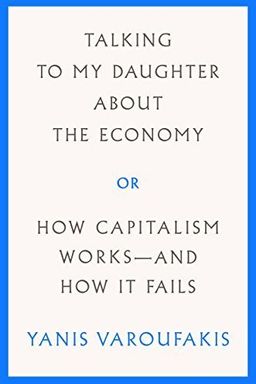
How Capitalism Works—And How It Fails
Why does modern society, capable of producing endless wealth, still leave millions poor, anxious, and overworked? In Talking to My Daughter About the Economy, Greek economist Yanis Varoufakis answers this question with warmth and clarity, explaining to his daughter—and to all of us—how capitalism arose, what sustains it, and why it periodically collapses under its own contradictions.
Varoufakis’s central claim is that capitalism, or as he prefers to call it, a “market society,” is not a natural form of human organization but rather a historical accident. It emerged when society began treating land, labor, and money—once matters of communal or moral concern—as commodities to be bought and sold. This shift transformed relationships, values, and even our concept of freedom. Yet while capitalism unleashed remarkable innovation, it also created systemic inequality, recurring crises, and environmental destruction.
The book is both a story and an analysis. It blends Greek myths, Western literature, and modern economic history into a conversation about debt, technology, money, and how humans repeatedly mistake tools for masters. The title itself reflects Varoufakis’s approach: an accessible explanation of economics as a human narrative rather than a technical science—one that relates directly to your daily life, your job, your phone, the food you eat, and even the air you breathe.
From Surplus to Society
Varoufakis begins with a simple but profound question: why are some people rich while others are destitute? To answer it, he takes us back to the birth of agriculture. The moment early humans learned to cultivate land and produce surplus, inequality became possible. Surplus created storage, debts, and hierarchies; it allowed some to live without tilling the soil at all. Writing, money, armies, and religion grew from this dynamic. Over time, rulers and priests legitimized unequal access to surplus, shaping ideologies that would evolve into the structures of modern economies.
The Great Transformation
The next enormous leap came in 18th-century England, when feudal society transformed into what Varoufakis calls a “market society.” Serfs were driven from their land in the great Enclosures, their subsistence replaced by wage labor. Land, tools, and even time became things to sell. A “Great Reversal” occurred: instead of producing first and distributing later, the logic of debt and interest required distribution—of rent, wages, and loans—to happen before production even began. Everything depended on credit, transforming survival itself into an economic gamble.
Here Varoufakis draws on literary analogies—Doctor Faustus, who sells his soul for twenty-four years of pleasure, and Goethe’s Faust, who seeks redemption through work—to show how Western culture absorbed and normalized this marriage of debt and profit. Debt became civilization’s main engine, both necessary and catastrophic. Without it, no industrial revolution; with it, unending instability.
Debt, Money, and the Illusion of Control
Banks, Varoufakis explains, turned into modern-day magicians: they create money “out of thin air.” Each loan pulls exchange value from the imagined future into the present. This “black magic” keeps economies alive but also guarantees periodic collapse. Every financial boom contains the seeds of its own bust, as entrepreneurs and bankers compete to conjure ever greater profits from a finite real economy. When the spells inevitably fail, governments must step in to rescue the system—revealing the paradoxical alliance between bankers and the state.
For Varoufakis, these cycles of creation and destruction prove that markets are anything but “free.” They depend on faith, trust, and government intervention—just as Mesopotamian farmers once relied on temple scribes to keep record of their grain debts. Money is political, not neutral. Attempts to “depoliticize” it, whether through the Gold Standard or modern cryptocurrencies like Bitcoin, are fantasies that ignore its social nature.
Haunted Machines and Living Labor
Varoufakis then connects economics to the human condition. Drawing from Mary Shelley’s Frankenstein and films like The Matrix, he argues that technology in capitalism functions like the doctor’s monster—created to serve us, but capable of enslaving us. Automation, AI, and robotics could free humanity from drudgery, yet under market logic they concentrate wealth and erode livelihoods. Each wave of innovation reduces demand for human labor, shrinking incomes and consumer power, until a crisis forces the system to reset. This “Icarus syndrome,” as he calls it, ensures that no matter how high capitalism flies, it must eventually fall.
Still, Varoufakis offers hope. He imagines a world where the fruits of automation—machines, data, and profits—are shared collectively rather than owned privately. In such a world, technology could enable what John Maynard Keynes once envisioned: a society that works less and lives more fully, freed from the “disgusting morbidity” of money-hoarding.
The Political Economy of Survival
The book culminates in an exploration of two intertwined crises: environmental collapse and democratic decay. Because markets prize exchange value (what can be sold) over experiential value (what makes life meaningful), capitalism treats forests, rivers, and even human relationships as disposable. Fires that destroy nature count as economic “growth.” Against this logic, Varoufakis proposes democratizing everything—from money creation to technology and ecological stewardship—so that decisions reflect collective wellbeing rather than private profit.
In the end, Talking to My Daughter About the Economy is a poetic manifesto disguised as an economic primer. It calls on you, the reader, to look past the illusion of expertise and reclaim economics as a shared language—a conversation about who we are, what we value, and how we choose to live together on this fragile planet.