
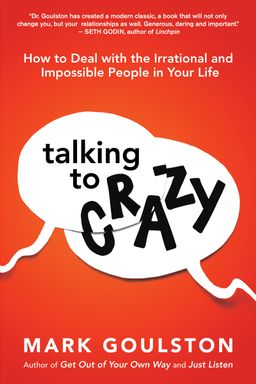
Talking to Crazy cover

Talking to Crazy

by Mark Goulston

In ''Talking to Crazy,'' Mark Goulston provides actionable strategies to manage irrational behavior in others and ourselves. By employing empathy, understanding triggers, and setting boundaries, readers can transform chaotic interactions into productive dialogues, enhancing personal and professional relationships.

Leaning Into the Crazy: How to Reach the Irrational and Impossible

Have you ever found yourself arguing with someone whose logic seems to have vanished—who twists facts, overreacts, or becomes impossible when you try to reason with them? Whether it’s a volatile boss, a manipulative parent, or a panicking partner, these situations can leave you drained and baffled. In Talking to “Crazy”, psychiatrist Dr. Mark Goulston argues that the only way to reach irrational people is to lean into their crazy instead of fighting against it. Drawing on decades of experience as a UCLA psychiatry professor and FBI hostage negotiation trainer, Goulston teaches that empathy, not argument, is the antidote to madness.

According to Goulston, “crazy” isn’t about mental illness—it’s simply irrational behavior. We all go a little crazy when our emotions hijack our reason. These irrational moments, large or small, often play out when fear, shame, or anger take over the brain’s decision-making center. Understanding how to manage these moments is critical if you want to defuse conflicts, lead effectively, or thrive in relationships.

Three Brains and the Roots of Irrationality

Goulston begins with neuroscience. Our mind is layered like an evolutionary sandwich: the reptilian brain (survival instincts), the emotional mammalian brain (feelings), and the rational neocortex (logic). Ideally, these three work together—a state he calls triunal agility. But under emotional stress, they misalign into triunal rigidity. The rational brain checks out, leaving the primitive brain in charge. That’s why a colleague snaps irrationally or a loved one panics over something minor: they’re literally “not in their right mind.”

You can’t cure this by logic. As Goulston warns, reason doesn’t work when reason itself is offline. Trying to explain facts to a person in fight-or-flight mode only provokes further resistance. Instead, you must approach from the inside out—acknowledging emotional needs first so the logical brain can return online. This concept, he argues, is as vital in boardrooms as in marriages.

Leaning Into Crazy: The Counterintuitive Strategy

The central message of the book is startling: instead of resisting irrationality, lean into it. Goulston illustrates this with a story from his own life in Los Angeles traffic. After accidentally cutting off a furious driver twice, he found himself facing an enormous man pounding on his window, screaming obscenities. Goulston didn’t argue or apologize profusely. Instead, he met the man on his emotional plane. “Have you ever had a day so bad you wish someone would shoot you to put you out of your misery?” he asked. The response disarmed the aggressor entirely—the man softened, reassured him, and ended up comforting him. This unorthodox empathy transformed a near-violent encounter into connection.

What happened here is what Goulston calls assertive submission—a psychological "belly roll" where you disarm aggression by mirroring vulnerability. When irrational people expect resistance, your calm empathy pulls the rug out from under their defensiveness. It’s not about agreeing with their delusions; it’s about stepping into their emotional reality long enough to coax them back to reason.

The Sanity Cycle

How do you execute this in everyday life? Goulston offers a six-step “Sanity Cycle”: recognize irrationality, identify the person’s modus operandi (M.O.), remember it’s not about you, enter their world with empathy, show alliance through listening, and, finally, guide them when calm. This systematic shift—from confrontation to connection—turns antagonists into allies. It also shifts you from panic to poise, replacing your body’s instinctive fight-or-flight reactions with calm authority.

This same cycle serves hostage negotiators facing armed criminals, managers dealing with volatile employees, or spouses navigating emotional conflicts. Whether you’re de-escalating a shouting match or handling a sulking teenager, the first goal is always the same: don’t talk them out of their feelings—talk them through them.

Why It Matters

At its heart, Talking to “Crazy” is a manual for emotional intelligence under fire. Goulston’s deeper message goes beyond managing others—it’s about mastering your own sanity in a world full of chaos. When you learn to see irrational behavior as fear rather than malice, conversations change. You reclaim control of your own brain chemistry, switch from reactivity to curiosity, and create a space where even the most impossible people can calm down.

Throughout the book, Goulston combines practical scripts, neuroscience insights, and memorable stories—from corporate war rooms to psychiatric wards—to show how empathy works as both shield and sword. In the chapters ahead, he explores tactics such as the “Time Travel” technique for defusing recurring fights, the “Eye of the Hurricane” for finding calm amid breakdowns, and the “Butter-Up” for handling know-it-alls. Ultimately, he invites you to replace frustration with fascination, engaging irrationality not as madness to escape but as a signal to connect. In his words, “You can’t make crazy go away by ignoring it. You conquer it by leaning into it.”


Understanding the Sources of Crazy

Goulston insists that irrationality doesn’t come out of nowhere—it’s the product of how the human mind develops and, sometimes, how it gets damaged. To understand someone’s current madness, you have to understand their past. Through decades in psychiatry, he’s seen how upbringing, trauma, and patterns of emotional response wire our brains to misfire in predictable ways.

The Three Paths to Crazy

For most people, craziness stems from one of three early-life experiences: coddling, criticizing, or ignoring. Coddled children grow up expecting others to handle their problems; criticized children learn bitterness and turn into blamers; ignored children grow afraid to take risks and hide from the world. Each of these paths builds rigid mental wiring that makes emotional flexibility difficult later on. Rationality, Goulston notes, isn’t a birthright—it’s learned through experiencing safe emotional correction.

The solution, by contrast, is what he calls “good enough nurturing.” People who were supported—neither overindulged nor neglected—build an inner framework of confidence. These individuals can face upsets without losing control because they’ve internalized compassion and boundaries. As British psychiatrist Donald Winnicott also argued, resilience comes from being loved imperfectly but consistently.

How Misalignment Works

When someone acts irrational, their brain isn’t malicious—it’s misaligned. Imagine their inner compass locked on an old emotional north, as if they’re still fighting their parents instead of dealing with you. Goulston calls this triunal rigidity. For instance, someone like Lucia, an elderly woman who lashes out at her daughter, is stuck reacting to long-ago betrayal. No amount of reasoning changes her because her internal world hasn’t caught up with the present.

Understanding this process helps you depersonalize conflict. The bully, the manipulator, the martyr—they’re all defending against an old fear. The key isn’t to fix their logic but to meet their fear with calm empathy. Once you see people’s behavior as self-preservation rather than sabotage, you can steer around their triggers instead of being consumed by them.


Spotting an Irrational Person’s M.O.

Every irrational person has a signature way of acting out—what Goulston calls a modus operandi (M.O.). Knowing someone’s M.O. is like knowing a boxer’s favorite punch; it lets you predict and counter their moves rather than being blindsided.

Common M.O. Types

  • The bully, who attacks to feel strong.
  • The manipulator, who plays the victim to get attention or avoid responsibility.
  • The martyr, who refuses help but resents others for not helping.
  • The know-it-all, who asserts superiority to mask insecurity.
  • The hopeless or withdrawn, whose silence manipulates by guilt.

For example, Harry—the entitled son of a CEO—constantly made excuses for missed work. Instead of scolding him, his manager Stephen learned that Harry’s true fear was disappointing his father. Stephen linked performance directly to paternal approval, and Harry finally delivered. The tactic worked because it addressed the underlying emotional lever, not the surface argument.

Why Recognizing the M.O. Matters

Once you can name someone’s M.O., you stop taking their antics personally. Their attacks, guilt trips, or neediness aren’t unique insults—they’re strategies for control. Awareness dissolves their power to hijack your emotions. Goulston even provides an “M.O. Detector” exercise—listing situations, reactions, and emotions—to help you map these patterns. The result: you become less reactive, more analytic, and far harder to manipulate.

In short, identifying someone’s M.O. gives you emotional radar. As psychologist Daniel Goleman highlighted in Emotional Intelligence, awareness precedes regulation. Only by recognizing the pattern can you rewrite the script.


Facing and Managing Your Own Crazy

Before you can talk to someone else’s crazy, you must confront your own. Goulston devotes an entire section to this blunt truth: you can’t control what you can’t see in yourself. Hidden insecurities, childhood wounds, and cognitive biases act as invisible buttons irrational people push to drag you into their dysfunction. If you don’t locate these triggers, you’ll keep reacting badly—and you’ll look just as irrational as they do.

Discovering Your Buttons

To help you self-diagnose, Goulston introduces reflective exercises like Back to the Future, where you revisit key life events to identify the beliefs you formed (“I’ll never be good enough,” “I can’t trust anyone”). These beliefs become your emotional “buttons.” He illustrates this with Don, a therapist who lost his cool when his wife questioned his listening skills—because her words triggered his old fear of inadequacy planted by a critical father.

Recognizing these patterns allows you to neutralize them. When you feel attacked, you can pause and ask, “Is this about now, or am I reliving an old story?” That self-awareness stops emotional time travel—the real source of many reactive arguments.

Keeping Your Cool

Goulston’s practical techniques for managing reactivity include three psychological “weapons.” The first is Reframing an Attack as an Opportunity for Poise—instead of reacting, you mentally say, “This is an opportunity to practice grace.” The second is Calling for Mentor Backup—picture the people who believed in you, and ask, “What would they advise me?” Gratitude disarms anger. Finally, the Eight-Step Pause teaches mindful self-regulation: identify your physical reaction, name your emotion, recognize your impulse, and choose a better response before you act. Used regularly, these drills turn emotional breakdowns into breakthroughs.

In essence, Goulston reframes emotional control as a learned skill, not a trait. By mastering your own brain’s “sanity cycle,” you model for others what sanity looks like.


Disarming Irrational Behavior with Tactical Empathy

Throughout the book, Goulston demonstrates that empathy is the universal solvent for irrationality. He backs this claim with striking stories from clinical and corporate life, each proving that emotional connection dissolves defensiveness faster than logic or authority ever could.

The Eye of the Hurricane

When you confront an emotional storm, your goal isn’t to outshout it—it’s to find the calm center. Goulston’s “Eye of the Hurricane” technique involves letting angry people vent fully, focusing on their left eye (which connects to the emotional right brain), and waiting for them to exhaust the rage. Then, ask simple grounding questions like, “What do you need me to do right now?” Once they articulate needs, they begin to re-engage rationally. This is precisely how he calmed a rampaging psychiatric patient—by seeing the sane inside the crazy.

Digging Down to Disappointment

Often when people scream, “I hate you!”, what they really mean is “I’m disappointed in you.” Goulston teaches a counterintuitive move: instead of arguing back, calmly ask, “Do you hate me—or are you deeply disappointed in me?” That one word—disappointed—shifts both parties from blame to sadness, which is easier to heal. In couples therapy, he used this to reconcile estranged fathers and sons or spouses mid-divorce. As he says, logic isn’t the cure for crazy—understanding disappointment is.

These empathy-based strategies may sound soft, but they’re hardcore communication tools. Like Chris Voss’s FBI negotiation methods in Never Split the Difference, they work because they treat emotion as the real conversation. Once you meet people where they are emotionally, you can lead them anywhere logically.


Handling Everyday Emotional Traps

Not all irrational moments involve shouting. Some show up as manipulation, guilt trips, or passive-aggression. Goulston demystifies these patterns and provides tactical scripts for each, transforming everyday chaos into structured conversations.

The Time Travel Technique

Borrowing from leadership coach Marshall Goldsmith, this strategy stops recurring fights by shifting focus from past blame to future behavior. Instead of “You never help,” ask, “Going forward, what do you need me to do differently?” This not only resets relationships but also creates accountability through concrete “if–then” expectations. In business, consultant Gordon used it to tame abusive lawyers by predefining communication rules—what Goulston calls moving from emotional reaction to procedural clarity.

The Split Second

Manipulators often play people against each other—a tactic called splitting. To stop it, Goulston advises calmly verifying stories (“Before I say anything, why do you think she said no to you?”) and reinforcing alliances among those being played. Once manipulators see you won’t take sides, they drop the game. The deeper goal, however, is compassion: helping them learn to survive disappointment without deceit.

By labeling and neutralizing such traps, you develop relational judo—redirecting people’s irrational energy instead of blocking it. Every tactic in this section, whether dealing with fear (the Three L’s) or know-it-alls (the Butter-Up), follows the same rhythm: acknowledge emotion, align temporarily, and lead forward.


Repairing and Rebuilding Broken Relationships

Beyond workplace tactics, Goulston explores healing family rifts—some decades old. He shows how radically honest conversations can turn lifelong estrangements into reconciliation. His powerful frameworks, like the Four H’s and Four R’s, guide this process step by step.

From Hurt to Healing

When trust has been devastated, forgiveness can’t start until the hurt is fully named. The Four H’s—Hurt, Hate, Hesitant to trust, and Holding a grudge—describe the emotional debris left by betrayal. Only after acknowledging these can both parties work through the Four R’s: Remorse, Restitution, Rehabilitation, and Requesting forgiveness. This compassionate structure helped one couple rebuild after alcoholism and humiliation wrecked their marriage. The process demanded six months of consistent change—proof that forgiveness is an earned rebuild, not a quick apology.

From Parents to Partners

In stories like Chris reconciling with his domineering father or Julia confronting her bullying mother, Goulston shows that love often hides beneath rage. Setting firm boundaries and expecting accountability restores respect without cruelty. Similarly, his “Assumptive Close” technique—offering parents structured choices instead of open debates (“Would you prefer an upscale or homey facility?”)—turns resistance into cooperation by assuming alignment.

These methods blend compassion with firmness, echoing Viktor Frankl’s belief that meaning arises when we face suffering with courage. Goulston’s philosophy redefines forgiveness not as surrender but as strength—the ability to stay sane and kind in the face of madness.


When “Crazy” Turns Clinical: Getting Real Help

For all his optimism, Goulston admits: not every form of crazy is fixable with empathy alone. When irrationality crosses into illness—depression, addiction, or psychosis—you need professional reinforcement. His final section offers a compassionate roadmap for helping loved ones secure treatment without coercion or despair.

Finding the Right Kind of Help

He distinguishes between several professional paths. Medically oriented psychiatry stabilizes brain chemistry through medication; psychotherapy addresses trauma and distorted beliefs; rehabilitation supports lifestyle and relapse prevention; and counseling bridges everyday conflict. True recovery integrates all four—anchored by community and mentorship. His admiration for programs like the Life Adjustment Team and LEAP Institute highlights the power of sustained, real-world engagement.

The Five-Step Method for Reaching the Resistant

When a person denies their illness (a condition known as anosognosia), logic fails. Goulston borrows from hostage negotiation playbooks: 1) Listen deeply; 2) Empathize; 3) Agree where possible; 4) Understand their perspective; 5) Act together. Each step humanizes the relationship until resistance softens. As in his patient Alice’s case, only after being heard did she consent to therapy that restored her stability. The lesson: you cannot argue someone into sanity, but you can listen them toward it.

He concludes with sobering chapters on suicide and violence prevention, where listening literally saves lives. By daring to ask, “What’s the worst thing for you right now?”—even when the answer terrifies you—you turn silence into connection, despair into dialogue, and, sometimes, tragedy into hope.

Dig Deeper

Get personalized prompts to apply these lessons to your life and deepen your understanding.

Go Deeper

Get the Full Experience

Download Insight Books for AI-powered reflections, quizzes, and more.