
Idea 1
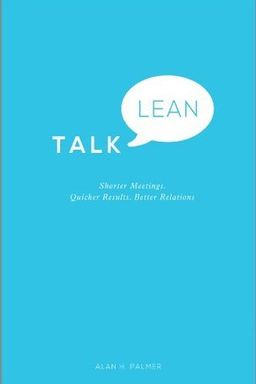
Talking Lean: The Art of Candid and Courteous Communication
Have you ever walked away from a meeting thinking, “That could have been half as long—and twice as effective”? Or left a conversation wishing you’d spoken more directly, but without offending anyone? In Talk Lean, Alan Palmer argues that the secret to more productive, respectful relationships—in business and in life—is the discipline of communicating both candidly and courteously. His book, drawn from Philippe de Lapoyade’s Interactifs method, is a blueprint for mastering that delicate balance: saying what you mean, quickly and clearly, while keeping the human connection intact.
Palmer contends that most of us face a false choice when we interact with others: either we’re direct and risk being perceived as rude, or we’re polite and risk being seen as evasive or weak. The Interactifs Discipline breaks that binary. It shows that real respect means being transparent about what you want or think while remaining attentive to how the other person feels. This simple but rigorous approach can transform meetings, negotiations, management discussions, romantic conversations—even awkward workplace confrontations.
Why We Need to “Talk Lean”
Across cultures and languages, Palmer notes, human beings repeatedly describe how they want to be spoken to: with clarity, respect, and simplicity. Yet very few of us actually speak this way consistently. Why? Because we confuse courtesy with avoidance. Out of fear of conflict, we bury our real intentions under unnecessary preambles, vague phrasing, and circuitous small talk. Paradoxically, this isn’t polite—it’s manipulative. Real courtesy is transparent and efficient; it treats the other person as an equal adult, worthy of honesty and trust.
Imagine, Palmer suggests, how much smoother work (and life) would be if every meeting followed three rules: 1) you begin by clearly stating your objective; 2) you stay focused on what’s relevant; and 3) you end by making sure everyone understands what has been achieved. That’s what he calls talking lean—getting to the point, fast and humanely, without waste or friction.
From Manipulation to Conscious Influence
Palmer distinguishes sharply between influencing others consciously and manipulating them unconsciously. Manipulation—especially psychological tricks or body-language “hacks”—might work in the short term but destroys credibility and relationships over time. Effective communication, in contrast, means working on the other person’s conscious mind: being upfront about what you want and inviting collaboration in achieving it. You influence by clarity and authenticity, not by stealth.
He argues that the most persuasive and seductive people (in the broad sense of seduction as “attractiveness of behavior”) are those whose speech is crystal-clear and emotionally coherent. Their words match their intentions. Think of the example Palmer gives of a young man on the London Underground who wins a woman’s admiration simply by saying, honestly and calmly: “I really like the way you look—and I’d like to have coffee with you.” Straightforward, confident, and kind—that’s the essence of talk lean.
A Practical Framework for Every Conversation
What makes Talk Lean stand out among communication books (compared to, say, Dale Carnegie’s How to Win Friends and Influence People or Chris Voss’s Never Split the Difference) is its insistence on discipline and practice. Palmer doesn’t offer abstract “tips.” He provides a structure you can use in every interaction:
- Define your objective first—what exactly do you want the other person to say, do, or agree to by the end?
- Announce your goal up front so no one is guessing your intentions. This builds trust and saves time.
- Speak with your emotions acknowledged, not suppressed. Saying “I’m nervous about bringing this up” is more human than pretending calm detachment.
- Practice “the three paths.” These conversational options—HIM/HER (understanding the other), ME (expressing yourself), and US (building a joint solution)—form the book’s communication triad.
Whether you’re delivering bad news to a client, confronting a boss about micromanagement, or flirting at 2 a.m., the same discipline applies: be clear about what you want, express it respectfully, and invite the other person’s viewpoint. Palmer’s examples—from corporate boardrooms to romantic near-misses—make the method vivid and universal.
Clarity, Courtesy, and Courage
The deeper message of Talk Lean is that courage and courtesy are not opposites but allies. It often takes boldness to be transparent. Yet, paradoxically, that boldness creates comfort—for both sides. When you tell someone openly what you want, you eliminate the anxiety of guessing motives. As Palmer puts it, true respect means being clear about your intentions while giving others the space to choose their response.
By the end of the book, you realize that “lean talking” isn’t just about shorter meetings or clever phrasing; it’s a philosophy of human connection. Words, like well-designed machines, should produce results efficiently—without friction, waste, or harm. The reward is profound: better results, stronger trust, and, as Palmer says, a small but meaningful contribution “to the sum total of human happiness.”