
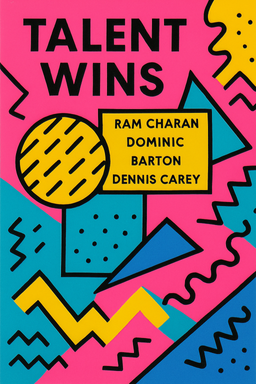
Talent Wins cover

Talent Wins

by Ram Charan, Dominic Barton & Dennis Carey

In Talent Wins, authors Ram Charan, Dominic Barton, and Dennis Carey reveal how prioritizing human capital over traditional structures can transform your organization. Discover practical strategies for fostering a high-performing, agile workforce through collaboration and cutting-edge technology, ultimately driving business success.

Putting People Before Strategy

What would happen if you ran your company as if your greatest resource wasn’t money, technology, or infrastructure—but people? In Talent Wins, seasoned advisors Ram Charan, Dominic Barton, and Dennis Carey argue that the core differentiator in today's business world is no longer having a brilliant strategy or the most capital—it’s having exceptional talent and deploying it wisely. They contend that in the age of what they call “talentism,” companies must manage human capital with the same discipline and intensity as financial capital.

The book makes a blunt claim: Talent, not strategy, is what drives value creation. The authors urge CEOs to recognize that reimagining their companies as people-first organizations is their most critical responsibility. While acknowledging talent's importance is easy, actually transforming into a talent-led company is deeply complex—one that touches strategy, structure, culture, and leadership itself.

From Resources to Capital

The authors argue that most traditional HR systems were built for predictable, stable environments. But the modern business landscape is fluid, often chaotic, and rapidly changing due to technological disruption and globalization. Conventional hierarchies, departmental silos, and multiyear strategic plans have become rigid barriers to adaptability. Instead, leaders must treat talent as an active investment—allocating people dynamically where they can have the most impact, much as they reallocate capital to fuel growth.

They cite research showing companies that aggressively reallocate financial capital outperform peers by up to 40% over time. Now, they propose applying that same logic to human capital: redeploying people, skills, and leadership to the opportunities with the highest potential return.

The People-First Playbook

The book offers a seven-part “CEO playbook” for putting people first. It begins with creating the “G3”—a power trio of the CEO, CFO, and CHRO who jointly manage financial and human resources as equal strategic assets. It continues with energizing the board to focus on Talent, Strategy, and Risk (the new “TSR”), redesigning company structures to enable flexible and agile teams, reinventing HR as a source of strategic advantage, and transforming how individuals learn and grow.

The journey then expands beyond internal systems. It demonstrates how to develop a talent-focused M&A strategy to acquire critical capabilities and integrate external talent. Finally, it concludes by redefining the CEO’s job: leading with people at the center, acting as the chief recruiter, the champion of learning, and the guardian of company culture.

Why It Matters Now

Charan, Barton, and Carey describe a historical inflection point much like the Industrial Revolution. Just as factories and machines defined the industrial age, they argue that human imagination and capability define the new age of talentism. The companies that best unleash and align their people will win markets and create enduring value. This isn’t a lofty principle—it’s an operational necessity in an environment where skills become obsolete quickly and innovation arises from networks of empowered individuals, not top-down directives.

From Google’s flexible project model to Haier’s network of microenterprises, the authors show that success now depends on releasing people’s energy rather than controlling it. CEOs, they argue, must become architects of environments where talent flourishes: dismantling hierarchy, digitizing HR insight, and coaching boards and teams to see people as creators of value, not line items on a spreadsheet.

In short, Talent Wins challenges every leader to embrace a radical shift: from strategy-led to talent-led management. It’s a manifesto for CEOs facing the future—a call to know your people as deeply as your numbers, to blend financial logic with human empathy, and to take personal ownership of building organizations where talent leads strategy, not the other way around.


The Power of the G3

At the heart of a talent-driven company lies a surprisingly simple but transformative idea: the G3—a leadership triad composed of the CEO, CFO, and CHRO who jointly make decisions that balance financial and human priorities. This structure, which began as an experiment at companies like Marsh and Tata Communications, proved so effective that the authors call it the modern CEO’s most important tool.

Why Combine Finance and People

The logic is straightforward but revolutionary: people and money are the two most valuable assets of any business, yet they’re usually governed in separate silos. CFOs control budgets and performance data, while CHROs manage leadership and talent, often without business context. The result is a disconnect between what the organization can afford and what it can accomplish.

In a G3, these barriers vanish. CEO Peter Zaffino at Marsh discovered that bringing his CFO and CHRO together immediately surfaced hidden performance issues—some units were growing revenue but lacked the organizational readiness to scale. By connecting financial insights with talent realities, Marsh realigned incentives and accelerated performance in a matter of weeks.

Elevating the CHRO

A true G3 only works when the CHRO is empowered as an equal to the CFO, not a subordinate. This is a radical shift in many organizations still trapped in the era of the “Super CFO.” The CHRO’s presence ensures that major decisions—like acquisitions, restructuring, or product launches—factor in not just financial risk, but also human capacity and leadership strength.

CEOs like Mary Laschinger at Veritiv and Greg Case at Aon exemplify this approach. Laschinger runs what she calls a “G4” including the General Counsel, acknowledging that HR insights are as strategic as legal and financial expertise. Case insists his CFO and CHRO work in lockstep, integrating capital allocation with people allocation: “Pure capital allocation is essential,” he says, “but that’s not enough. Do we have the right talent in place?”

The G2 Within the G3

The most successful G3s function as two collaborations in one: the CEO’s oversight and a powerful “G2”—a tight partnership between the CFO and CHRO. When both continually exchange insights, the company links dollars to people performance. At McGraw-Hill, for instance, CFO Jack Callahan and CHRO John Berisford spearheaded a dramatic turnaround by consolidating financial and HR data. By aligning costs to talent value, they quadrupled the company’s market value and streamlined operations after years of stagnation.

The lesson is simple: great strategy comes from great questions asked by a small, focused team. The G3 becomes the company’s “central brain trust,” ensuring that every financial forecast is grounded in talent reality. When properly executed, this trio turns talent management into a competitive advantage and redefines how leadership decisions get made across the entire enterprise.


Energizing the Board for Talent

If the G3 aligns management around talent, then the board of directors must act as its amplifier. Ram Charan and his coauthors argue that a CEO’s transformation will stall without a board that treats talent, not just financials, as the central discussion. Boards must evolve from focusing on TSR as “total shareholder return” to a new definition: Talent, Strategy, and Risk.

Reintroducing HR to the Boardroom

The first step is to break the barrier between directors and the CHRO. At many firms, HR leaders have long been seen as administrative experts, excluded from strategic deliberations. But when the CHRO becomes a trusted voice—helping boards evaluate future leadership, succession, and culture—the board’s understanding of the business deepens dramatically. At Telenor, for example, the CHRO helped the board ensure gender diversity commitments turned into measurable action, doubling the number of women in leadership.

Reorganizing the Board Around Talent

The book advocates renaming the “compensation committee” to a “Talent and Rewards Committee.” While this change sounds symbolic, it reflects a real shift in priorities—from approving executive pay to understanding how the organization identifies, develops, and rewards its top 2% of talent. GE’s Management Development and Compensation Committee serves as the gold standard: directors lead site visits, mentor emerging leaders, and review leadership pipelines across divisions. One director described GE’s board as “a university of capable people.”

Reprioritizing the Agenda

Boards in a talent-driven company must make CEO succession, health of critical talent, and diversity standing items on every agenda. Without a clear succession plan, a supposed “people-first” company crumbles when leadership changes. Apple’s smooth transition from Steve Jobs to Tim Cook demonstrates this principle. Discussions about the top 2% should examine not just performance metrics, but cultural impact and leadership development capability. And diversity, the authors stress, is not a quota discussion—it’s a business necessity tied to innovation and global relevance.

When boards take on these responsibilities, they become true partners in building a future-proof organization. They signal to investors, employees, and the market that talent is the engine of enterprise value. As the authors put it, “A board that’s focused on talent is a board that’s focused on the future.”


Designing Organizations for Agility and Meaning

What does a company built for talent actually look like? Instead of thick hierarchies and reporting lines, Talent Wins envisions agile, fluid networks that move as fast as opportunity does. These organizations thrive on three pillars: agility, platform thinking, and meaning. Each transforms not only how work happens, but why it matters.

Building for Agility

Agility, the authors argue, is not chaos—it’s “a fixed backbone with flexible muscles.” Facebook embodies this through autonomous, cross-functional teams that form, disband, and re-form around new products. Mark Zuckerberg famously told his teams, “Come in with mobile, or I’ll kick you out.” That decree pushed engineers to pivot from desktop to mobile overnight, boosting revenue by billions. Facebook’s Hackamonth program even allows employees to test new projects for a month, illustrating how freedom and adaptability fuel innovation.

Thinking in Platforms, Not Pyramids

The second shift is structural: from vertical hierarchy to horizontal platforms. The Chinese appliance giant Haier exemplifies this with its 2,000 “microenterprises,” small, self-managed teams empowered to make decisions and manage profits. Each unit serves its own customers and can even fire its leaders. CEO Zhang Ruimin’s philosophy—“lose control step by step”—captures the paradox of leadership in the age of talent: trust and transparency trump oversight.

(Haier’s approach parallels Frederic Laloux’s Reinventing Organizations, which also highlights self-managing, purpose-driven systems.) By dismantling central bureaucracy, Haier has sustained double-digit profit growth and empowered employees to act as entrepreneurs rather than functionaries.

Making Work Meaningful

Finally, no structure succeeds without a shared sense of meaning. At Amgen, CEO Bob Bradway and CHRO Brian McNamee enlisted 30 high-potential employees to define Amgen’s future culture. Their initiatives—from rethinking how the biotech giant recruits scientists to enhancing digital patient care—transformed engagement across the company. Meaning, as Amgen learned, must be co-created with employees, not mandated from above.

These three qualities—agility, platforms, and meaning—give companies dynamic stability. Instead of controlling people, they cultivate them. Instead of rigid plans, they design resilient systems. When CEOs grasp this, they stop managing structures and start orchestrating energy.


Reinventing HR as a Strategic Engine

For decades, HR has struggled with a perception problem: seen as administrative rather than strategic. Talent Wins argues this must end. In a true talent-driven organization, the HR function becomes a powerhouse for value creation—an analytical, technologically sophisticated, and business-savvy engine for growth.

From Paperwork to Profit

The authors emphasize that CHROs need business acumen equal to their CFOs. Larry Costello, the former HR executive at Tyco and PepsiCo, illustrates this new model. He doesn’t “run HR” so much as run the business through the lens of talent. His credibility arises from years of operational exposure, financial literacy, and courage to challenge the CEO. The best CHROs are, as Alan Mulally of Ford says, “dynamite business strategists.”

Digitizing HR

Cutting-edge HR is now as data-driven as finance. PepsiCo’s Shakti Jauhar modernized HR systems into a global cloud platform with instant analytics, robotic automation, and AI-based insights. This allowed HR leaders across 260,000 employees to make faster, evidence-based decisions about hiring, turnover, and succession. Johnson & Johnson likewise automated two-thirds of its HR processes, freeing time for high-value work like leadership development and talent forecasting.

Developing Talent Value Leaders

The book introduces the idea of Talent Value Leaders (TVLs)—HR experts embedded within business units who sit alongside finance and operations leaders to shape performance. They go beyond advisory roles to co-own results. Humana’s CHRO Tim Huval exemplified this, exchanging HR staff with business-unit employees to cross-pollinate skills. The result: engaged HR partners who think like entrepreneurs, not administrators.

Paying for Strategic Influence

Ultimately, the authors call for ending the pay gap between CHROs and CFOs. When HR holds equal strategic weight, its leader deserves comparable reward—and, perhaps, succession consideration. As Dave Ulrich’s research shows, CHROs often share the same leadership traits as CEOs. The message is sharp: reward HR as you do finance, and you’ll attract transformational leaders who make talent your greatest asset.


Scaling and Developing Individual Talent

Once your company’s structure and leadership align around talent, the next challenge is nurturing it. Talent Wins dedicates an entire section to showing how world-class companies like BlackRock, GE, and AT&T make talent development a competitive advantage. The goal? To create a culture where learning is constant, performance is transparent, and careers evolve in sync with company strategy.

Data-Driven Development

At BlackRock, CEO Larry Fink and CHRO Jeff Smith treat talent like portfolio management. Their “Human Capital Committee” reviews data and judgment together each quarter—evaluating not just performance, but also engagement, inclusion, and leadership growth. A 97% employee participation rate in surveys reveals deep trust built on transparency: feedback loops directly shape company initiatives. By combining data analytics with emotional intelligence, BlackRock ensures that leadership evolves faster than the market.

Rethinking Reviews and Pay

The traditional annual review, the book insists, is obsolete. GE replaced its century-old ranking system with a continuous-feedback app—PD@GE—that invites real-time, two-way coaching. Zalando crowdsources peer feedback after every project. This shift transforms performance management from punitive judgment to mutual growth. Similarly, pay structures must evolve: Google’s Laszlo Bock famously advocates “paying unfairly,” rewarding top performers five or ten times more than others because their value creation is exponential, not incremental.

Continuous Learning

Talent development thrives on perpetual learning. AT&T’s “Workforce 2020” invests $250 million yearly to reskill employees in AI, analytics, and cybersecurity. Employees access online courses and personalized dashboards to see which capabilities they'll need for future roles. Pfizer’s CFO Frank D’Amelio expresses this philosophy succinctly: “I don’t limit capital deployment to money—it’s all capital, including human.” Training, therefore, becomes a strategic investment, not an expense.

Together, these innovations transform companies into “talent accelerators.” They prove that when employees feel regularly coached, fairly rewarded, and continuously challenged, they stop needing to be managed—they start managing themselves.


M&A as a Weapon for Acquiring Talent

When industries converge and skills evolve faster than companies can retrain, the fastest route to growth is often acquiring talent, not just assets. The authors spotlight Volvo’s transformation under Chinese owner Geely as a masterclass in talent-oriented M&A. Facing an aging culture and limited digital skills, Volvo rebuilt its workforce by importing fresh expertise from seemingly unrelated industries.

From Cars to Code

Under CHRO Björn Sällström and CEO Stefan Jacoby, Volvo realized that to compete in autonomous and electric vehicles, it needed more software engineers than mechanical ones. The company recruited from Nokia (for R&D), Google (for sales analytics), and even the fashion and furniture industries to improve design thinking. Within four years, a quarter of Volvo’s engineers were new hires from outside the auto sector—proof that fresh DNA breeds innovation.

Acquihires and Peripheral Vision

The book highlights the rise of “acquihires”—purchasing startups primarily for their people, not revenue. Google’s purchase of DeepMind and Ford’s billion-dollar acquisition of Argo AI are examples. To execute these moves effectively, CEOs must cultivate peripheral vision—the ability to detect trends and talent across industry borders. Steve Jobs mastered this by studying fields as disparate as fashion and industrial design, applying insights from Milan boutiques to Apple Stores.

CHRO at the Center

Too often, M&A decisions are driven solely by finance teams. The authors argue that this is a costly mistake: over half of mergers fail due to cultural misfit or talent loss. A people-first M&A puts the CHRO at the negotiating table from day one, auditing talent alongside financials, planning cultural integration, and identifying critical roles before contracts are signed. As Jack Welch once said, “If you want to build a great team, talk more with the head of player personnel than the accountant.”


How CEOs Drive the Talent Agenda

The book closes with a direct message to CEOs: transforming your organization around talent cannot be delegated. You, not HR, must lead it. Charan, Barton, and Carey outline what this new model of CEO leadership looks like—part strategist, part coach, part recruiter, and all in on people.

New Mindset

A talent-first CEO views people as the starting point, not the endpoint, of strategy. Quarterly business reviews center on key players, not only metrics. Leaders ask: who’s in the critical 2%, what skills do we lack, and how can we stretch our best performers into new opportunities? As Aon’s Greg Case says, “We live to help people achieve their full potential.”

Time and Energy

Charan notes that top-performing CEOs often flip the traditional ratio of time: spending as much as half their week on people decisions. Masahiko Uotani, CEO of Shiseido, personally interviews key recruits to assess not just skill but “kokorozashi”—a Japanese word for inner determination. CEOs like him embody the principle that leadership presence signals what the company truly values.

Living the Data

Modern CEOs must engage directly with talent analytics as they do with financial dashboards. The same rigor used to track cash flow now applies to turnover, diversity, and leadership potential. Regular G3 reviews ensure alignment between talent deployment and capital performance. Great CEOs, like BlackRock’s Larry Fink, integrate both views seamlessly—financial data explains what happened; talent data predicts what will happen.

Ultimately, being a talent-first CEO means redefining success: it’s not commanding control but cultivating creativity. As Haier’s Zhang Ruimin advised, “Lose control step by step.” That humility—the willingness to empower others—is what truly separates yesterday’s managers from tomorrow’s leaders.

Dig Deeper

Get personalized prompts to apply these lessons to your life and deepen your understanding.

Go Deeper

Get the Full Experience

Download Insight Books for AI-powered reflections, quizzes, and more.