
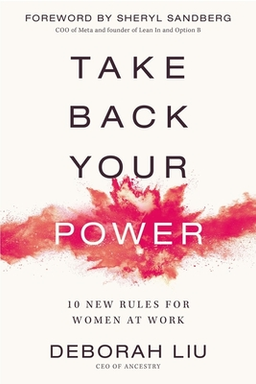
Take Back Your Power cover

Take Back Your Power

by Deborah Liu

Take Back Your Power by Deborah Liu is both a memoir and a practical guide for women seeking success at work. Through real-life anecdotes and ten powerful rules, Liu offers invaluable insights and strategies for overcoming systemic barriers and thriving professionally. Discover how to harness your inner strengths and build a supportive foundation for lasting success.

Taking Back Power in a Biased World

What would change in your life if you stopped giving away your power? That question sits at the heart of Take Back Your Power: 10 New Rules for Women at Work by Deborah Liu, a Silicon Valley executive and the CEO of Ancestry. Liu argues that the world's persistent gender bias doesn't just shape how women are treated—it also conditions how women see themselves. Women often dim their light, stay silent, or hesitate to lead because they have been taught, consciously and unconsciously, that power is a dirty word for them. Her book is both a rallying call and a roadmap for reclaiming that power in workplaces that remain uneven playing fields.

The Double Bind: Why Power Feels Dangerous

From Liu’s experiences at giants like Facebook, eBay, and PayPal, she reveals that women who seek authority are often punished for it—while men are rewarded. Society tells women to be polite and likable, yet these same traits are weaponized against them in professional settings, branding assertive women as abrasive or difficult. This contradiction forms what Liu calls the “double bind”: if you lead, you’re resented; if you serve quietly, you’re overlooked.

Liu contends that breaking out of this double bind begins with understanding that power, rightly used, isn’t domination—it’s agency. Power is the ability to influence events and shape outcomes. Women wield enormous potential influence but frequently undercut themselves by believing that seeking power is selfish or unfeminine. That belief, Liu warns, is the invisible tether holding many talented women back.

Navigating a Biased System

Liu doesn’t sugarcoat the realities: systemic inequality is entrenched. It's clear in pay gaps, promotion disparities, and cultures that reward masculine communication styles. Drawing from studies and stories—including Lean In research by Sheryl Sandberg and analyses from McKinsey—she shows that for every hundred men promoted to manager, only eighty-six women are. The solution, Liu stresses, is not blind optimism but strategic adaptation. “You don’t have to fix the system to thrive in it,” she writes; “you need to understand it to win within it.”

Her approach echoes similar pragmatism found in Jeffrey Pfeffer’s 7 Rules of Power—another book that explores how to navigate flawed corporate structures. But Liu’s lens is distinctly gendered: she teaches women to observe biases like a map of obstacles—to see the mines and plan how to cross them. Understanding your environment, she insists, is the first act of reclaiming power.

The Ten Rules for Reclaiming Agency

From that recognition flow ten new “rules” designed to help women reshape their mindset and actions:

  • Know your playing field — understand gender biases and structural inequities before strategizing your success.
  • Don’t give yourself a free pass — push past fear or self-doubt to speak up, take risks, and be visible.
  • Chart your own course — define success by your values, not someone else’s ladder.
  • Build a learning mindset — treat every setback as a chance to adapt and grow.
  • Learn to forgive — release resentment that drains energy and focus.
  • Develop allies — find mentors and sponsors, especially men in power, who open doors.
  • Embrace who you are — discover your unique superpower and lean into it unapologetically.
  • Create balance at home — build equitable partnerships that sustain work-life harmony.
  • Find your voice — speak authentically even in cultures that reward silence.
  • Make your mark — live with purpose and build a legacy that reflects your true power.

Stories That Shape Lessons

Liu uses powerful real stories—from NASA engineer Ellen Ochoa standing alone in dissent to prevent a deadly shuttle launch, to Sheryl Sandberg’s advice about persistence—to embody her lessons. These women serve as examples of speaking up, pivoting through career setbacks, and leading authentically. Liu’s own experiences at Facebook—building Marketplace after years of advocating for the idea—show how trusting your instincts can shift industries.

Through such examples, she invites you to see your own life as a series of opportunities to reframe fear and injustice into agency. If you understand power as influence born of integrity, you can use it to reshape both your career and the culture around you.

Why This Matters

“Take Back Your Power” is not a manifesto against men—it’s a manifesto for human wholeness. Liu reminds readers that strength and compassion, ambition and balance, leadership and humility are not opposites but allies. Her goal is not just to elevate women but to help every professional live courageously within an imperfect world. In that sense, Liu’s philosophy bridges self-help and social movement—it’s about personal transformation as the first step toward systemic change. Her book dares you to stop shrinking your power and start using it to write your own story.


Know Your Playing Field

The first of Liu’s ten rules starts with awareness. You cannot change a system you don’t understand. “Know your playing field” means learning the invisible rules that shape professional life, especially the ones that operate differently for women. Liu paints a vivid picture through data and anecdotes: women earn less, are promoted less, and are more harshly judged for ambition. These inequalities begin early—when girls are called bossy while boys are called leaders—and persist into boardrooms and paychecks.

Understanding the Double Standard

Research Liu cites shows that power-seeking men are admired, while power-seeking women elicit “moral outrage.” Think of Hillary Clinton’s campaigns, where her competence was applauded only when tempered with vulnerability. This contradictory expectation forces women into a double bind: be strong and risk rejection, be soft and risk invisibility. Liu’s key insight is that the problem isn’t women’s lack of confidence—it’s the world’s punishment of female confidence.

Language and Culture Reinforce Bias

Even our words betray these hierarchies. Liu cataloged workplace phrases like “manpower,” “right-hand man,” “old boys’ club,” and contrasts them with demeaning ones tied to women—“prima donna,” “Debbie Downer.” This linguistic bias subtly tells you who belongs. Job listings filled with masculine-coded terms such as “aggressive” or “dominant” tend to discourage female applicants (a phenomenon also confirmed by Harvard Business Review studies). Knowing your playing field means listening for these linguistic traps and refusing to internalize them.

Bias in Systems and Algorithms

Liu shares the striking example of Amazon’s recruiting algorithm that learned from past hiring data—and excluded female candidates by penalizing resumes mentioning women’s organizations. Bias, she shows, scales through data. These systems learned what human decision-makers had been doing all along. Recognizing this teaches you that the playing field isn’t tilted because of one bad actor—it’s coded into the infrastructure of opportunity.

The Motherhood Penalty

Another recurring bias Liu exposes is motherhood. Women are asked who will care for their kids while men are asked how fatherhood inspires them. The result? Mothers lose approximately thirty percent of lifetime earnings, while fathers gain six percent per child. This “motherhood penalty” is a silent career tax, built into both social expectation and organizational design. By contrast, societies that value caregiving equality tend to have smaller wage gaps and stronger economies. Knowing this helps women confront realities rather than blame themselves.

Responding Strategically

Awareness becomes power only when paired with strategy. Liu urges women to stop hoping for fairness and start adapting. Analyze your company’s culture, identify who gets promoted and why, learn the language that conveys authority, and call out bias without apology. As she writes, “We can pretend the world is fair, but if we don’t recognize the mines on the field, we’ll keep stepping on them.” Knowing your playing field means seeing truth clearly and using that knowledge not as despair, but as your navigation guide toward genuine agency.


Don’t Give Yourself a Free Pass

If the first rule is about seeing the field, the second is about stepping onto it with courage. “Don’t give yourself a free pass” means stop excusing your silence or passivity with phrases like, “I’m shy,” “I don’t want to say the wrong thing,” or “It’s not my place.” Liu calls this giving away power by default. Every time you stay quiet when you have insight, you grant authority to someone else.

What a Free Pass Looks Like

Liu tells stories from her own career—standing on the sidelines at meetings full of men, and from Facebook’s Ellen Ochoa at NASA, who once voted “No Go” on a shuttle launch alone among dozens of “Go” votes, preventing possible catastrophe. The common thread: courage to act when uncomfortable. Leadership researcher Carol Isozaki coined Liu’s favorite term for this habit: the “unintentional ridiculous strategy”—the tendency to step back quietly rather than risk error. But silence is costly. You lose influence, visibility, and opportunity.

Learning to Speak Up

Liu recounts how she learned extroversion as a skill, not a personality trait. She rated herself on daily participation, forcing improvement through measurable practice. Her advice mirrors the behavioral techniques found in Lean In—set small measurable goals, like making three contributions per meeting. Over time, speaking up becomes second nature.

When Action Defines You

“If they don’t give you a seat at the table, bring a folding chair,” Shirley Chisholm once said. Liu extends that spirit to career advancement. Many women silently train their own bosses—doing everything a manager does without claiming the title. Maeley Tom’s story illustrates this vividly: after training three consecutive California Assembly chiefs of staff, she finally told Speaker Willie Brown that she should have the job herself. He replied, “What took you so long to ask?”

Turn Kryptonite into Superpower

Being different—whether by gender, race, or personality—isn’t weakness; it’s perspective. Liu challenges you to see the aspects of yourself you hide as potential power sources. Instead of self-editing to fit culture, she urges using your distinct lens to innovate, just as she leveraged her identity as a mother to imagine Facebook Marketplace. Your difference can be your power—but only if you tear up your free pass and start playing to win.


Chart Your Own Course

Liu’s third rule dares you to stop climbing ladders built by others. “Chart your own course” is about defining your own version of success instead of chasing what society, peers, or parents expect. For Liu, that realization came when she reached an executive level at Facebook and asked herself, “Is this all there is?” She realized she had spent decades climbing someone else’s invisible hierarchy instead of defining what truly mattered.

Dreams Beyond the Expected

She shares how other women, like Loveboat, Taipei author Abigail Wen, found alternative paths by writing fiction while working full-time in tech. For twelve years Wen devoted nights to writing before becoming a bestselling novelist. Her persistence illustrates Liu’s point: progress comes from small, consistent steps toward personal dreams, not quick leaps of luck. Charting your course requires patience and vision, two things our fast-paced culture undervalues.

Failure as a Catalyst

Every career detour in Liu’s narrative begins with rejection. She reframes setbacks as necessary redirections. Sanyin Siang’s story is emblematic—losing her scholarship forced her to reinvent herself as a leadership coach, turning apparent defeat into purpose. Katia Verresen’s car accident redirected her from law into life coaching, eventually mentoring Silicon Valley CEOs. These examples reinforce Liu’s assertion: you overestimate what you can do in a year but underestimate what you can build in a decade.

Career and Motherhood

Liu juxtaposes her own journey of giving up teams at Facebook—painful yet transformative. When Zuckerberg asked her to pass her portfolio elsewhere, she saw failure; in hindsight, it forced her to focus on what became Marketplace. The key, she explains, is learning to look toward the horizon when seasickness sets in—to use disruption as recalibration.

Step Functions and Nonlinear Growth

Borrowing from physics and business, Liu introduces “step functions”—moments that let you leap multiple rungs at once. Instead of small promotions, seek transformational skills that create exponential jumps. Peggy Alford’s trajectory—moving from CFO roles to Facebook’s board—embodies this principle. Your success will rarely be linear; it unfolds through reinvention. Charting your own course means seeing the whole map, not just the prescribed path, and daring to build new roads when none exist.


Build a Learning Mindset

Rule four is about transforming doubt into growth. Liu reminds readers that imposter syndrome—feeling like you don’t belong—is nearly universal among high-achieving women. Instead of combating it through perfectionism, she reframes it as evidence that you’re expanding beyond your comfort zone. “Learning, not mastery, is the real skill,” she argues. Knowledge becomes stale; adaptability stays relevant.

From Imposter to Explorer

Liu recounts joining PayPal without knowing what a product manager did. Her honesty with leaders like Amy Klement allowed her to learn quickly and lead billion-dollar projects. When asked to code for empathy with developers, she instead listened deeply, discovering that reliability mattered more than features. Being a beginner gave her a fresh lens. This “beginner’s mind,” borrowed from Zen philosophy, lets learners see what experts miss.

Resilience Through Adversity

The stories of Christine Tsai (CEO of 500 Startups) and Lenore Blum highlight learning through chaos. Tsai rose after her cofounder resigned amid scandal, forced to rebuild the firm from scratch. Blum, shut out of math departments sexist hiring, founded programs that educated over a million girls in STEM. Like Liu, they treated setbacks as data—inputs for iteration, not indictments of worth.

Learning How to Learn

Liu urges replacing static resumes with dynamic curiosity. Ask questions, observe systems, and make mistakes loudly. A KPMG survey found that 75% of female executives experience imposter syndrome; Liu sees that as normal growth discomfort, not deficiency. In environments that reward certainty, being the learner makes you dangerous—because learning transforms the unknown into opportunity. Mastery limits you, but learning liberates you to grow perpetually stronger.


Develop Allies

No one thrives alone. Liu’s sixth rule—“Develop Allies”—is about creating networks of mentorship and sponsorship strong enough to sustain your rise. She shares vivid scenes: male colleagues who interrupted her stopped when her manager privately intervened. That, she explains, is true allyship—someone using power in service of fairness.

Levels of Allyship

Liu identifies four key types of allies: mentors, sponsors, teams, and circles. Mentors guide; sponsors advocate; teams support execution; circles provide emotional strength. Most women, she notes, have mentors but few sponsors—the people who say your name in rooms you’re not in. Sylvia Ann Hewlett’s research backs this: men are nearly 50% more likely to have sponsors. Sponsorship, not mentorship alone, accelerates careers.

The Power of Sponsors

Liu’s career blossomed through sponsors like Sheryl Sandberg, who introduced her to Intuit’s CEO for a board role that changed her trajectory. Sponsors open doors you can’t reach alone. But they must find you worthy of trust. Showing results, reliability, and courage earns that advocacy. “Sponsors find you when you prove you deserve them,” she writes.

Building Circles of Support

Beyond formal alliances, Liu champions informal circles. Her group of Facebook’s “Leading Ladies” demonstrated the strength of shared community—women who scaffolded each other’s ambitions with mutual trust. She calls such circles emotional infrastructure. These networks turn isolation into belonging, and belonging into shared power. Allies, she concludes, are both your armor and your wings—the ones who lift you higher when you stumble.


Embrace Who You Are

Rule seven is Liu’s rallying cry for authenticity. “Embrace who you are” means championing the very traits you’re told to hide—your personality, identity, and story. Society, Liu writes, trains girls from birth to conform: don’t be bossy, don’t be loud, don’t take up space. The result is generations of women dimming their light to be likable. She challenges you to reverse that conditioning and let your whole self lead.

Finding Your Superpower

Liu describes her own discovery: her “superpower” was connecting dots others missed. For years she dismissed her intuition, believing she must be wrong if no one else saw what she saw. That insight—uncovering hidden patterns—led to Facebook Marketplace’s birth. Coach Katia Verresen taught Liu that what makes you different makes you powerful. She invites readers to name their superpower and amplify it instead of hiding it.

Defying Labels

Through Sylvia Acevedo’s story—an engineer from a modest Mexican American family who led NASA projects and became CEO of Girl Scouts—Liu demonstrates how rejecting imposed definitions frees you to succeed. Acevedo refused to be boxed in by gender or tragedy, transforming grief into achievement. Her motto: “I am more than the rules of others.”

Authentic Leadership

Fidji Simo’s rise from a fisherman’s daughter in France to CEO of Instacart epitomizes authenticity. Despite illness, she wore heels and couture in male tech spaces that prized sweatshirts. Her vulnerability—leading through health crises while showing openness—became her strength. Liu’s message: your difference is not a flaw; it’s a feature. True power comes not from imitation but from integration—when you lead as wholly yourself, you become unstoppable.


Create Balance at Home

You can’t win at work if you lose at home. Rule eight—“Create Balance at Home”—shifts power from workplace politics to domestic equality. Liu argues that your partner is your most consequential career decision. She explores what sociologist Arlie Hochschild called “the second shift”—the unpaid household labor women perform after their day jobs—and how it silently sabotages professional growth.

The Second Shift in Practice

Women spend two more hours daily than men on chores and childcare, even in dual-career households. Over decades, that imbalance drains time, energy, and ambition. Liu contrasts mothers penalized for parenthood with fathers rewarded—the “motherhood penalty” and “fatherhood bonus.” She shares her own experiences managing motherhood at Facebook, noting that systemic imbalance only yields when couples intentionally design partnership.

Swim Lane Marriage

Liu coins the idea of a “swim lane marriage”: partners divide cognitive labor clearly and respect each other’s autonomy. Each manages their own responsibilities—one handles bills while the other manages kids’ medical needs—without micromanaging. Balance means shared accountability, not constant reminders or perfection policing. Empathy, she adds, grows when partners periodically swap roles to understand each other’s burdens.

Redefining Partnership

The stories of leaders with supportive spouses—Anne-Marie Slaughter, Fidji Simo, even Liu herself—reinforce that equality at home fuels success at work. “The most important career choice you’ll ever make,” Liu echoes Sheryl Sandberg, “is who you marry.” Taking back your power includes demanding reciprocity and redesigning family norms. A strong partnership is not just emotional—it’s strategic infrastructure for thriving professionally and personally.


Find Your Voice

If authenticity is inner power, voice is how it reaches the world. Liu’s ninth rule—“Find Your Voice”—urges women to speak up even when cultural norms silence them. Raised in a conservative Chinese Christian household, she learned to equate humility with silence. But over decades, she discovered that voicelessness breeds invisibility, and invisibility erodes influence.

Overcoming Cultural Silence

Liu recounts how a pastor once told her husband to lead and her to follow—claiming God ordained male authority. Her husband reminded her that even in scripture, Deborah judged and led Israel. That moment crystallized her belief: faith and leadership are not mutually exclusive. She found courage to confront authority and learned that truth spoken kindly but firmly shifts paradigms.

The Power of Narrative

At Facebook, Liu discovered that success depends not only on results but on narrative. Her team’s billion-dollar Games product failed to gain recognition because she never told its story; the next product did—and became famous. Owning your narrative ensures your work doesn’t speak quietly into the void; it reverberates. Leaders communicate vision as story, not data.

Speaking Up Despite Risk

Liu profiles venture capitalist Aileen Lee, who broke silence about sexism in tech and founded All Raise to empower female founders. Women who speak risk backlash—studies show they are interrupted 33% more than men—but silence keeps bias alive. Liu also honors Amy Klement, written out of the PayPal Mafia history, for choosing to look forward and champion inclusion instead of bitterness.

Authentic Expression

Finding your voice doesn’t mean being loud; it means being heard. Liu learned that vulnerability—sharing stories on Facebook about motherhood, failure, or fear—builds connection faster than perfection. Your unique fingerprint of voice can inspire, heal, and transform workplaces. Silence protects comfort; speech creates change. The world needs your truth, not your quiet.


Make Your Mark

The tenth and final rule—“Make Your Mark”—asks you to define the legacy you want to leave. Liu describes writing your own obituary as an act of intention: outline how you wish to be remembered, and then live toward that vision. Legacy, she insists, isn’t wealth or fame—it’s the ripple you leave in others’ lives.

Living with Purpose

Liu recounts the story of Stacy General, a Silicon Valley marketer living with terminal cancer, who continues to work and raise her son, saying, “I choose to live fully for as long as I have.” Stacy embodies the book’s ethos: power is meaning lived deeply, not dominance achieved externally.

Crafting a Vision

Liu’s own practice—writing vision statements each year—keeps her aligned. She urges readers to treat their legacy as a north star. Pediatrician Dr. CC Lee’s “bili-ruler” innovation to diagnose infant jaundice in poor countries shows how purpose-driven work outlasts ego. Whether through products, policies, or mentorship, the mark you make must be anchored in service.

From Obituary to Action

Liu advises setting annual milestones that inch you toward your legacy—similar to Carolyn Everson’s yearly vision letters guiding her career. Arianna Huffington’s reinvention with Thrive Global at sixty-six reinforces Liu’s thesis: it’s never too late to pivot, redefine, and reassert your purpose. Making your mark isn’t waiting for greatness—it’s choosing to live with courage today. The power you reclaim, Liu concludes, isn’t merely professional—it’s spiritual: you take back your power by living a life that matters.

Dig Deeper

Get personalized prompts to apply these lessons to your life and deepen your understanding.

Go Deeper

Get the Full Experience

Download Insight Books for AI-powered reflections, quizzes, and more.