
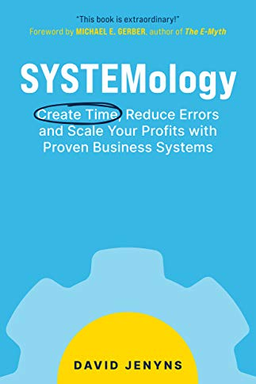
SYSTEMology cover

SYSTEMology

by David Jenyns

SYSTEMology by David Jenyns reveals a powerful framework for transforming businesses through systemization. By following its practical steps, business owners can create efficient processes that enhance productivity, reduce errors, and scale profits. This book is essential for those seeking to streamline operations and achieve sustainable growth.

Building a Business That Works Without You

Have you ever wondered what would happen if you stepped away from your business for three months—no emails, no meetings, no decisions? Many entrepreneurs would break into a cold sweat just imagining it. In SYSTEMology: Create Time, Reduce Errors, and Scale Your Profits with Proven Business Systems, David Jenyns argues that the true purpose of entrepreneurship isn’t to build a business that depends on you—it’s to design a business that runs without you. His central claim is bold yet freeing: the key to growth, sustainability, and freedom lies in building systems, not adding more hustle.

Jenyns picks up where classic business thinkers like Michael E. Gerber (author of The E-Myth) left off. While Gerber taught us to work on our business, not just in it, Jenyns provides the practical, step-by-step framework for how to actually do that. He doesn’t merely advocate for systems—he builds a system for systemising itself. The result is the SYSTEMology method, a seven-stage process that helps small business owners create a self-sufficient company capable of scale, sale, or serenity—whichever outcome they desire.

At the heart of the book is a simple question: can your business run without you? If not, Jenyns proposes that you are stuck in survival or stationary stages—reliant on your own daily decision-making. Your goal should be to reach the 'saleable' stage, where systems—not people—drive consistent performance and value.

Why Systems Matter

Systems, according to Jenyns, are far more than documentation—they’re the invisible infrastructure behind every great company. He demonstrates how broken systems cause chaos: poor recruitment leads to bad hires, unstructured finances cause cash-flow crises, and inconsistent operations deliver unpredictable results. Yet most small business owners ignore this, assuming that systems are only for big corporations. Through relatable stories—especially his time managing his own digital agency and his partnership with E-Myth author Michael E. Gerber—Jenyns shows how even small teams can apply systemisation without bureaucracy or burnout.

The Seven-Stage SYSTEMology Framework

The heart of the book is a 7-stage process, each addressing a specific barrier to building a self-sustaining business:

  • Define: Identify only the most critical 10–15 systems—the ones that actually drive value through your core product or service.
  • Assign: Take the business owner out of the equation by assigning system creation to existing team members who already know the work.
  • Extract: Capture team know-how quickly and painlessly, without creating lengthy manuals nobody reads.
  • Organise: Centralize all your systems in accessible locations and ensure accountability through technology.
  • Integrate: Build a culture where people follow and improve systems naturally.
  • Scale: Expand capacity responsibly by systemising finance, HR, and management functions.
  • Optimise: Continuously refine systems and create dashboards for intelligent decision-making.

Each stage builds on the previous one, moving you closer to what Jenyns calls Complete Business Reliability: the confidence that your business consistently delivers results, regardless of who’s running the day-to-day.

From Overload to Opportunity

Jenyns begins with a deeply personal story: a once-in-a-lifetime offer to collaborate with Michael Gerber on his final E-Myth book. This would’ve been impossible a few years earlier when he was chained to his agency 70 hours a week. But thanks to SYSTEMology, he could leave for three months—and his business improved in his absence. This empowerment—switching from operator to designer—is what he promises readers too.

This book matters because it shifts the small business narrative. Instead of glorifying endless hustle, Jenyns champions elegance, structure, and freedom. SYSTEMology is not about corporate rigidity; it’s about liberation through clarity. As you move through the stages, you’ll learn the tools (like the Critical Client Flow diagram and Departments, Responsibilities & Team Chart), mindsets, and examples from dozens of companies—from doggy daycare to ecological consulting—that prove that freedom through systems is not a myth—it’s a method.


Stage One: Define What Really Matters

The first step in SYSTEMology cuts through overwhelm. Most entrepreneurs panic at the thought of documenting hundreds of processes, but Jenyns insists you only need to define the 10–15 critical systems that create and deliver your core product. His philosophy is simple: systemise the core before the more.

The Critical Client Flow (CCF)

At the heart of this stage is the Critical Client Flow—a visual map of how your ideal customer moves from discovering your brand to becoming a loyal advocate. You pick one perfect client type and one core offering, then document each step that delivers consistent results—attention, inquiry, sale, money, onboarding, delivery, repeat/referral. This simple flow highlights the ‘vital few’ systems that drive success. Documenting what actually happens—not what should happen—reveals inefficiencies, bottlenecks, and blind spots you didn’t know existed.

Keep It Simple

Jenyns warns against complexity. He recalls his friend Mike Rhodes, who once created hundreds of detailed systems only to realize that no one used them. His team was overwhelmed, the systems were outdated, and it all backfired. The lesson: simplicity scales; complexity kills. SYSTEMology prioritizes the 80/20 rule—the top 20% of your systems create 80% of your efficiency wins.

Case Study: Ecosystem Solutions

Gary McMahon, an ecological consultant working 110 hours a week, used SYSTEMology to reclaim his life. Mapping his Critical Client Flow revealed bottlenecks and allowed him to document only the most essential steps. Within months, profitability surged by 80%, and for the first time in his career, he took a three-week family vacation. He described his new life as, “It’s like I’ve lost 50 kilos.”

This stage teaches you to reduce scope and focus. By defining what truly drives your business engine, you free yourself from trying to fix everything. Systemisation starts not with mass documentation—but with clarity on what counts.


Stage Two: Assign Knowledge, Not Tasks

Once the critical systems are identified, it’s time to break a dangerous assumption: that the business owner must create every system. Jenyns calls this the micromanager’s trap. The truth is that your best team members already perform key tasks exceptionally well—your job is not to teach them, but to extract their expertise.

The Departments, Responsibilities & Team Chart (DRTC)

To locate where expertise lives, SYSTEMology uses the DRTC framework. You divide your company by departments (marketing, sales, operations, finance, HR, management). Then, you assign key responsibilities and identify which team members hold the knowledge for each task. These are your “knowledgeable workers.” The chart clarifies ownership, reveals skill gaps, and—importantly—helps remove the founder from every equation.

Model the Best, Don’t Reinvent

Instead of designing new processes, model what your top performers do and replicate their best practices. This approach accelerates performance improvement across the entire company. It also transforms documentation from a burden into an act of capturing excellence that already exists.

Case Study: Absolute Immigration

Immigration firm director Jamie Lingham once discovered each of his departments was operating like a different business. SYSTEMology helped him step back and empower his operations manager to lead documentation. Within weeks, the chaos subsided. The result: consistency, alignment, and dramatically improved capacity. Lingham credits this step with enabling the firm to scale smoothly without compromising accuracy—a vital trait in immigration law.

Stage Two replaces founder-dependency with team empowerment. By assigning systems creation to those who live the work, you multiply efficiency and engagement, laying the foundation for a self-managing enterprise.


Stage Three: Extract Knowledge Efficiently

At this stage, the question becomes: how do you capture all this knowledge without drowning in documentation? Most businesses fail at systemisation because their process for creating systems is itself broken. Jenyns’ breakthrough is the idea that creating systems should always be a two-person job.

Two Roles: Knowledgeable Worker and Systems Champion

Instead of forcing employees to both perform and document tasks, SYSTEMology separates the roles. The knowledgeable worker performs the task and explains it aloud while being screen-recorded. The systems champion—an organized, detail-oriented team member—then transcribes, refines, and structures that recording into a simple checklist or guide. This minimizes resistance and produces usable documentation quickly.

The System for Creating Systems

Jenyns even provides a system for system creation—a meta-framework that guides every document. It includes steps: identify outcome → record the process → create documentation → review and train others. Screenshots, videos, and short text are enough; no need for corporate-style SOP binders. The guiding mantra? Keep it usable, not perfect.

Case Study: Oh Crap

Henry Reith and Bruce Hultgren, founders of the eco-friendly dog waste bag company Oh Crap, scaled from 200,000 to 6.3 million bags by embracing this approach. Once they delegated recording and documentation to a systems champion, they eliminated bottlenecks. The team could now scale production, run ads continuously, and innovate without chaos. Henry notes: “Systems created space for creativity.”

This stage destroys the myth that systemisation is slow or painful. By pairing recorders with documenters, SYSTEMology transforms an overwhelming project into a streamlined production line of improvement.


Stage Four: Organise and Centralize Systems

Once you’ve built a handful of systems, the next challenge is organising them so your team can actually use them. Jenyns cautions: “A system scattered across Dropbox, desktops, and emails is no system at all.” Stage Four is where technology becomes your ally—but not your master.

Separate Systems Management from Project Management

Jenyns argues that the biggest mistake small businesses make is believing one piece of software can do everything. Instead, he separates two critical functions: Systems Management Software (the single home for your how-to instructions) and Project Management Software (the accountability layer that tracks who does what, by when). Keeping them distinct prevents overwhelm and ensures clarity in responsibility.

Simplicity Over Software Shiny Objects

His message: don’t invest in the fanciest tools—start simple. Cloud systems, intuitive interfaces, and clear permission levels matter more than automation bells and whistles. “The money,” he writes, “is in the systems, not the software.” This practical approach allows teams to find information easily, use it consistently, and update it collaboratively.

Case Study: Mount Martha Preschool

When Daniel Power-Mirfin applied SYSTEMology to a local non-profit preschool, he replaced disorganized Word docs with an online system hub. The result was immediate: new committee members could “hit the ground running” instead of spending months figuring out how things worked. Parents noticed the smoother coordination; teachers noticed fewer errors. A clear example of how systems amplify not just profits—but trust.

Stage Four converts chaos into clarity. It’s less about choosing tools and more about building a transparent ecosystem where everyone knows what to do, how to do it, and where to find it.


Stage Five: Integrate Systems Culture

Documented systems mean nothing if no one follows them. Integration is about transforming systems from checklists into culture—making process-thinking “the way we do things here.” Jenyns explores how to handle human resistance and how to recruit champions who embody systemised leadership.

Leadership vs. Management

SYSTEMology thrives when visionary founders (leaders) partner with operational managers (executors). Leaders create ideas; managers ensure consistency. Jenyns uses his own partnership with Melissa, his operations head, as example. When he broke his own system by sending “urgent” instructions directly to staff, Melissa publicly reminded the team to ignore his unscheduled requests. Though humbling, it proved the power of disciplined adherence to process.

Dealing with Resistance

Employees may fear that automation or documentation threatens job security. Jenyns advises reframing systems as tools for empowerment: they free staff from micromanagement and create vacation flexibility. He also outlines a practical eight-step rollout plan—from identifying a systems champion to addressing pushback through accountability and incentives.

Case Study: Inception Websites

Aimee and Mike Hamilton’s web agency for chiropractors faced overload from success—thirty new clients a month with no operational backbone. Once they implemented SYSTEMology, they could scale marketing without stopping to reset. Their quote sums it up: “When we have time to be creative, we grow ten times faster than when we’re stuck in the day-to-day.”

Stage Five transforms good documentation into a living system—one driven by accountability, supported by leaders and managers, and baked into the company’s daily rhythm.


Stage Six: Scale Without Losing Control

Scaling a business shouldn’t mean chaos. Jenyns insists that scale is simply the logical outcome of strong systems. Once your core operations are stable, you then systemise finance, HR, and management functions to build capacity. And contrary to myth, systems don’t kill creativity—they create the mental space for it to flourish.

The Four Key System Departments

Jenyns identifies finance, HR, and management as the next leverage points. For finance, systemise recurring rhythms like invoicing, payroll, and reporting. For HR, engineer recruitment and onboarding systems that attract systems-minded people. For management, systemise your meeting rhythms and goal reviews. Together, these subsystems unlock scale without diluting culture.

The Two Exceptions

Normally, SYSTEMology says to capture what you already do—but in hiring and onboarding, you must elevate to your ideal. These systems set cultural DNA. Include links to your core SOPs in job ads. During onboarding, have new hires read SYSTEMology to immerse them in “the way we do things here.”

Case Study: Den Lennie

Creative entrepreneur Den Lennie once juggled endless client demands and believed systems stifled creativity. SYSTEMology flipped that thinking. By constructing frameworks and hiring within that system, his business reclaimed order—and ironically, his creativity exploded. He now coaches other creators to do the same and describes systems as “the structure that lets genius breathe.”

Stage Six teaches that scale is not about growth for its own sake; it’s about eliminating key-person dependency and multiplying decision-making quality through clarity.


Stage Seven: Optimise and Achieve Reliability

The final stage is where SYSTEMology graduates from foundation to flow. Optimisation converts your systems into a continuous improvement loop—what Jenyns calls Complete Business Reliability. He warns against comparing yourself to McDonald’s too early; perfection takes decades of refinement.

Data Drives Improvement

To improve, you must measure. Jenyns introduces the CCF Dashboard—a simple spreadsheet tracking your seven core metrics: attention, enquiry, sales, money, onboarding, delivery, and repeat/referral. With these in view, you can pinpoint bottlenecks and focus on improving one element at a time. He cautions: monitor five to seven metrics, not fifty.

The Problems List

Every issue revealed by data becomes a potential new system. Teams log problems, discuss them monthly, and fix one at a time—“eating the elephant” piece by piece. This process transforms firefighting into proactive refinement.

Case Study: diggiddydoggydaycare®

After years of operation, Jeanette Farren systemised her award-winning dog daycare before selling it. When corporate buyers reviewed her business, they immediately valued its systems above everything else. Because her company ran without her, she sold it for a high multiple of profits—proof that reliability equals value.

In Jenyns’ postscript, he details selling his own agency for a premium using the same method, completing the arc from survival to saleable. Optimisation isn’t the end—it’s the beginning of continuous improvement, where systems evolve as your business and opportunities expand.

Dig Deeper

Get personalized prompts to apply these lessons to your life and deepen your understanding.

Go Deeper

Get the Full Experience

Download Insight Books for AI-powered reflections, quizzes, and more.