
Idea 1
Mastering the Art of Switch Craft
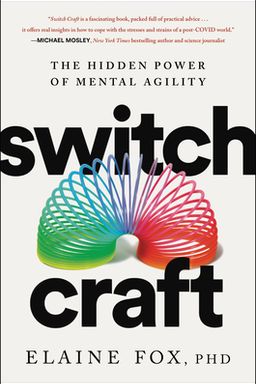
How do you stay grounded when nothing seems certain? In Switch Craft, psychologist Elaine Fox argues that thriving in a volatile world depends on mastering one crucial capacity: psychological agility. Fox defines switch craft as the ability to flex your thinking, emotions, and actions—to decide wisely when to persist (stick) and when to adapt or pivot (switch). It’s not just resilience or positivity; it’s a multidimensional skill set combining awareness, flexibility, and disciplined experimentation.
Drawing on neuroscience, behavioral science, and vivid real-world examples—from military medics making split-second calls to athletes redefining themselves after injury—Fox shows how agility produces strength. A predictive brain craves stability, yet survival depends on flexibility. The challenge of modern life, she contends, is to retrain that system so you can respond to uncertainty with curiosity rather than fear.
The predictive brain and sticky mind
Your brain is a prediction machine: it constantly forecasts what will happen next and adjusts body resources—what neuroscientist Lisa Feldman Barrett calls your body budget. Fox explains that while predictions give efficiency, they also create inertia. Familiar patterns feel safe, even when they hurt you. This is why your attention clings to an angry email or a painful memory—the mind becomes 'sticky' and resists new input. Breakthrough comes when you notice this stickiness and deliberately test an alternative. Over time, you teach your predictive system that flexibility is safe, not dangerous.
Agility as nature’s design
Fox grounds her psychology in biology. Even simple life forms like worms or coral depend on variability to survive. Evolution favors redundancy—many ways to achieve the same goal. This principle of degeneracy explains why the immune system generates countless antibody shapes and why the human brain can repurpose circuits for new functions. Agility, she argues, is not an invention of modern psychology but a basic law of life. Like fish that change sex when the population skews too far one way, humans flourish when they can shift identity, strategy, or belief to match changing conditions.
Mindset: acceptance and transition
Change is constant, yet we often resist it. Borrowing from William Bridges, Fox distinguishes between change (external shifts) and transition (internal adjustment). Adaptation fails not because of change itself but because we rush through endings without grieving old identities. That’s why she urges you to create the 'fertile void'—a pause between what was and what will be. Reflection and mourning make room for transformation. Tools like the 'thrive gauge' (a traffic-light map of benefits, risks, and threats) help clarify how to protect what matters while welcoming new possibilities.
The ABCD of agility
Fox distills mental agility into four trainable capacities: Adapt to changing demands, Balance competing goals, Change perspective when stuck, and Develop mental competence through practice. From military emergency teams who swap roles mid-mission to negotiators who read emotional cues under pressure, agility arises from coordinating these elements. It’s like owning a golf set—the clubs (skills) mean little unless you know which to use when.
Emotion, intuition, and regulation
Emotions, once seen as hardwired reactions, are reframed here as constructed tools—brain-made interpretations of bodily states shaped by culture and context. Fear and excitement share physiology; meaning makes the difference. When you learn to reinterpret arousal as energy rather than threat, you expand your response range. Equally vital is emotional flexibility: knowing when to express, when to suppress, and how to reappraise. Fox integrates Dialectical Behavior Therapy strategies like the 'wise mind' and ABC-PLEASE checklist to show that emotional regulation begins with physical care—sleep, nutrition, and movement stabilize your baseline.
Self-awareness: beliefs, values, and stories
Agility starts with knowing yourself. Fox combines personality science (the OCEAN traits), belief analysis, and narrative psychology to help you map your inner landscape. Beliefs simplify a complex world but also trap you when inflexible. Values act as a compass, while your personal stories reveal recurring life themes. She invites you to write four key memories—a high point, low point, turning point, and self-defining moment—and trace their themes. These patterns show what you truly protect or pursue. When Tom, an executive, realized his 'protector' identity underpinned many choices, he could reframe his controlling tendencies as care misapplied—and adjust them consciously.
From worry to curiosity
Because the predictive brain dislikes ambiguity, uncertainty easily breeds worry. Fox demonstrates that ritual, contingency planning, and exposure experiments can retrain your tolerance for not knowing. Her 'NOSE' acronym—Notice, Observe, Step back, Expect the unexpected—anchors you during chaos. The goal is not to eliminate worry but to engage it with structured curiosity. When you test your catastrophic predictions and record the actual outcomes, you teach your mind that flexibility pays off.
The craft of choosing
Ultimately, switch craft is judgment in motion: knowing which mind, belief, or emotion to rely on in real time. It fuses grit and agility—sustained effort plus creative adaptability. Persistent people complete marathons; agile minds change course midrace when weather shifts. The craft lies in integration: thinking broadly, feeling deeply, and acting flexibly. As Fox writes, the aim isn’t perfection but nimble wisdom—the ability to switch paths without losing direction.
Key takeaway
Switch craft is a lifelong practice of awareness plus variety—recognizing bodily cues, revising beliefs, and navigating emotion—so that you can choose, more often than not, to pivot when needed or persevere when it matters most.