
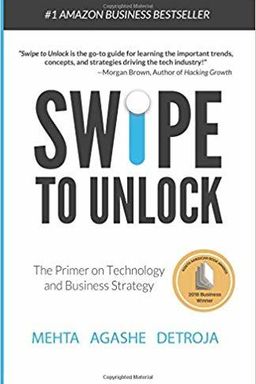
Swipe to Unlock cover

Swipe to Unlock

by Parth Detroja

Swipe to Unlock is your essential guide to the digital age, simplifying complex technology and business strategies. From internet mechanics to big data''s power, this book equips you with the insights needed to excel in today''s tech-driven world, regardless of your technical background.

Unlocking the Logic Behind Technology and Business

Have you ever scrolled through your phone, jumping between Spotify, Uber, or Instagram, and wondered how these seemingly simple apps actually work—or how they make money when most of them are free? In Swipe to Unlock, Neel Mehta, Aditya Agashe, and Parth Detroja argue that to truly thrive in today’s world, you must grasp not only how technology functions but also the strategic and economic logic that drives it. The authors—product managers from Google, Microsoft, and Facebook—contend that technology literacy has become as essential as reading or math. Understanding how digital systems, algorithms, and platforms operate is now the prerequisite for success in business, leadership, and even daily life.

The book reframes technology as something accessible—not an intimidating black box reserved for coders, but a toolset anyone can learn to navigate. Using real-world case studies—from Google’s search algorithm to BlackBerry’s downfall—the authors reveal the symbiotic relationship between engineering choices and business incentives. Each chapter starts with a relatable question—“Why does Spotify seem to know your taste?”, “Why are most apps free?”—and then dissects both the technological ‘how’ and the commercial ‘why.’ By the end, you’re not just decoding your favorite apps—you’re learning to think like a technologist.

From Curiosity to Fluency: Learning to ‘Think in Tech’

The authors’ mission is empowerment. They argue that anyone—student, manager, or entrepreneur—can learn to think technologically. This doesn’t mean learning to code; it means developing a working understanding of software, data, and the digital business models shaping our time. Much like how The Lean Startup by Eric Ries democratized entrepreneurship, Swipe to Unlock democratizes technical literacy. It turns buzzwords like API, SaaS, and cloud computing from jargon into simple, logical concepts tied to clear business motives.

Why Technology Understanding Matters Now

The authors remind you that technology is no longer a niche industry—it’s the foundation of every major one. They note that the world’s most valuable companies—Apple, Google, Microsoft, Amazon, and Meta—are all tech firms. Even traditional sectors, from medicine to farming, now rely on digital systems, automation, and AI. If you can’t interpret these forces, you’ll be like a businessperson in the 20th century who never learned accounting. So, the book’s call to action is clear: you must become fluent in the logic of modern technology because it’s redefining competition and careers.

The Framework of the Book

The authors divide their exploration into three tiers. The first explains the fundamentals—how software development, the internet, and app economics work. The second section highlights advanced technologies and infrastructures, such as cloud computing, big data, and cybersecurity. The final section addresses global and strategic issues, from business models and emerging markets to ethical questions about privacy, jobs, and policy. This layered approach mirrors how a product manager must think: start with the technology, connect it to a business, and then frame it in its global and societal environment.

A Case Study Approach to Modern Tech

What makes Swipe to Unlock stand out is its use of stories rather than theory. You don’t just learn that algorithms power personalization—you explore Spotify’s Discover Weekly in detail: how collaborative filtering uses billions of playlists to find your next favorite song, and how that feature keeps customers loyal, raising “switching costs.” When you learn about Google’s Android strategy, the authors explain how giving Android away for free was a masterstroke to dominate mobile search and ads. When they unpack Netflix’s success, they show how A/B testing—popularized by digital newsrooms like The Washington Post—turns tiny design changes into measurable engagement gains.

Why This Matters for You

The book isn’t just about trivia—it’s about empowerment in an economy where digital awareness defines opportunity. If you’re building products, leading teams, or navigating your career, understanding why Facebook tweaks its News Feed or how blockchain decentralizes transactions gives you leverage. Mehta, Agashe, and Detroja close with a challenge: like Steve Jobs said, “Everything around you... was made up by people no smarter than you.” Once you see the mechanisms and motives behind today’s technology, you can change it, improve it, or compete with it. That’s the mindset Swipe to Unlock wants you to adopt: curiosity backed by comprehension, and comprehension leading to creation.


How Software Shapes the World

Software, the authors explain, is the invisible architecture of modern life. Every app—whether Facebook, Excel, or Netflix—begins as a set of digital instructions, much like a recipe. Once you grasp the key components of software systems, you start seeing the logic that powers everything from your search results to predictive policing algorithms.

Google Search: The Algorithm That Organized the Internet

When you search Google, you’re not scanning the internet directly. Instead, Google indexes the web through automated crawlers and ranks results using PageRank. This innovation, developed by founders Larry Page and Sergey Brin, transformed online discovery by measuring importance based on links from other pages. Crucially, quality links mattered more than quantity—similar to measuring influence by who cites you, not how many followers you have. The result is a smarter, faster, and seemingly omniscient search engine that reshaped access to information.

Spotify’s Algorithms and the Personalization Edge

Spotify’s Discover Weekly illustrates how machine learning personalizes experiences to keep users hooked. The platform uses collaborative filtering: it compares your listening patterns with millions of others to infer music you’ll love. This isn’t just user delight—it’s competitive strategy. The more you listen, the better Spotify’s predictions become and the harder it is for you to switch services. This concept of switching costs—the pain of leaving an ecosystem—is fundamental in technology strategy. (In Hooked, Nir Eyal describes this as the habit loop companies design to retain users.)

Facebook’s News Feed: Engagement as a Business Model

Facebook’s News Feed algorithm reflects the dark side of algorithmic personalization. Designed to maximize engagement—likes, shares, and comments—it learns what keeps you scrolling. But in doing so, it can amplify fake news and emotional polarization. The authors explain how “engagement” became the default metric for growth, revealing how business incentives shape technical design. In response, Facebook began introducing features like “meaningful social interaction” metrics and user flagging systems, blending human oversight with automated learning.

The Lesson

Algorithms reflect values. To understand software, you must look not just at its function but at its incentives. Every algorithm solves a technical problem but creates an ethical one.

A/B Testing: Data-Driven Decisions Everywhere

The authors showcase A/B testing through The Washington Post’s “Bandito” tool. By serving two versions of a headline and tracking click-through rates, the paper learned which headlines maximized engagement. What began in journalism now drives every digital experience—from sign-up buttons to Netflix’s thumbnails. A/B testing distills innovation into a statistical question: “Does this change measurably improve a key metric?” It’s the scientific method applied to business.

Ultimately, software development is an interplay of logic, psychology, and data. You can think of code as a skeleton, machine learning as its brain, and user interaction data as the nervous system that keeps evolving the product. Once you see this pattern, the digital world stops being magical—and starts looking like an intricate, testable system you can learn to influence.


Operating Systems and the Battle for the Future

Few business stories illustrate technological disruption better than the fall of BlackBerry and the rise of iOS and Android. The authors use these examples to show that operating systems—the software that runs all other apps—are not just technical foundations but strategic battlegrounds. Every successful OS combines technical innovation with user insight and ecosystem control.

BlackBerry’s Collapse: Missing the Consumer Wave

At its height, BlackBerry held 20% of global market share, beloved by executives and governments for its physical keyboard and secure email. But the company viewed smartphones solely as productivity tools. Apple’s 2007 iPhone reframed them as lifestyle devices—touchscreen entertainment hubs for everyone. BlackBerry’s failure to recognize this cultural shift, coupled with its weak app ecosystem, sealed its fate. The company fell into what the authors call the “chicken-and-egg problem”—no users meant no developers, and no developers meant no users.

Google’s Genius: Android as a Free Trojan Horse

Why did Google give Android away for free? The answer is strategic leverage. By offering an open-source mobile OS to manufacturers like Samsung and LG, Google ensured widespread adoption while embedding Google apps—Search, Maps, YouTube—by default. Every Android phone became a data-generating gateway for Google’s ad empire. Even though the software was ‘free,’ Android drives billions in indirect revenue through advertising and Play Store commissions. It’s a case study in platform economics: give away the product, sell the ecosystem.

Open Source and the Power of Ecosystems

Android’s open-source nature, built on Linux, let developers around the world customize it into spin-offs like LineageOS. This openness fosters innovation while locking users deeper into Google’s influence. Contrast this with Apple’s tightly controlled, premium ecosystem. Both models work, but through opposing philosophies: openness for reach, control for quality. As the authors point out, Google’s open strategy maximizes user acquisition, while Apple’s closed environment maximizes profit per user. Together, they reveal that the OS wars are ultimately ecosystem wars—fights for network dominance, not hardware specs.

The lesson is both technical and strategic: whoever controls the operating system doesn’t just run apps—they run the marketplace, the culture, and the data that define digital life.


Why Apps Are Free—and Businesses Still Win

Imagine walking into a store where everything costs $0. That’s what the app marketplace feels like. From Instagram to Tinder, most of your favorite apps are free to download but are worth billions. The authors unpack how companies survive—and thrive—through clever monetization strategies that shift value from users to data and networks.

The Freemium Equation

The “freemium” model—free access with paid upgrades—drives much of the app economy. Candy Crush gives free play but sells power-ups; Tinder limits daily swipes unless you upgrade; Spotify offers ad-free experiences for Premium listeners. These upgrades target a small fraction of users—the so-called “whales”—who generate most of the revenue. In economic terms, it’s price discrimination optimized by data analytics.

Ads, Data, and the True Currency of the Internet

If you’re not paying, you’re the product. Facebook and Google don’t need your subscription—they need your attention. Using targeting powered by massive user datasets, they sell advertisers precision access to behavior. Facebook’s ad auctions balance price (Cost-Per-Click) and relevance (engagement potential), creating a marketplace where every scroll is monetized. As the authors note, this is why data privacy debates are inseparable from business models; your data is the revenue stream.

Native Advertising and the Blurring of Truth

Beyond banners, “native ads”—sponsored content blending with journalism—keep media alive in the digital era. Outlets like The New York Times or BuzzFeed rely heavily on these to survive collapsing ad margins. Yet this convergence of marketing and media poses ethical risks, blurring lines between information and influence. Understanding these shifts isn’t just business knowledge—it’s media literacy for the 21st century.

The Marketplace Model: Airbnb, Uber, and Beyond

Platforms like Airbnb or Uber operate as digital marketplaces: they connect buyers and sellers and take a cut from each transaction. This “two-sided network effect” magnifies growth—the more riders join Uber, the more drivers sign up, and vice versa. Developers win through scale, not margin. The authors show that even free services like Robinhood, the commission-free trading app, profit through interest and premium tiers. In today’s app economy, ‘free’ is rarely charity—it’s strategy.

Key Insight

Every free app monetizes something—time, data, or network power. Understanding which commodity a business sells tells you where its true value lies.


The Cloud, the Data, and the Future of Work

Behind every modern app or website lies an invisible infrastructure called the cloud. The authors demystify this often-misunderstood term: instead of data floating ethereally, “the cloud” refers to physical data centers hosted by Amazon (AWS), Microsoft (Azure), or Google Cloud. These rent computing power and storage as utilities—replacing the need for local infrastructure.

Cloud Computing: Renting the Internet’s Brain

The analogy is simple: in the past, businesses owned servers like they owned factories. Now, they rent them by the hour. This shift, called Infrastructure-as-a-Service (IaaS), has fueled an explosion of innovation: startups can scale globally without buying hardware. Meanwhile, large enterprises reduce costs and improve reliability through redundancy—distributing databases across multiple data centers to prevent failure.

Big Data and Predictive Insights

“Big data” isn’t just about size—it’s about extracting value. Netflix correlates billions of viewing interactions to personalize recommendations, while Walmart uses data analytics for supply-chain optimization. As the authors note, this transforms management from intuition-driven to evidence-driven decision-making. Yet, they also warn that big data’s predictive powers raise ethical questions about privacy, fairness, and surveillance capitalism (echoing concerns from scholars like Shoshana Zuboff).

Automation, AI, and the Jobs Question

Artificial intelligence may be the next frontier. The book explores how machine learning automates not just physical labor but cognitive tasks—financial modeling, diagnosis, even hiring. The authors challenge the reader to view AI not as an enemy but as augmentation. Still, they acknowledge its darker side: job displacement and the erosion of human judgment. Like industrialization before it, today’s data revolution demands new skills and ethics.

In short, the cloud and big data represent more than digital storage—they’re transforming how economies scale and how humans work. The skill that matters most now isn’t coding but conceptual translation: the ability to bridge data, design, and decision.


The Geopolitics of Emerging and Digital Markets

Technology isn’t evenly distributed. The authors argue that emerging markets—from India to sub-Saharan Africa—are laboratories for innovation precisely because they leapfrog legacy infrastructure. Their stories of mobile money and lightweight operating systems reveal how constraints inspire creativity.

India’s Jio Revolution and KaiOS

India’s telecom giant Reliance Jio democratized internet access with free calls and dirt-cheap data. But millions lacked smartphones. Enter KaiOS—a lightweight system adapted from Mozilla’s Firefox OS that brings apps like YouTube and WhatsApp to $20 feature phones. The result? Over 85 million new internet users. Here, innovation wasn’t about sophistication—it was about accessibility. (This parallels how Kenya’s M-Pesa transformed mobile payments by turning simple SMS systems into financial tools.)

China and the Platform State

Meanwhile, China’s tech giant ecosystem—Alibaba, Tencent, and Huawei—shows how state support and closed networks can produce global alternatives to Western dominance. WeChat’s super-app model combines payments, social media, and e-commerce into one interface, a digital infrastructure that Western companies still struggle to replicate. The authors highlight this as both innovation and warning: when convenience merges with surveillance, technology becomes power policy.

The Global Digital Divide Narrows—and Shifts

Emerging markets defy the assumption that innovation flows only from Silicon Valley. As network effects globalize, markets like Indonesia and Nigeria are shaping the next generation of scalable solutions—from ride-sharing to fintech—custom-fitted to local conditions. The authors invite readers to see technology as a global story, where necessity often breeds the most disruptive ideas.

The message is hopeful: by understanding how economic and infrastructural limits drive unique solutions, you see global tech not as hierarchy but as an ecosystem of adaptive problem-solvers.


Ethics, Policy, and the New Digital Citizens

Technology doesn’t just change industries—it rewrites moral and political rules. In their final chapters, the authors step into debates about privacy, free speech, and accountability, arguing that understanding technology must go hand in hand with understanding its societal impact.

Privacy and Data Regulation

Data breaches at Equifax or Facebook’s Cambridge Analytica scandal underscored the fragility of online trust. The authors highlight the EU’s General Data Protection Regulation (GDPR) as the first serious attempt to legislate digital ethics. Its “right to be forgotten” and consent requirements reframe privacy as a human right, not a consumer choice. Yet, they warn that compliance costs may cement tech monopolies by making global startups harder to launch.

Net Neutrality and Digital Access

The fight over net neutrality—led in the US by FCC Chairman Ajit Pai—illustrates how policy decisions shape innovation itself. Without neutrality, internet providers could privilege big platforms (like Netflix or Google) over newcomers, distorting competition. The authors place this debate within a broader ethical question: should the internet be a public utility or a private marketplace?

The Human Role in a Machine World

As algorithms decide credit, hiring, and votes, “tech literacy” becomes civic literacy. Learning how code makes decisions isn’t just useful for a career—it’s vital for citizenship. The authors echo Steve Jobs’ call to reality-shapers: once you realize the world’s rules are human-made, you gain agency to rewrite them. Whether you’re a policymaker, an entrepreneur, or simply a digital citizen, the challenge is the same: to use technology consciously rather than passively.

In this sense, Swipe to Unlock isn’t just a primer on business and technology—it’s a manifesto for technological agency. The future belongs to those who not only use technology well but understand the power structures behind it.

Dig Deeper

Get personalized prompts to apply these lessons to your life and deepen your understanding.

Go Deeper

Get the Full Experience

Download Insight Books for AI-powered reflections, quizzes, and more.