
Idea 1
The Feynman Way of Thinking
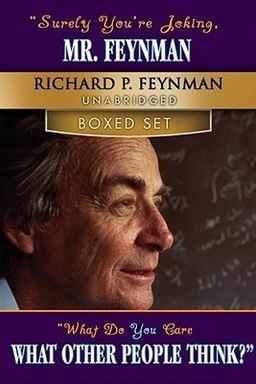
How can curiosity, play, and integrity produce extraordinary insight? In Surely You're Joking, Mr. Feynman! and related memoirs, physicist Richard Feynman argues that real learning and discovery come not from instructions or status, but from hands-on experimentation, honest questioning, and the refusal to fool yourself. His life stories, from fixing radios as a boy to safecracking at Los Alamos, turn scientific thinking into a universal method for living.
Curiosity as the engine of genius
Feynman's childhood in Far Rockaway begins with tinkering: light bulbs, batteries, tin‑foil fuses, and spark coils. He treats household materials as experimental systems, learning how circuits fail, how resistance changes with heat, and how real devices differ from textbook predictions. This relentless curiosity lays the foundation for his adult problem‑solving style. He doesn’t just study; he plays until he understands. The home lab becomes an apprenticeship in how nature responds to questions.
Persistence and the puzzle drive
From those experiments grows a trait he calls his “puzzle drive.” Once a mystery attracts him, he cannot let it go—whether it’s a faulty resistor, a safe combination, or a parity contradiction in weak interactions. You discover that persistence is not romantic stubbornness but practical training. At Metaplast, he solves a plating problem by substituting formaldehyde for glucose; in radio repairs, he inspects every possible failure until the sound clears. Feynman shows that staying with difficult puzzles builds the intuition that shortcuts later results.
Learning through doing and alternative tools
As he matures, Feynman identifies what makes a thinker flexible: a varied toolkit. At Princeton he loves the messy cyclotron lab because he can touch things and experiment instantly. Mathematically, he uses an unusual trick—differentiating under the integral sign—learned from Advanced Calculus by Woods, which later becomes a trademark method. He insists that people fail not for lack of intelligence but for blindness to other tools. (In modern terms, this anticipates “cognitive diversity” as valued in problem-solving networks.)
Anti‑pretension and playful skepticism
Feynman’s humor is not incidental; it is diagnostic. From teasing Einstein’s assistant to joking at Dean Eisenhart's tea, he exposes superficial knowledge and artificial formality. When he tricks classmates with a fake “French curve discovery,” we understand that mocking false authority is his way of defending authentic inquiry. He honors practical craft—electricians, painters, machinists—over social status. The moral is clear: question rituals, respect competence.
From introspection to outward experiment
Even in dreams and thought experiments, Feynman applies the scientific method. He designs an introspective study of falling asleep, records data, and recognizes the observer effect—the act of observing modifies the process. He hypothesizes an “interpretation department” of the mind that constructs narratives from sensory fragments. This inner lab mirrors his outer one: curiosity is the same whether directed at electrons or consciousness.
Action, secrecy, and scale at Los Alamos
The Manhattan Project magnifies his traits. In Los Alamos Feynman translates complex physics into practical routines for teams running IBM tabulators. By explaining meaning, he motivates operators to invent faster methods. He challenges sloppy security protocols by cracking safes and exposes weak locks not out of rebellion but to improve real safety. His Oak Ridge audits save lives by catching water‑moderation risks. The lesson: clarity and integrity scale better than bureaucracy.
Learning that counts: concrete over rote
In Brazil he attacks rote education. Students recite definitions of Brewster’s Angle yet cannot identify polarization in sunlight. Textbooks fake data to appear noisy, misleading students about real measurement. Feynman’s teaching method forces contact with the world—you cannot say “moment of inertia” without explaining a door’s swing. For him, science equals connection between words and experience.
Play beyond physics: drums, art, and culture
Feynman’s curiosity spills into samba and drawing. In Copacabana he plays frigideira in Carnaval; at home in Pasadena he takes art lessons, sells sketches under “Ofey,” and gains new ways of seeing. These hobbies reaffirm his method—practice, feedback, iteration—and extend it socially. Later, his travels in Japan and Brazil teach humility in language: broken Portuguese communicates better than fluent English to struggling students. The same principle holds—meet people where they are.
Integrity and the 7% solution
Finally, Feynman’s cardinal rule—“You must not fool yourself, and you are the easiest person to fool”—anchors both his theory and his ethics. From the cargo cult analogy to parity violation discoveries, he insists that honesty and testable models define real science. The difference between faith and knowledge lies in the willingness to expose your own mistakes. Like the 7% Solution story, small errors can lead to profound correction if you keep truth above ego.
Across these chapters, you see a unified approach to thinking: learn through direct contact, persist through puzzles, keep playful skepticism alive, and remain brutally honest about uncertainty. Whether you are soldering wires, observing dreams, drumming in Rio, or teaching students in Portuguese, the Feynman way insists that curiosity only matters if it meets reality head‑on. That mindset transforms everyday experiments—and life itself—into genuine science.