
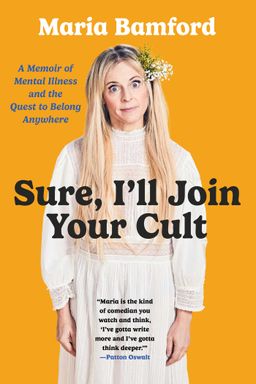
Sure, I'll Join Your Cult cover

Sure, I'll Join Your Cult

by Maria Bamford

The comedian details her encounters with show business and anonymous fellowship groups.

Belonging Through "Cults" and Comedy

Have you ever felt so hungry to belong that you’d say yes to almost any room that promised rules, rituals, or results? In Sure, I’ll Join Your Cult, comedian Maria Bamford argues that our craving for structure and acceptance—especially when we’re anxious, depressed, or simply human—is not a character flaw. It’s a survival strategy. She reframes “cults” broadly as any rigid community with rituals and rules: family systems, twelve-step programs, corporate brands, productivity movements, even music lessons. Bamford contends that her lifelong pattern—joining, learning, laughing, and then gently dissenting—became both her coping strategy and her art. But to make peace with that pattern, you have to face the messy parentage of it: intrusive-thought OCD, eating disorders, bipolar II, a dazzling and demanding mother, and the merciless audition-filter of show business.

In this guide, you’ll discover how Bamford turns “cults” into containers—places that hold you when you’re wobbly—while keeping your mind alert to their limits. You’ll see how the cult of family shaped her drive for applause and approval; how naming diagnoses (“Diagnos-YES!”) reduced shame; and how DIY healthcare in church basements (OA, DA, SLAA, RCA) often outperformed official systems. You’ll then learn how ambition and ethics collided in a Target ad campaign, the psychiatric collapse that followed, and the practical tools (CBT exposures, meds, boundaries at work) that helped her return. Finally, you’ll learn how love, humor, and limits—especially in marriage—let you keep going without pretending it’s easy.

Why call everything a “cult”?

Bamford opens with a story: she’s in a hotel ballroom getting pitched a $1,500 weekend of instant self-actualization (“Heartbouncers”), nearly signs, then sprints out and buys hot peanuts at 7‑Eleven. That pattern—magnetized by promises, skeptical of costs, clinging to jokes—frames her thesis: you’ll do almost anything to feel okay. And sometimes the very systems you join become bridges: to work, to community, to a small, consistent plan for getting through Thursday. The joke is kind; it’s also a warning. Belonging helps, but no group replaces medication or accountability. And no savior arrives—except the one who fills pillboxes, calls their sponsor, and learns people’s names at Café de Leche.

The radical power of disclosure

Bamford’s comedy career is basically a spiritual practice of oversharing. She turns private terror (e.g., harm- and pedophilia-themed intrusive thoughts) into public language so others feel less alone. She notes the lineage of artists who helped her—Jonathan Winters, Richard Lewis, Kay Redfield Jamison—and offers her own data (including finances) because secrecy keeps people sick. Her north star: medicine is the best medicine, and honesty is cheaper than PR. The joke works because it serves someone; the service works because it’s funny enough to hear.

A scrapbook, not a straight line

If you expect a trauma-to-triumph arc, Bamford warns: this is a series of “emotional sudoku puzzles” she sometimes abandons for a fresh grid. That formal honesty matters because it mirrors recovery. You don’t graduate from OCD, grief, or money issues. You apprentice to them. Bamford’s “memoir of mentals” is therefore modular: family cult; food cult (Richard Simmons to OA); business cult (Debtors Anonymous); fame cult (The Artist’s Way; Target; Lady Dynamite); and the mental health industrial complex (psych wards with drained pools and sheet cake). Each module carries recipes (funny, feral), checklists, and real numbers (her book advance, tour income, charity percentage), so you can feel what “living inside the bit” actually costs.

Why this matters for you

You might not perform for Netflix or call Delta at a nervous system’s notice, but you probably do what Bamford does: cobble together a life from unequal parts medicine, community, work, and one person who knows the worst thing about you and stays. The book’s core claim—that rules and rooms can help until they don’t—helps you hold two truths: you need people and you need boundaries. Her approach is DIY science (CBT, exposure, PRGs) plus DIY church (twelve steps) plus DIY labor rights (uncompromising 12‑hour turnarounds on set). The result is not bliss; it’s sustainability.

Throughline

“You just keep going, kid.” (Advice Jonathan Winters gave Bamford; she now pays it forward.)

What you’ll learn in this summary

- How the “cult of family” forged Bamford’s showbiz ethic, money anxiety, and need to please.
- Why naming disorders (intrusive-thought OCD, bipolar II) shrinks shame—and precisely how exposure therapy works when the thought content is taboo.
- How twelve-step rooms became a parallel healthcare system: OA for binging, DA for solvency, SLAA and RCA for intimacy—plus what she rejects in cultish dogma.
- What happens when ethics, money, and identity collide (Target ads), and how a breakdown unspools across hospitals, meds, and work.
- How she redesigned work (offer-only auditions, on-set sleep tent) and love (anger-management, Gottman tools, safety plans) to keep showing up, shaky but present.

Taken together, these ideas offer you a stigma-dissolving, brass-tacks manual for being a person with a brain who needs help—one who still likes jokes, receipts, and the occasional gas-station banquet. There’s no conversion, only maintenance. And maintenance counts.


The Family Cult: Love, Rules, Applause

Bamford calls her first and most formative “cult” the family—led, lovingly and forcefully, by her mother, Marilyn. If you grew up in a house where attention was currency and taste doubled as theology, you’ll recognize this tribe. It’s funny; it’s exacting; it’s the taproot of both ambition and anxiety.

Marilyn, the charismatic guru

Marilyn is a social energizer: book groups, Bible study, WeightWatchers, deacon duties, and a phone glued to her ear. She is also a brand cultist (“Nordstrom good; Ann Taylor not good; Delta yes; American no”). What looks superficial is actually a sorting ritual: naming something “GOOD” declares it known, safe, and therefore lovable. When she’s hospitalized with terminal cancer, she still gathers biographies from every nurse within five minutes. That interpersonal mastery shapes Bamford’s work—comedy as intimacy machine—and her money anxiety (pay everyone; bring a gift; send a thank-you; be excellent).

But devotion has a price. Marilyn’s affection can feel conditional: “Smiles, ladies, smiles!” She triages beauty and cleanliness (“Your skin has oils!”) and sometimes confuses self-acceptance with goal weight. Bamford learns to chase maternal sparkle by performing—first on a Suzuki stage, then a comedy club. The applause fixes a longing; it also hardwires people-pleasing. (Compare: Nora Ephron’s essays on her mother’s show-must-go-on mantras.)

Joel, the loose cannon and kind man

Her father, Joel, is a paradox—community-minded physician who also parks in the red and eats Circus Peanuts mid-errand. He’s beloved and baffling; he invites you over and then negs the invitation (“Dealer’s choice!”). From him, Bamford inherits a tic: simultaneous reach and retreat. She’ll hand you a gift and shout, “Feel free to regift!” He’s also the source of the family’s quiet melancholy and their black-belt in passive-aggression. Yet in grief after Marilyn’s death, Joel becomes a surprising model—baking bread for neighbors, seeking outpatient care for depression at 82, and learning to date again with endearing honesty. He embodies the book’s ethic: you can be complicated and still keep going.

Sarah, the brilliant sibling mirror

Bamford’s sister, Sarah—doctor turned author/coach/shaman—is funnier, thinner, more organized (Maria’s words), and the inadvertent seed of Bamford’s OCD content. Childhood teasing (titty-twisters; “Fred”) sprouts into intrusive, taboo thoughts about harming women—thoughts Bamford mistakes for truth and hides for decades. As adults, their differences become weather systems: Maria’s atheism vs. Sarah’s spirituality; Maria’s stage bits about family vs. Sarah’s desire for privacy in a small town. The dynamic is tender, competitive, and deeply loyal—she visits Maria in the psych ward; Maria devours her books selectively (not the totem talk; absolutely the hemorrhoid fiasco). The lesson lands: the facts are ordinary; the feelings are tsunamis. Know the difference.

How family primes your “cult” appetite

In a Bamford household, you learn that being delightful secures love and that rules (a spotless quilt, the right bread) organize chaos. No wonder strict systems feel like home later: Suzuki’s militancy, Dale Carnegie’s scripts, twelve-step schedules, even showbiz hierarchies. These rooms are predictable; they also give you an enemy to push against without leaving. Bamford plays the perfect cult member: devoted enough to benefit, disobedient enough to stay herself.

Field Test

Ask: Which rules at home felt like religion? Which rituals delivered love? That’s your “first cult.”

Why this helps you

If you can name your family’s operating system, you can debug its adult echoes. Do you overperform for a “good girl” badge? Do you hoard brands-as-belonging? Or, like Joel, do you create connection and chaos in a single text? Bamford doesn’t judge; she annotates. That annotation—humor as marginalia—lets you keep the parts that nourish (Marilyn’s connection superpowers; Joel’s service; Sarah’s care) and retire the rest. That’s growth without disowning your people.


Diagnos-YES: Naming the Mentals

Bamford’s fiercest claim is diagnostic: when you name what’s happening in your brain, shame shrinks and choices multiply. She names three big dragons—intrusive-thought OCD, eating disorders morphing into bulimia-by-exercise, and bipolar II—and shows you exactly how she fought them: exposures, meds, and persistent, slightly ridiculous logistics.

Intrusive-thought OCD, explained and de-fanged

At 9–11, Bamford begins having violent and sexual intrusions (harm OCD): flashes of giving her mom or sister a “titty twister,” then escalating fantasies she detests. She counters with compulsions—sitting on her hands, butt-clenching, eyelid-vacuuming vigilance—until exhaustion. When she finally tells her mom, she’s misread as questioning her sexuality (“It’s okay if you’re gay”). Shame cements. Decades later, she names it to a friend and then to a therapist, Marketa Velehradska, LCSW, who publicly affirms in the book: these are common, tormenting, ego-dystonic thoughts, not secret desires. That sentence is a lifeline for any reader whose mind shows horror films against their will. (Compare: Jon Hershfield and Tom Corboy’s The Mindfulness Workbook for OCD.)

Exposure therapy that actually worked

Her pivotal intervention comes from Dr. Rodney Boone (CBT Center of Southern California). He has her write the worst-case script in present tense—vividly monstrous—and record it. She listens for an hour daily, white-knuckling until anxiety peaks and falls. Then she schedules high-trigger activities (e.g., two-hour one-on-one with a friend) while holding the hot potato. That’s exposure with response prevention (ERP): no ritualizing, no avoidance. It’s grotesque content managed by neutral process. And it gives her life back. If your intrusions are taboo, note how much of her healing depends on a clinician who has seen it all and doesn’t flinch.

Eating disorders: from Richard Simmons to OA

At nine, she discovers Richard Simmons’s Never-Say-Diet (funny, energetic, restrictive) and drops weight with ankle weights and measuring cereal. Cue the cascade: starvation → binge → punish with exercise and fasting (bulimia without purging). Her mother lives in the Temple of Thin; her aunt vomits. Bamford lands in Overeaters Anonymous, which helps at first (structure, slogans, phone calls), then turns brittle (food as morality). She later adds outpatient treatment matching modern ED science: all foods fit, abstinence mindset can backfire. She can still weigh herself and love daily sundaes—recovery here is weird, human, and ongoing. (Context: OA’s abstinence model contrasts with Health at Every Size and CBT‑E approaches.)

Bipolar II, meds, and the cost of fog

The breakdown arrives after ethical whiplash (Target ads), grief (accidentally causing her pug Blossom’s death), overwork, and probably hypomania. She cycles through psych wards with drained pools and sheet cake, meets Dr. Pilz (who googles her Conan set mid-intake—do not recommend), rejects Depakote out of weight-gain fear, and tries Lamictal (speech/cognition slow). The eventual cocktail—Depakote 1000 mg, Seroquel 50 mg, Prozac 40 mg—stabilizes her but sedates. On Lady Dynamite, she enforces a 12‑hour turnaround and naps in a set-side tent between takes. This is what accommodation looks like when “the art is about the illness.” She says it flatly: medicine is the best medicine; side effects are real; keep tinkering, and don’t do it alone.

Practical Scaffold

Name the thing → Find a bored expert → Do exposures as written → Adjust meds → Build boring guardrails (sleep, money, work boundaries) → Repeat.

Why this helps you

Bamford’s map is stark but navigable. If you fear your thoughts, define OCD; if you sabotage your body for control, don’t fight alone; if your moods spin, prioritize pharmacology over pride. Most of all, treat “I should be better by now” as a prank from the illness itself. This is maintenance work. Your job is to keep the machine humming well enough to get to the coffee shop, learn the barista’s pet’s name, and text your sponsor. That’s not settling; that’s staying.


Twelve-Step Rooms as DIY Healthcare

Bamford doesn’t romanticize twelve-step programs; she treats them like a pragmatic, imperfect safety net—often faster and kinder than formal care. OA helped her stop binge–restrict cycles. Debtors Anonymous saved her from medical debt and career paralysis. SLAA curbed chaotic hookups. Recovering Couples Anonymous gives her and Scott new scripts when anger or despair starts running the show. You don’t have to accept the theology to benefit from the choreography.

Debtors Anonymous: solvency is a group project

In LA, broke, mugged, allergic to her antibiotic, and living amid roaches, she owes $5K to four creditors. DA gives her a sponsor (Mindy), a Pressure Relief Group (PRG), and marching orders: daily calls to temp agencies at opening bell (“I’m available!”), honest letters to creditors (“no phone calls; $2/month until I can do more”), and a “B job” while pursuing the “A job” (creative work). She moves into a room in Glendale at $300/month on a payment plan, gets receptionist and exec‑asst roles at Nickelodeon, then voice work. The alchemy is simple: peers who laugh at your avoidant drama; tiny behaviors repeated long enough to rebrand you reliable; and numbers you can say out loud without vomiting. (Compare to Vicki Robin & Joe Dominguez’s Your Money or Your Life.)

SLAA & RCA: desire, intimacy, and boundaries

After a grim one-night stand (“dirty talk” as alien invasion), she tries SLAA. The “dating plan” slows her roll: six dates in six weeks before sex and an explicit exclusivity check-in. Results: one year with a New Zealand clown (he forgot to pick her up at the airport); eleven months with Andy (paranoia, anger, also laughs); eventual marriage to Scott, whom she meets online after the psych ward. With Scott, RCA and Gottman tools teach micro moves (ditch the “harsh startup,” watch for the Four Horsemen), while an anger-management course gives them de-escalation scaffolding. None of this makes them serene. It makes them resourced.

OA and critique: when abstinence becomes a cage

OA’s early structure helps her stop binging; later, the abstinence frame (no sugar/flour) collides with outpatient ED science. A sponsor tells her “I will die before I eat sugar”; her treatment team asks her to eat a candy bar. She chooses the latter and steps back from OA dogma while still appreciating its phone trees and slogans. That’s a Bamford specialty: take what you want, leave the rest, keep the people.

What these rooms do better than clinics

Speed, access, and camaraderie. You can walk into a church basement tonight and be lovable within five minutes. You can get a PRG on your calendar this week. You can tell fifty strangers you parked in front of a hydrant at LAX for ten days and hear peals of recognition instead of scolding. These rooms are laboratories for behavior change and oxygen for shame-choked truth. They are not medicine; they are medicine-adjacent.

Bamford’s Working Formula

“Half-assed makes cash.” Tiny, consistent, socially reinforced actions—call the agency, send the creditor $2, nap in the set tent—beat grand transformations that never start.

Why this helps you

If therapy or psychiatry feels out of reach or too slow, twelve-step rooms give you scripts, bodies, and a clock. They also teach a professional skill Bamford leans on in Hollywood: offer-only boundaries. Because she had DA, she could say no to unpaid auditions and still pay her assistant. Solvency is creative freedom’s quiet twin. You don’t have to chant; you do have to show up and stack chairs.


Ambition, Ethics, and the Breakdown

The book’s middle is an ethics case study that turns into a psychiatric collapse. It starts with The Artist’s Way and a Star Trek mall show; levels up with a beloved Target holiday campaign; and detonates when Bamford’s values, grief, and workload collide. The lesson isn’t “don’t sell out.” It’s that your nervous system is one of your stakeholders—and it always collects.

From vision boards to Bajor

Working The Artist’s Way solo, Bamford writes a one-woman show, adopts the affirmation “I’m one of the top ten comedians in the United States,” and says yes to odd gigs. Paramount hires her as a Bajoran officer at the Mall of America’s Star Trek Experience, where she’s paid well to banter as a space clown. It’s a critical lesson: her “B job” can be creative if she accepts the craft (patter, photo ups) and her limits (she’s shy; she didn’t do Star Trek homework). The joke is a job; the job is data.

The Target conundrum

Her Target character (red-and-white retail zealot) becomes beloved. Money improves, but audiences now arrive expecting the ad persona, not the depression ballet. Meanwhile, Target employees share union-busting complaints; friends send her a company anti-union training video starring SAG actors (her union). During a nonunion web shoot, she’s forced into a snowsuit in a 115°F house with no AC, eats twelve hours of “funnier, faster,” and breaks down crying. She asks a priest, a professor, and the New York Times Ethicist whether she should keep doing Target. The Ethicist says no. She’s never asked back. Cue identity whiplash.

Grief as accelerant

Amid the moral crisis, she makes a quick, bad decision to remove the dog-door ramp to prevent her blind pug, Bert, from raiding the trash—forgetting that Blossom (older, inside) might exit, fall, and fatally injure herself. Bamford returns from a voiceover audition to find Blossom dead at the foot of the drop. That unthinkable accident obliterates her stabilizers. She keeps booking jobs, throws a five-hundred-person Christmas party (everyone in her Gmail gets invited), and sprints into a breakdown.

Psych wards and the real work

She checks herself into Las Encinas (pretty website; locked pool; drained programming) and then Glendale Adventist (purple van, sheet cake, “life is suffering” lectures). She refuses Depakote until a brain-scan sales pitch returns the same recommendation her doctor made at the start. Once she agrees—Depakote plus Seroquel plus Prozac—stability returns incrementally. The moral: you can’t thought-lead your way out of a neurochemical wildfire. Meds first. Paperwork later.

Redesigning the work to fit the brain

When Mitch Hurwitz builds Lady Dynamite around her life, Bamford structures production around her nervous system: a rigid 12‑hour turnaround and a black pop‑up tent on set for naps. Crew members grumble (“Teamsters get eight!” “Hair has brain cancer!”). She holds the line. This is disability accommodation in practice, not theory. The show gets two seasons. She’s grateful—and relieved when it ends. Her “offer-only” audition stand becomes a long-term boundary: she’d rather clean a kitchen than drive four hours for a $40 prestige set.

Receipts, Literally

She prints show-by-show P&L: $7,000 gross; airfare $465; opener $1,200; agent 10%; manager 7.5%; net $3,490 before taxes. Also, charity: 11% of net—“exactly 1% more than the Christians.” Money clarity quiets anxiety and gives you leverage to say no.

Why this helps you

Ambition without ethics corrodes; ethics without capacity collapses. Bamford’s path shows you how to balance the triangle: values (no scabbing on unions), viability (pay the opener well, charge what you’re worth), and vessel (sleep, meds, turnaround). If one side breaks, the structure falls. Your calendar is a moral document—so is your pill organizer.


Love, Limits, and Staying Alive

The final movement is domestic and existential: marriage as a gentle two-person cult; boundaries as love language; suicidal thinking as a frequent, unglamorous visitor; and help as anything that keeps you here one more day—even if it’s gas-station snacks and a phone call to a hotel front desk.

Marriage as a recovery container

Bamford meets painter Scott Marvel Cassidy after the hospital. On date two, he tells her everything—trauma and all. It’s a lot; it’s also honest. They adopt Gottman tools (watch the “harsh startup”; avoid the Four Horsemen) and join Recovering Couples Anonymous, plus a court-approved anger-management course. Their fights don’t disappear; the rupture–repair cycle shortens. During Covid and after Marilyn’s death, both have rough days that edge toward self-harm planning; they laugh grimly (“You should have asked me how to OD—alcohol plus Xanax”) and sign a fridge safety plan. Some days, the win is a handshake agreement: “Not today.”

Boundaries that look like love

With family in Duluth, Scott’s PTSD surges; Maria’s urge is to “coach”: take the car, draw in the woods. He needs to not be there. He goes home to the dogs; his mood lifts. They name that truth without assigning blame. Back in LA, she underlines consent and capacity in work, too: a 12‑hour turnaround isn’t diva behavior—it’s the cost of showing up tomorrow. When a room or a book (“Ten Days to Self-Esteem”) doesn’t fit her brain, she returns it to a metaphorical Little Free Library. This is the anti-cult muscle: choose your rituals; decline the rest.

The suicide chapter that refuses platitudes

Bamford despises tidy “hang in there” posts. She affirms dignity for those who die by suicide (including friends), refuses to shame attempts, and offers granular, sometimes absurd, crisis tactics: text 988; if that fails, call anyone who answers—AT&T, Domino’s, an antiabortion clinic (“Have someone prove life is a gift”); ask the junior high receptionist for the nurse; beg the Ritz-Carlton concierge for kindness; get to an ER with an advocate. It’s not romantic; it’s scavenger survival. Her point: lower the bar in crisis. Shitty-ass help counts. (Context: this is harm reduction applied to psychiatry, akin to Anne Lamott’s “bird by bird”—one scrap at a time.)

Humor as a respiratory therapy

Recipes punctuate the book like coping mechanisms: “Gas Station Benefit Banquet,” “Mug Muffin for Maximum Binge Eating,” “Psych Ward Graham Crackers.” They aren’t flippant; they’re dissociative enough to get a spoon past your lips when nothing tastes like tomorrow. The more she jokes about money (openers get $1,200; 11% to charity), the more you trust the parts she can’t joke about. The technique is classic Bamford: defang fear with specificity; pair it with logistics; add a pug anecdote.

Minimum Viable Staying

One lifeline, one joke, one nap, one message to a stranger who likes your work. That’s not a cure. It’s a bridge to the next hour.

Why this helps you

You don’t need a perfect system; you need a workable one. Bamford’s life with Scott shows that love isn’t the absence of symptoms—it’s shared problem-solving with snacks. Her refusal of platitudes gives you permission to build a weird, bespoke crisis kit. And her insistence on limits—at home, on set, in twelve-step traditions—models a healthier belonging: membership with a door you can use.

Dig Deeper

Get personalized prompts to apply these lessons to your life and deepen your understanding.

Go Deeper

Get the Full Experience

Download Insight Books for AI-powered reflections, quizzes, and more.