
Idea 1
Superhuman Innovation: How AI Amplifies Human Potential
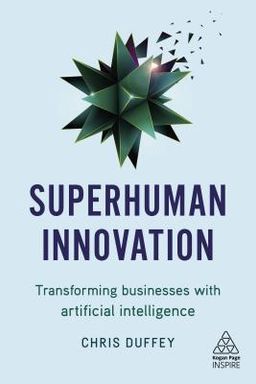
What if artificial intelligence could make you faster, smarter, and infinitely more creative? In Superhuman Innovation: Transforming Business with Artificial Intelligence, Chris Duffey proposes that we are entering a new era of human advancement, where AI doesn’t replace us—it enhances us. Duffey, drawing on his experience as Adobe’s creative technology lead and co-creating the book with an AI assistant named Aimé, argues that this collaboration between human curiosity and machine intelligence will define the Fourth Industrial Revolution.
Duffey invites you to see AI not as a cold, robotic replacement but as a creative partner. By blending science and artistry, he says AI will enable us to become ‘superhuman’—able to imagine, design, and solve problems at a scale never before possible. The book positions AI as the new electricity—an ambient force that powers the next wave of creativity, efficiency, and understanding.
The Second Mind
In the introduction, Duffey uses a developmental psychology metaphor: around age two, children realize others have separate thoughts and feelings—a milestone known as the ‘theory of mind.’ Humanity, he argues, is now experiencing a parallel awakening with AI—a ‘theory of the second mind.’ Artificial intelligence has matured enough that we now engage with it as an independent, reasoning entity capable of understanding context, patterns, and even intent. This second mind doesn’t compete with us; it complements us, creating a feedback loop of continuous learning.
Throughout the book, Duffey’s virtual co-author, Aimé, represents this companion consciousness. Their dialogue format models how AI can become a collaborator in our processes—an intelligent peer that pushes human imagination into new frontiers.
The SUPER Framework
Duffey structures his thesis around the SUPER framework—an acronym for Speed, Understanding, Performance, Experimentation, and Results. These five qualities form the essential architecture for using AI to transform business and personal capability. Each element represents both a technological and human characteristic: speed reflects agile adaptation; understanding mirrors empathy and contextual awareness; performance focuses on measurable improvement; experimentation celebrates curiosity; and results link all innovations to real-world outcomes. Together, they offer a scaffold for any organization or individual seeking to use AI purposefully rather than reactively.
Humans at the Center
The book insists AI’s real mission is service to humanity. Unlike dystopian science fiction that imagines domination or obsolescence (for example, HAL in 2001: A Space Odyssey or the replicants in Blade Runner), Duffey sees AI as a partner that empowers workers, entrepreneurs, teachers, and artists. He clarifies that AI’s goal is not to build smarter machines, but smarter societies. Rather than deskilling jobs, intelligent systems can handle repetitive, data-heavy tasks—freeing humans for creativity, empathy, and strategy. This mirrors the optimism of pioneers like Ray Kurzweil, who predicted humans would merge with technology to amplify their cognitive reach.
The Fourth Industrial Revolution
The context for this argument is what experts call Industry 4.0—the convergence of digital, biological, and physical systems. Duffey shows how AI, together with cloud computing, the Internet of Things (IoT), and big data, enables a world of smart cities, autonomous vehicles, and personalized healthcare. The chapter on the Fourth Industrial Revolution positions AI as the integrative force linking all innovations. Just as electricity once powered factories and homes, AI will power experiences and decisions. It’s a massive recalibration of how value is created—moving from mass production to mass personalization.
(Note: This vision aligns closely with Klaus Schwab’s definition of the Fourth Industrial Revolution in his World Economic Forum writings, but Duffey extends it by embedding human creativity and ethics as central pillars.)
From Data to Experience
Early sections of the book detail how data became the new fuel of innovation. With 2.5 quintillion bytes produced daily, Duffey calls data humanity’s ‘digital exhaust.’ But raw data alone is meaningless without interpretation; intelligence—human or artificial—must shape it into experience. Businesses, therefore, must evolve from focusing on products to designing experiences supported by this data. Companies like Amazon, Netflix, and Starbucks illustrate this shift: they use AI not just to predict behaviors, but to create delight through personalization and speed. This is what Duffey calls the experience economy.
Why It Matters
The stakes, Duffey warns, are existential for organizations. The next decade will mirror past technological leaps where slow adopters vanished (as Inc. Magazine predicted, half of the S&P 500 will be replaced). But beyond business survival, he argues there’s a deeper human promise: when people and AI collaborate well, we achieve superhuman innovation—the synthesis of imagination and insight enriched by machines. Through curiosity, ethics, and empathy, we create technology that serves life, not the other way around.
In sum, Superhuman Innovation is both a blueprint and a manifesto. It reframes AI from a technical challenge into a creative partnership. Across its dialogue-driven chapters, Duffey lays out how any person or organization can embrace this second mind—by building trust between human curiosity and machine intelligence, anchored in the SUPER framework. His message: the future belongs not to machines that think, but to people who think with machines.