
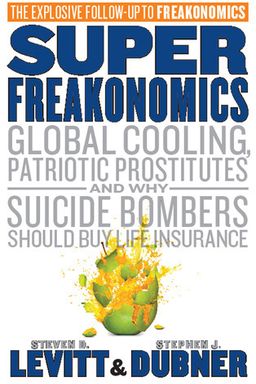
SuperFreakonomics cover

SuperFreakonomics

by Steven D Levitt and Stephen J Dubner

SuperFreakonomics explores how economic thinking and data analysis unravel the mysteries of our world, offering surprising solutions to global challenges. Through captivating stories, Levitt and Dubner reveal how understanding economic principles can lead to innovative problem-solving and a deeper comprehension of human behavior.

The Hidden Logic Behind Human Behavior

Why do smart people do seemingly irrational things? Why do incentives so often backfire, and why are our best intentions undermined by unforeseen consequences? In SuperFreakonomics, economists Steven D. Levitt and Stephen J. Dubner explore these paradoxes by using the lens of economics to reveal what truly drives human behavior. Building upon their first book, Freakonomics, they argue that people respond to incentives—just not always in predictable or rational ways. Every choice, they suggest, contains hidden costs and unforeseen ripple effects shaped by our desires, fears, and the systems that govern us.

At its core, the book expands the realm of economics far beyond money and markets. Instead, it defines economics as a comprehensive tool for understanding how people make decisions in all areas of life—from crime and healthcare to terrorism and climate change. Through compelling stories and counterintuitive data, Levitt and Dubner reveal that the world can only be improved when we recognize and adjust for the incentives that actually motivate people’s actions.

Seeing the World Through the Economic Lens

Levitt and Dubner argue that traditional moral or emotional reasoning often blinds us to what’s really happening. For instance, we tend to see drunk driving as bad and walking home as good—but when they calculated the data, walking drunk turned out to be eight times deadlier per mile than driving drunk. They challenge the reader to replace gut intuition with empirical evidence—a shift from moral outrage to curious analysis. This “freakonomics approach” means asking the right questions, even if the answers are uncomfortable.

The authors stress that data reveals patterns of incentives and unintended consequences. Governments, institutions, and individuals create policies or actions meant to do good, but these often produce unexpected outcomes. The book encourages you to embrace that unpredictability, using logic rather than ideology to navigate complex realities.

Unintended Consequences, Unlikely Heroes

Whether exploring prostitution, hospital safety, or climate change, the authors consistently find unexpected solutions hidden in plain sight. Small, simple interventions—like handwashing, television access, or a few dollars’ incentive—can profoundly change systems. One example: a study in India revealed that women’s empowerment rose dramatically not from policy initiatives but from exposure to cable television, which redefined gender norms through depictions of independent women. This demonstrates how innovation and cultural incentives can achieve what laws often cannot.

Yet the authors caution that good intentions don’t guarantee good results. Policies like the Americans with Disabilities Act or endangered species protections can perversely harm the very groups or habitats they aim to protect. The cause, as always, is misaligned incentives—when rational actors behave in ways that make sense for them but produce destructive collective outcomes.

Learning from Extremes: What Prostitutes, Doctors, and Terrorists Reveal

Rather than moralize, Levitt and Dubner analyze the economics behind human extremes. Why does a street prostitute resemble a department store Santa? Because both operate as seasonal, elastic labor markets driven by temporary demand spikes. Why are suicide bombers financially rational? Because terrorism, they show, is often organized by educated, middle-class individuals responding to ideological—not purely economic—rewards. Similar logic applies to doctors, whose behaviors follow incentive structures shaped by hospitals, technology, and fear of lawsuits rather than pure moral duty.

Why Simple Fixes Win

A recurring theme in SuperFreakonomics is that complex problems often have simple, cheap solutions. From Ignatz Semmelweis’s 19th-century discovery that washing hands could prevent maternal death to Nathan Myhrvold’s modern proposal that a “garden hose to the sky” could block greenhouse gases, the book highlights innovation born of clear thinking rather than fear or politics. The ultimate message is pragmatic optimism: while human folly is pervasive, human ingenuity—when guided by rational analysis—can produce extraordinary change.

“To change the world, you first have to understand it.”

This credo captures the heart of SuperFreakonomics. Levitt and Dubner argue that curiosity, humility, and evidence—not ideology—are the essential tools for navigating life’s paradoxes. Before fixing a problem, you must accept how messy and counterintuitive its real causes can be. Economics, they insist, is not a cold science—it’s a human one, uncovering how our incentives shape everything from daily choices to the fate of the planet.


Incentives and the Law of Unintended Consequences

If people respond to incentives, then any system designed to manage behavior—from taxes to traffic laws—creates its own ripple effects. This central insight drives many of Levitt and Dubner’s stories. They show how the same rule that governs the economy can explain everything from crime rates to charity failures: good incentives make people do surprising things, while bad ones cause chaos.

When Solutions Backfire

Levitt and Dubner revisit the classic economic principle popularized by Adam Smith and later refined by Gary Becker: people act in their own self-interest. Yet even moral behavior is driven by incentives, often hidden. Take the Americans with Disabilities Act (ADA). Designed to protect the disabled from discrimination, it inadvertently discouraged employers from hiring them—because firms feared lawsuits if they later dismissed or disciplined those employees. Similarly, laws protecting endangered species led landowners to preemptively destroy habitats before they could be regulated, ensuring the animals never returned.

The pattern is consistent: well-meaning actions without incentive alignment often make things worse. The authors drive this point home through their now-legendary reminder about “the perils of walking drunk.” You might think walking home after drinking is a moral choice—but data show drunk walking kills more people per mile than drunk driving. Incentives are moral-neutral forces—they work relentlessly whether used for good or bad.

Economic Thinking as a Moral Upgrade

Levitt and Dubner suggest that thinking economically doesn’t make you cold-hearted; it makes you realistic. Rather than punishing people for doing what benefits them, change the structure that shapes their choices. For instance, when India introduced cash rewards for midwives who didn’t perform female infanticide but instead brought baby girls to hospitals, the compliance rose dramatically. Money succeeded where moral pleas failed.

The Role of Unintended Consequences

Every action has second-order effects. The Endangered Species Act made environmentalists feel virtuous but prompted deforestation. Trash taxes led to “Seattle Stomps”—citizens jumping in garbage bins to compress waste—and illegal dumping in forests. Even religious sabbatical laws in ancient Israel caused credit shortages when debt forgiveness discouraged lending.

Good intentions without an understanding of incentives are history’s quiet disasters.

By reframing morality through incentives rather than wishful thinking, SuperFreakonomics helps you see that human progress depends less on laws and ideals than on getting the equations of motivation right. If you want to change the world—or even your own habits—first figure out what you’re truly rewarding and punishing. The outcomes will surprise you.


Markets of Morality: Prostitution, Crime, and Gender

Levitt and Dubner’s research on modern prostitution and labor markets challenges moral preconceptions and exposes the economics of gender inequality. By analyzing data gathered by sociologist Sudhir Venkatesh and Chicago street workers, they reveal how sex work, discrimination, and the labor market share surprisingly similar logics.

Prostitution as Economics in Action

Street prostitutes, the authors note, earn more per hour than female workers in nearly any other blue-collar job—but face dangerous working conditions and legal risks. Their hourly premium compensates for that risk, perfectly illustrating economic theory. Yet earnings have plummeted since the early twentieth century when brothel workers in Chicago made modern-equivalent salaries of $70,000. Why? Market competition. Widespread acceptance of premarital sex created free substitutes, driving down the price of paid sex. Prostitution, in Levitt’s terms, is just another example of how supply and demand respond to cultural shifts.

Pimps, Realtors, and Incentive Designers

Venkatesh’s fieldwork showed that prostitutes working under pimps actually earned more, worked less, and faced less violence—a counterintuitive result similar to using a real estate agent. The “pimpact,” Levitt jokes, was greater than the “rimpact.” Like any agent, a pimp markets the product, protects the worker, and provides access to clients a solo seller can’t reach. Economics even explains criminal cooperation—rational actors maximizing comparative advantage in black markets.

Gender, Incentives, and Modern Work

The authors connect this to broader gender dynamics: women’s pay gaps, career interruptions, and biological disadvantages are all amplified through incentives rather than discrimination alone. Highly educated women often trade higher-paying jobs for flexibility when they have children—an economically rational choice that still widens inequality. Levitt and Dubner propose that markets reflect preferences more than politics, even when outcomes look unfair.

By tying prostitution to Wall Street habits and feminism’s progress to corporate incentives, the authors highlight an uncomfortable truth: moral narratives often hide economic realities. Whether selling sex or securities, people optimize for the rewards available. Change the incentives, and behavior—not morality—follows.


Fear, Risk, and the Illusion of Rationality

Humans pride themselves on being rational, but SuperFreakonomics reveals how fear and perception consistently override logic. By using examples from terrorism to shark attacks, Levitt and Dubner show how misjudging risk leads societies to divert resources from real dangers to imagined ones.

Terrorism and the Price of Fear

After 9/11, Americans feared flying and chose to drive—and that simple fear caused an estimated 1,000 extra traffic deaths in the following months. Statistically, a person’s annual chance of dying in a terrorist attack is around 1 in 5 million—yet governments have spent trillions combatting this infinitesimal threat. The authors call terrorism “leverage through fear”: a small act that imposes huge costs on the anxious public.

The irony is that sometimes, the simplest systems prevent disasters. Data from handwashing, police distribution, and even emergent hospital management show that information beats panic. The “Man Who Fixes Hospitals,” Dr. Craig Feied, redesigned emergency care using real-time data rather than intuition—lowering deaths and costs simultaneously.

Mistaking Drama for Data

The authors dismantle the 2001 “Summer of the Shark” media frenzy, when shark attack coverage skyrocketed despite fatality rates that were statistically unchanged and astonishingly low. More people are killed by elephants every year than by sharks, yet the stories we tell distort our sense of probability. By making rare events seem imminent, media incentives exploit fear instead of truth.

Humans fear what’s spectacular, not what’s probable—which makes us easy to manipulate and hard to save.

Levitt and Dubner’s message is both practical and philosophical: emotion skews our decision-making far more than we admit. By grounding fears in data—not drama—we reclaim the rational tools necessary for smarter governance and personal choice. Relearn how to assess risk, and you’ll see the world with clearer, calmer eyes.


Altruism, Apathy, and the Economics of Goodness

Are people naturally good? SuperFreakonomics revisits the famous 1964 Kitty Genovese murder—long taught as a cautionary tale of urban indifference—and discovers that the story itself was mostly false. Through this and the work of behavioral economists, Levitt and Dubner expose how supposed moral failures often reflect flawed data, context, and incentives rather than true apathy.

Myth-Busting the Bystander Effect

The legend claims 38 witnesses watched Genovese die without calling police. But interviews decades later revealed that some did call, others intervened, and most didn’t even realize what was happening. The moral outrage that fueled decades of psychological research came from inaccurate journalism. Levitt and Dubner use this case to prove how “moral data” can be skewed by social bias, cementing false lessons into public consciousness.

From Morality to Measurable Behavior

To test altruism objectively, economists built lab experiments like the Dictator Game. Participants given money decided how much to share with an anonymous stranger. Results seemed generous—until economist John List added realism: he let participants steal, earn the money themselves, or play outside of lab eyes. The generosity disappeared. When stakes and context changed, people stopped giving—proving that altruism often depends on being watched, not being good.

Even charitable acts, the authors argue, are full of mixed motives. Donating can relieve guilt, signal virtue, or even yield tax benefits—a classic “warm-glow” effect. Economic generosity, like buying lattes at a fair-trade café, often reflects self-interest cloaked in moral language.

Humans act altruistically not because we’re saints, but because kindness feels good, earns trust, or keeps us out of trouble.

By grounding morality in measurable incentives, SuperFreakonomics replaces cynicism with understanding. People aren’t selfish or selfless—they’re strategic. If goodness seems rare, it’s because we’ve built systems that don’t reward it. Change the incentives, and “human nature” changes with them.


Simple Fixes and Complex Problems

Throughout history, civilization’s biggest breakthroughs often emerged not from grand reforms but from small, cheap, and intuitive tweaks. What unites Ignatz Semmelweis’s handwashing discovery, Robert McNamara’s seat belts, and today’s geoengineering ideas is the same lesson: the solution to an impossible problem is often dangerously simple.

Semmelweis’s Simple Revolution

In 19th-century Vienna, childbirth killed one in six women. Doctors blamed women’s modesty or bad air until Ignatz Semmelweis noticed that medical students who handled cadavers before delivering babies infected their patients. His radical fix—washing hands with chlorinated water—cut deaths by 90%. Yet doctors ridiculed him and refused to comply. It’s a parable of human resistance: the cheaper and simpler a solution, the less prestigious it seems.

Technology’s Cheap Rescues

Levitt and Dubner list many “cheap miracles”: the forceps, the polio vaccine, ammonium nitrate fertilizer that fed billions, and the car seat or seat belt that saved millions. Each transformed tragedy into habit. But they also warn that behavior change often matters more than invention—seat belts languished for decades before social pressure made wearing them normal.

From Handwashing to Climate Engineering

In their boldest section, the authors describe a modern “Semmelweis” moment for climate change. Former Microsoft researcher Nathan Myhrvold’s team at Intellectual Ventures proposed cooling Earth not through carbon taxes but via a “garden hose to the sky”—a high-altitude pipe spraying sulfur dioxide to mimic volcanic shade. It would cost under $250 million, compared to the trillion-dollar global climate industry. The lesson isn’t advocacy—it’s humility: innovation often hides where ideology refuses to look.

When confronted with complexity, start with simplicity. Reality rewards pragmatists, not prophets.

Levitt and Dubner’s “cheap and simple” law reframes progress as the art of removing needless complexity. Whether in medicine, policy, or climate repair, the most transformative answers aren’t expensive—they’re merely ignored.


Geoengineering and the Economics of Global Warming

In one of their most controversial chapters, Levitt and Dubner confront global warming with an economist’s detachment and an engineer’s imagination. They acknowledge the reality of climate change but question whether moral guilt and costly policies will solve it. Their conclusion: if you treat warming as a problem of incentives and efficiency, not faith, you see hope in low-cost technical innovation.

The Problem with Expensive Virtue

They mock the idea that switching to Priuses or banning plastic bags will meaningfully offset carbon buildup. Even drastic restrictions on fossil fuels may stabilize emissions only after decades—by which time, the damage could persist for centuries. Worse, moral appeals often fail because they ask individuals to bear costs while the benefits are global, creating a collective action trap. Economics calls this a “negative externality”: the polluter doesn’t pay, the victim doesn’t charge.

Cheap Engineering, Big Impact

Enter Nathan Myhrvold’s Intellectual Ventures lab, which proposed volcanic-style clouding as a planetary air conditioner. Their idea—pumping small quantities of sulfur dioxide into the stratosphere to reflect sunlight—could cool the Earth at minuscule cost, replicating the natural cooling effect of Mount Pinatubo’s 1991 eruption. Though branded heretical by environmentalists, scientists like Nobel laureate Paul Crutzen supported researching it as a backup plan if traditional solutions failed.

Ethics, Politics, and Pragmatism

The authors argue the real barrier isn’t science but ideology. Al Gore calls geoengineering “nuts” because it conflicts with the moral narrative of repentance. Yet history’s greatest breakthroughs—from Pasteur’s germ theory to Semmelweis’s sanitation—were first dismissed as blasphemous meddling. For Levitt and Dubner, rejecting experimentation out of fear is costlier than the risk of trying. Pragmatism, not purity, saves lives.

Whether or not you accept their proposal, the authors’ larger point is clear: problems created by human ingenuity will be solved by human ingenuity. Economics reminds us to optimize, not sermonize.


A Monkey’s Lesson: The Hidden Economics of Instinct

The book closes with an unexpected experiment that connects all its themes: the study of capuchin monkeys taught to use money by economist Keith Chen at Yale. This whimsical story becomes a profound metaphor for human nature. Once monkeys grasped currency’s value, they displayed all-too-human traits—greed, marketplace fairness, even prostitution—mirroring our own incentive-driven instincts.

Monkeys, Markets, and Rational Madness

Chen taught capuchins to trade coins for treats. They learned classic economies: they responded to “price shocks” by buying less when costs rose, and they preferred sure gains over risky gambles—showing the same “loss aversion” that shapes human investing. When given free money, they overpaid, hoarded, and even traded sex for coins—demonstrating that morality is not innate but emergent.

The Mirror of Human Behavior

Levitt and Dubner use this quirky study to prove a serious point: economic behavior is biological behavior. Our systems of trade, morality, and hypocrisy grow from primal self-interest. The capuchins, like humans, quickly equated tokens with survival, pleasure, and power. The experiment ends when supervisors halt it, fearing the monkeys’ society would collapse—a chilling metaphor for our own volatile markets.

“Monkeys are people too.” The closer we look at irrationality, the more rational it appears.

The closing story encapsulates SuperFreakonomics’ central message: whether analyzing monkeys or markets, prostitutes or policymakers, the patterns are the same. Incentives govern instinct; morality masks self-interest; and beneath every irrational belief lies a rational hunger. To understand humanity, follow the money—even when it leads to a mirror.

Dig Deeper

Get personalized prompts to apply these lessons to your life and deepen your understanding.

Go Deeper

Get the Full Experience

Download Insight Books for AI-powered reflections, quizzes, and more.