
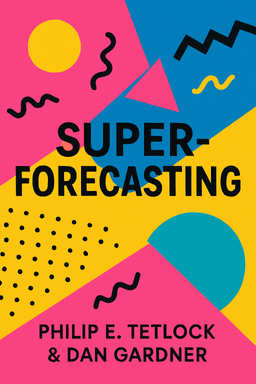
Superforecasting cover

Superforecasting

by Philip E Tetlock & Dan Gardner

Superforecasting reveals the art and science behind accurate predictions, challenging the notion that only experts can foresee the future. Through engaging stories and practical techniques, the book empowers readers to sharpen their forecasting skills and make informed decisions in an unpredictable world.

Thinking in Probabilities, Acting with Humility

How can you think like a scientist while deciding like a leader? In Superforecasting, Philip Tetlock and Dan Gardner argue that the quality of your predictions—and by extension, your decisions—depends on how you think about uncertainty. The book’s landmark studies, from Tetlock’s early Expert Political Judgment studies to the later Good Judgment Project (GJP), reveal that forecasts can be improved dramatically when we measure accuracy, adopt probabilistic thinking, and institutionalize learning. The authors show that even non-experts can make consistently accurate predictions about world events when they approach uncertainty with discipline, humility, and curiosity.

Tetlock invites you to become an optimistic skeptic—someone who believes forecasting can be improved by careful measurement and feedback, but who also recognizes inherent limits in what can be known. Through this lens, the world appears as a mix of clocks (systems with predictable regularity) and clouds (turbulent, complex systems that defy exact prediction). Smart forecasters learn to tell the difference, using methods suited to each situation.

The Good Judgment Project and Its Revolution

After his earlier research famously showed that experts often performed no better than "dart-throwing chimps," Tetlock co-led the IARPA forecasting tournament. The Good Judgment Project assembled thousands of volunteers to make testable probability estimates about geopolitics. Crucially, every forecast was scored using mathematical measures like the Brier score, allowing participants to see and improve their performance. Over time, some individuals—dubbed superforecasters—consistently outperformed intelligence analysts and other experts.

This empirical breakthrough changed the way people thought about prediction. Superforecasters weren’t sages or savants; they were disciplined thinkers. Their magic, Tetlock shows, came from systematic habits: fine-grained probabilistic thinking, continual updating, collaboration with peers, and a willingness to learn from error. The data proved that skill, not luck, dominated in the long run—a finding with wide implications for business, policy, and personal decision-making.

From Foxes to Bayesian Thinkers

A key insight from the book’s earlier research is the contrast between hedgehogs—those fixated on one grand theory—and foxes—those who juggle many small, partial perspectives. Foxes, with their intellectual humility and diversity of mental models, proved far more accurate. They naturally think like Bayesians: starting from base rates, weighing new evidence proportionally, and making small, disciplined updates. People like Tim Minto and Jay Ulfelder exemplify this mindset, revising their probabilities dozens of times as conditions evolve. Their modesty becomes strength: they treat beliefs as adjustable hypotheses, not ideological banners.

Why Institutions Fail and What to Fix

Most failures in forecasting—whether in intelligence analysis, economics, or journalism—stem from institutional habits that reward confidence over accuracy. The 2002 National Intelligence Estimate on Iraqi WMDs, for example, used categorical language that concealed uncertainty, leading to disastrous policy decisions. Tetlock contrasts this with medicine’s evolution toward evidence-based practice: only after rigorous measurement did medicine escape its cargo-cult phase. Similarly, the IARPA tournament forced analysts to quantify, score, and learn—an institutional shift that produced genuine progress.

The Book’s Core Promise

If you absorb one principle, it’s this: forecasting skill is learnable. Like any complex performance skill—from chess to violin to investing—it improves through deliberate practice, clear feedback, and the right mindset. Tetlock calls this being in perpetual beta: viewing every belief as an experiment that can be corrected. Forecasting tournaments provided a laboratory for this growth, creating a community where rigor replaced punditry and measurable learning replaced rhetorical spin.

By the end, Tetlock unites epistemic humility with pragmatic optimism. You can’t predict everything—black swans still swoop in—but you can become vastly better at probabilistic judgment, decision-making, and institutional learning. The book’s broader message extends beyond prediction: it’s a manifesto for evidence-based thinking in uncertain worlds.

Core message

The future isn’t unknowable—it’s unequally knowable. By measuring performance, embracing uncertainty, and learning continuously, you can push the boundary of what’s predictable.

This synthesis sets the stage for the book’s deeper lessons: how to define scorable questions, think in probabilities, calibrate your confidence, aggregate diverse views, update beliefs Bayesian-style, and apply these lessons to leadership and institutions. Together, they form a clear roadmap for navigating uncertainty with both humility and competence.


Measuring to Improve Judgment

You can’t improve what you don’t measure. Tetlock’s research begins with this premise: forecasting only gets better when it’s precisely defined, recorded, and scored. His early studies exposed that pundits and political experts were rarely held accountable for their accuracy. Measurement—explicit probabilities attached to time-bound questions—was the missing ingredient.

Turning intuition into data

Tetlock’s team required forecasters to give concrete numerical probabilities and then scored each one using the Brier score, which penalizes both overconfidence and indecision. Calibration and resolution charts tracked how well forecasters matched their words to reality. These metrics provided the feedback loop that previously only meteorologists or poker players enjoyed. When questions were clear and scoring was consistent, learning accelerated dramatically.

The dangers of rubbery language

Sherman Kent’s experience at the CIA highlighted why precision matters. Terms like “likely” and “serious possibility” were interpreted wildly differently across readers—ambiguity that destroyed accountability. Tetlock revives Kent’s call for a standardized lexicon, arguing that words must be translated into numbers. Only then can progress be measured and disputes resolved objectively. (Note: this insight echoes Daniel Kahneman’s critique of verbal vagueness in Thinking, Fast and Slow.)

The institutional payoff

The IARPA tournament brought this discipline into intelligence analysis, forcing agencies to compete on transparent metrics. The results were startling: civilian amateurs who kept score outperformed professionals whose forecasts were untracked. This echoed Ernest Codman’s crusade for hospital outcome reporting a century earlier—public measurement ultimately leads to improvement, even if accountability feels uncomfortable at first.

Practical takeaway

Clarify the question, specify a time frame, assign a numeric probability, and score results consistently. Without measurement, judgment remains superstition.

Once scores are tracked and feedback made visible, forecasting stops being punditry and becomes a data-driven skill—one that can be trained, tested, and rewarded.


The Fox Mindset

When Tetlock compared thousands of expert predictions, one personality difference explained much of the variance: the cognitive style of foxes versus hedgehogs. Hedgehogs favor grand unifying theories; foxes juggle multiple small insights. The metaphor, borrowed from Archilochus (“the fox knows many things, but the hedgehog knows one big thing”), frames the contrast between simplicity and nuance.

Why foxes win

Foxes thrive because the world rarely conforms to single, static models. They integrate diverse evidence, remain modest about what they know, and revise their views easily. Bill Flack, a retired U.S. Treasury officer turned top-tier forecaster, became a model fox: he decomposed complex questions (e.g., Arafat’s polonium case) into smaller components and continuously updated probabilities.

Dragonfly eyes and internal crowds

Foxes think with many mental lenses—a “dragonfly eye,” as Tetlock calls it, composed of many tiny perspectives. This mental aggregation mirrors the statistical advantage of crowds. Just as diverse individual errors cancel each other out in a poll aggregator like Nate Silver’s FiveThirtyEight, foxes internally pool their small hypotheses to reach balanced, evidence-weighted conclusions.

Cultivating foxiness

To become more foxlike, you must resist ideological simplicity. Seek competing explanations, experiment with different hypotheses, and maintain intellectual humility. (In this sense, Tetlock’s advice parallels Adam Grant’s notion of “thinking again.”) The goal isn’t to appear confident on television but to stay calibrated to reality. Foxiness is not indecision—it’s disciplined pluralism applied to complex realities.

When you think like a fox, you keep your ego out of your predictions, blend conflicting data, and adapt fluidly—a crucial set of habits for anyone tasked with navigating uncertainty.


Thinking in Probabilities

At the psychological core of superforecasting is a shift from categorical to probabilistic thinking. Rather than asking “Will X happen?” you learn to ask “How likely is X to happen within this timeframe?” This mental retooling turns every judgment into a testable, updatable hypothesis.

Why certainty fails

Our brains evolved for binary decisions—fight or flee, safe or dangerous—producing cognitive habits that oversimplify uncertainty. We often treat 80% as certain and 50% as ignorance. The result is overconfidence and hindsight bias (“I knew it all along”). Superforecasters replace that primitive dial with a fine-grained probability scale that forces nuance and learning.

Bayesian reasoning in everyday form

Bayesian updating is the logic behind the superforecasters’ success: start with a prior (base rate), consider new evidence, and adjust proportionally. You don’t need to compute formulae—just adopt the habit of frequent, small updates. Tim Minto’s thirty-plus revisions to a refugee forecast, each changing by only a few percentage points, exemplify disciplined Bayesian thinking. Overreaction and paralysis are both avoided through incremental realism.

Aleatory vs. epistemic uncertainty

Tetlock urges you to distinguish between reducible uncertainty (epistemic) and randomness (aleatory). If more data can clarify, you invest in analysis. If it’s fundamentally random—like short-term currency swings—you stay humble and widen your confidence bands. Recognizing which uncertainty you face makes your probabilities meaningful rather than decorative.

Rule for better judgment

Treat beliefs as probabilities, not convictions. The difference between 55% and 65% may seem small, but those subtleties accumulate into accuracy.

Probabilistic thinking replaces overconfidence with trackable realism. It allows learning through feedback, translating the messy uncertainty of life into manageable, measurable bets on the future.


Learning Through Aggregation and Teams

Forecasts improve not only through individual technique but through collaboration. Tetlock shows that combining diverse judgments—via teams, weighted averages, or statistical algorithms—consistently boosts accuracy. The Good Judgment Project’s best results came from deliberate aggregation and intelligently designed superteams.

External and internal aggregation

Aggregation works because different forecasters see different parts of the elephant. Weighted crowd averages correct individual biases and amplify shared evidence. When the crowd’s consensus was “extremized” slightly toward 0 or 100 (simulating shared knowledge), results improved further. Internal aggregation works similarly in a single mind: a fox uses many mini-models to internally average perspectives.

Designing superteams

Teams can underperform due to groupthink, but Tetlock’s data reveal the conditions for success: (1) active open-mindedness, (2) generosity in sharing evidence, and (3) disciplined precision in discussion. Teams that asked, “What data support X over Y?” outperformed even markets. Superforecaster teams were roughly 50% more accurate than individuals acting alone—a striking real-world validation of structured collaboration.

Outside view, Fermi decomposition, and synthesis

The most effective teams began with the outside view (base rates from history), moved to the inside view (specific details), and then aggregated both perspectives. They decomposed complex questions “Fermi-style”—breaking them into measurable sub‑questions—and pooled results. This disciplined approach produced reliable accuracy even on messy global events like elections, sanctions, and wars.

Whether within an analytic cell or a corporate boardroom, the lesson is universal: diversity trumps dogma only when you combine it with structured sharing, psychological safety, and quantified synthesis.


Separating Skill from Luck

Great forecasters aren’t just lucky streaks—they show persistence across trials. Tetlock uses the logic of regression analysis to distinguish durable skill from chance. A lucky coin-flipper wins once; a skilled forecaster performs well year after year.

Regression to the mean

Performance naturally varies around a mean. If top performers immediately fall back to average, their success was mostly luck. In the Good Judgment Project, however, top forecasters’ year-to-year correlations hovered around 0.65—a strong sign of consistent skill. Some (like Doug Lorch) stayed elite across years, proving that forecasting competence is real and measurable.

Implications for evaluation

You must track performance across many questions and periods before labeling someone “skilled.” Forecast tournaments provide exactly that wide data window. Organizations that judge on single successes (such as pundit hits or portfolio wins) misread luck as talent and entrench mediocrity.

Rule of persistence

If accuracy endures across independent rounds, you’re seeing skill. If it evaporates, you’re seeing luck. The difference is what allows real expertise to be cultivated instead of mythologized.

For decision-makers, this principle is gold: revise incentives and recognition systems to reward long-term calibration, not flashy single wins.


Perpetual Beta: Continuous Learning

At the heart of superforecasting lies a growth mindset. Forecasting skill improves not from innate genius but from deliberate, evidence-based practice. Superforecasters operate in what Tetlock calls perpetual beta—a state of constant refinement.

From failure to feedback

Like John Maynard Keynes, who reinvented his investment approach after repeated downturns, superforecasters examine their mistakes meticulously. Every forecast is a mini-experiment: make a prediction, see the score, analyze errors, and refine. Mary Simpson and Jean‑Pierre Beugoms used detailed postmortems and notes to accelerate their own learning curves. Feedback transforms failure into data.

Grit, curiosity, and tacit practice

Grit sustains improvement. Anne Kilkenny’s persistence and Elizabeth Sloane’s recovery-driven participation underscore the motivational side of skill. But forecasting expertise also includes tacit knowledge—pattern recognition that only emerges through practice, much like a musician’s ear. Online training can provide a 10% boost, but nothing replaces actual forecasting with consistent, measurable feedback.

Habit for improvement

Treat every belief as a prototype. Test it, learn from the results, and iterate. Learning compounds faster than talent.

Perpetual beta serves as both a forecaster’s mindset and a philosophy of life: humility plus disciplined practice builds genuine expertise over time.


Forecasting with Limits and Leadership

Even the best forecasts face hard limits. Daniel Kahneman warns of scope insensitivity and cognitive bias; Nassim Taleb warns of black swans and fat tails. Tetlock doesn’t deny these constraints—he incorporates them, defining a realistic boundary for prediction.

What can and can’t be forecast

Superforecasters are accurate in the “Goldilocks zone”—questions one month to one year out, where patterns exist but chaos hasn’t yet erased them. They can’t predict singular shocks like pandemics or coups years in advance, but they can improve early detection and scenario probability estimates. This middle ground turns fatalism into constructive skepticism.

Design resilience, not prophecy

Taleb’s emphasis on antifragility complements Tetlock’s measured optimism. Use forecasts to inform systems that can adapt to surprise, not eliminate it. Kahneman’s teachings push you to structure judgment, specify time horizons, and guard against story bias.

Humility and decisiveness in leadership

For organizations, the paradox is clear: leaders must deliberate humbly but act decisively. Tetlock praises Prussian mission command (Auftragstaktik), Eisenhower’s D-Day approach, and modern corporate parallels like Amazon’s “disagree and commit.” The right cultural design—debate before decision, resolve after—is how humility and decisiveness coexist.

Leadership insight

Encourage debate, demand quantified reasoning, and once a course is chosen, execute firmly—but remain ready to revise if the evidence changes.

Forecasting, when properly bounded and embedded in resilient culture, supports better strategy. It replaces false certainty with adaptable clarity—leadership under uncertainty.

Dig Deeper

Get personalized prompts to apply these lessons to your life and deepen your understanding.

Go Deeper

Get the Full Experience

Download Insight Books for AI-powered reflections, quizzes, and more.