
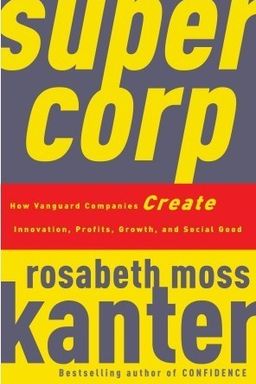
SuperCorp cover

SuperCorp

by Rosabeth Moss Kanter

SuperCorp illuminates a revolutionary approach to business, showcasing how vanguard companies like IBM and Procter & Gamble harmonize profit-making with societal impact. Learn how these trailblazers innovate through strong values, employee empowerment, and a commitment to social good.

Building Vanguard Companies That Do Well by Doing Good

How should a company thrive amid global turbulence while also improving the world? In SuperCorp, Rosabeth Moss Kanter argues that the best companies of the twenty-first century—the “vanguard companies”—succeed not by separating profit from purpose, but by intertwining them. They are profitable, innovative, and global—but also guided by explicit values and a humanistic mission. These firms demonstrate that moral purpose can generate strategic advantage when aligned with strong execution and learning cultures.

Defining the Vanguard Model

Vanguard companies are not saints; they are pragmatic innovators who embed values in operations and measure success through both societal and financial outcomes. Kanter compares IBM’s global reorientation, P&G’s value-led renewal in emerging markets, Banco Real’s community financing, and Cemex’s social ecosystem programs. Despite spanning technology, banking, and manufacturing, they share a pattern: purpose integrated into strategy. Service to society becomes a source of innovation, reputation resilience, and employee motivation.

The Role of Values as a Compass

Values, when truly lived, guide thousands of daily decisions that can’t be programmed from headquarters. IBM’s “ValuesJam” crowdsourced its three company principles from 350,000 employees worldwide, giving it global legitimacy. P&G’s ‘Purpose, Values, and Principles’ (PVP) system became more than a poster: it shaped hard calls, such as prioritizing disaster relief and sustainability investments even at immediate cost. Values-based companies accelerate decisions under uncertainty because every employee understands the moral framework supporting them.

Innovation as a Values Dividend

Kanter reframes innovation as an outcome of empowerment and empathy. When employees are encouraged to solve social problems, they discover new markets and technologies. The P&G Brazil “Básico” line was born from empathy for low-income consumers, yet it became a global product template. IBM’s Reading Companion, designed for literacy, improved its voice-recognition software. When a company sees customers and communities as co‑innovators, it broadens its creative base and strengthens both financial and social returns.

Ecosystems and Inclusive Growth

Vanguard companies view business as participation in ecosystems rather than control of supply chains. Cemex’s Construrama empowers small hardware shops and low-income families through training and micro-credit. Banco Real treats suppliers and even local trouble spots as partners in improvement. IBM’s corporate service corps links the firm’s engineers and data scientists to humanitarian missions with NGOs, creating a global network of trust. These partnerships extend reach, build resilience, and achieve sustainable impact.

Leadership for Turbulence

Kanter identifies four global forces—uncertainty, complexity, diversity, and transparency—that overwhelm old-style management. Leaders like Sam Palmisano (IBM), A.G. Lafley (P&G), and Fabio Barbosa (Banco Real) show how to respond: use values as filters, build empathy across cultures, delegate authority, and rely on connectors and networks rather than bureaucracies. They demonstrate that the greatest lever of control in a turbulent world is a trustworthy culture, not top‑down command.

The Core Message

Business, Kanter insists, is society’s most powerful platform for change when guided by principle rather than greed. The vanguard model proves that humanistic capitalism—profitable yet dignified—can outperform cynical competition. For leaders and citizens alike, the book is a call to make organizations that don’t just make money, but make meaning and progress simultaneously.


Values as the True Operating System

Kanter teaches that in high-performing organizations, values are the guidance system. They aren’t slogans; they are decision protocols built through participation and reinforced through both symbols and enforcement. Without them, global operations fracture into silos and mistrust.

Building Shared Language and Trust

IBM’s “ValuesJam” became a modern classic in participatory management. Rather than imposing rules, CEO Sam Palmisano invited people in 160 countries to co-create three universal principles. The output doubled as a moral GPS and a cultural unifier. It demonstrated that values gain traction only when thousands own them, not when executives dictate them.

Turning Words into Action

Values survive only when reinforced by consistent stories and sanctions. P&G proved its priorities through tangible choices: during crises, it protected staff families and donated supplies instead of sacrificing safety for margins. Cemex dismissed a manager who violated ethical norms—signaling zero tolerance. At Banco Real, principles determined credit approval and product design. These actions translated lofty words into social currency employees trusted.

Embedding Values in Systems

Vanguard firms institutionalize this moral logic. Omron re-teaches its founding ethics at sales and research meetings. IBM’s annual values certification and Banco Real’s Sustainability Directorate operationalize belief. The result is self-regulation: problems are spotted early because everyone feels empowered to use the moral language of the firm to challenge or justify decisions.

Core lesson

When values are lived, they become invisible controls that keep trust high and bureaucracy low. The system polices itself because people know what good looks like.

If you want to use values as your compass, make them explicit, participatory, and enforceable. Model your decisions on them in both easy and hard moments, and celebrate heroes who live them visibly. That’s how culture becomes your best governance tool.


Innovation Driven by Purpose

For Kanter, the most surprising outcome of humanistic values is not compliance—it’s creativity. She calls this the values dividend: purpose and moral challenge amplify an organization’s innovative potential. When employees are told to invent solutions that better lives, it sparks ingenuity that pure profit incentives often miss.

Social Insight as Innovation Catalyst

The story of P&G Brazil’s “Básico” shows this principle vividly. Facing economic stagnation, local leaders reimagined essential products for low-income consumers—making them cheaper yet dignified. Innovation came from empathy, field immersion, and cross-functional improvisation. The project boosted revenue and reputation, later influencing global product lines.

Open Innovation and Learning

Vanguard firms don’t guard R&D; they open it. P&G’s “Connect and Develop” and IBM’s “Reinventing Education” partnered with schools, NGOs, and customers to co-design products. The feedback loop enriched technology (as with IBM’s voice recognition advances) and trained new partners to share value. Social projects became incubators for technical and managerial talent.

Emerging Markets as Laboratories

True innovation often starts under constraint. ICICI Bank in India and Cemex in Mexico both turned resource scarcity into invention: mobile banking for illiterate villagers, and microfinance-backed housing for informal workers. These solutions later scaled globally. When you mix empathy with engineering, social insight drives breakthrough design.

Innovation takeaway

Purpose is not an extra—it’s a lens that helps you see unmet needs as profitable opportunities.

If you direct creative energy toward public benefit, you gain both new products and deeper trust. That is the double dividend of innovation guided by conscience.


Ecosystems and the Extended Enterprise

The vanguard enterprise expands its moral circle beyond employees and shareholders to include an “extended family” of partners and stakeholders. Kanter calls this ecosystem logic the backbone of sustainable capitalism.

From Supply Chains to Value Webs

Cemex’s Construrama is a prime case: by upgrading neighborhood hardware stores with training, technology, and credit links, Cemex increased sales while improving community wellbeing. Banco Real’s supplier screening and cleanup of adjacent neighborhoods followed a similar pattern. IBM’s partnerships during the 2004 tsunami—combining NGOs, governments, and local engineers—created distributed competence that endured long after initial relief.

Principles for Durable Partnership

  • Design projects so partners profit in tangible ways—financially or through reputation.
  • Engage communities as creators, not beneficiaries.
  • Treat transparency and capability transfer as central deliverables.

By aligning mutual incentives, ecosystem partnerships achieve scale and credibility that pure philanthropy cannot. Each partner becomes an agent of shared value creation.

Ecosystem principle

“When partners gain, purpose sustains.” Effective ecosystems balance altruism with economics.

If you envision your market as a living web of interdependence, you unlock innovation and loyalty that endure shocks. Ecosystems are not CSR—they are strategy.


Leading Through Turbulence

Globalization’s new reality—uncertainty, complexity, diversity, and radical transparency—forces leaders to balance agility with principle. Kanter’s portraits of Palmisano, Lafley, Lévy, and Barbosa illustrate what leadership must become: distributed, humble, and values-driven.

The Four Forces

Modern executives face shocks (uncertainty), hyper‑connected operations (complexity), identity differences (diversity), and constant scrutiny (transparency). Traditional control collapses under such strain. The antidote is culture—shared purpose that decentralizes coordination without losing coherence.

Behavior of Vanguard Leaders

Sam Palmisano focused on trust and personal responsibility as IBM globalized. Fabio Barbosa matched banking strategy to social legitimacy. Maurice Lévy built integration around respect and empathy, using personal diplomacy to heal acquisitions. They model accountability, emotional intelligence, and distributed power rather than command-and-control authority.

Culture as Crisis Shield

When turbulence hits, companies with strong, humanistic cultures respond faster because employees already understand why their work matters. IBM’s volunteers self-organized after the tsunami without waiting for headquarters. Cemex’s norms allowed rapid post‑merger adaptation. Culture multiplied capacity by aligning hearts before rules.

Your practical task as a leader is to codify values, enable distributed problem-solving, and use empathy as infrastructure. When markets or morale collapse, integrity and inclusion restore momentum quicker than any strategic plan.


Networks, Connectors, and the New Power

Modern vanguard companies replace hierarchies with overlapping networks. Influence flows through connectors—people who cross units, geographies, and functions to mobilize cooperation. Formal authority weakens; informal connection strengthens execution speed.

The Architecture of Distributed Work

IBM’s global transformation demonstrates this shift. Palmisano relocated executives to customer centers, flattened management, and empowered project teams to make decisions locally. Cemex built post-merger integration (PMI) teams of experienced “transfer agents” who circulated good ideas across plants. Shinhan Bank used hundreds of temporary connectors after an acquisition to merge cultures smoothly. The emphasis: align laterally, not vertically.

Connector Roles and Political Skill

Connectors act as idea scouts, integrators, and negotiators. They coordinate resources by persuasion, not power, often through “tin-cupping”—collecting favors and talent from other departments. Kanter notes that success in these networks demands diplomacy, framing, and moral suasion. “She who has the biggest network wins.”

The Human Cost—and Reward

Connector life can be exhausting: endless travel, blended time zones, emotional negotiation. But it confers influence that formal charts cannot grant. Those who steward goodwill—like Nick Donofrio mentoring hundreds or Henry Chow mentoring younger leaders—quietly shape corporate direction.

Connector principle

In networked organizations, the unit of power is not position but participation.

If you want to lead in this world, cultivate social capital. Join diverse teams, volunteer across boundaries, and build reputation for moving ideas fast. Connection, not command, is the new authority.


Integration, Inclusion, and Shared Identity

Diversity and mergers both challenge belonging. Kanter shows that emotional integration—whether between companies or cultures—depends on rituals, empathy, and shared identity platforms more than on spreadsheets or policies.

Emotional Leadership After Mergers

At Shinhan–Chohung Bank, protests and pride clashed after merger announcements. Rather than force compliance, leaders structured symbolic unity events like the “Serabol Summit,” mountain climbs, and shared committees. Publicis used respectful “reverse takeovers” that honored acquired agency cultures. Cemex institutionalized the “Cemex Way” to unify standards while respecting local identity. These cases prove mergers succeed when hearts align before systems.

Diversity as Opt‑In Unity

Kanter contrasts tokenistic diversity with a participatory, opt-in approach pioneered by Banco Real. “Diversity Day” allowed employees to celebrate chosen identities freely, leading to concrete reforms—from accessible offices to inclusive recruiting. The balance lies between liberty and cohesion: people express difference yet share overarching company purpose.

Common Platforms and Values Glue

Tools like Cemex’s standard processes or IBM’s unified intranet become pragmatic forms of culture—they make routine actions objective. Combined with daily recitation of values (Omron) and symbolic rituals (IBM’s global jam sessions), they create shared identity across continents. Platforms provide consistency; values provide meaning.

When you merge teams or manage difference, craft shared routines and shared meaning. Integration is emotional architecture—give people both stability and voice, and cultures will merge themselves.


Corporate Diplomacy and Social Innovation

Kanter’s vanguard companies redefine corporate citizenship. They practice corporate diplomacy: using enterprise capabilities to solve systemic problems through cross-sector collaboration. The result is enduring legitimacy and expanded influence.

Real Change, Not Charity

IBM’s Reinventing Education and KidSmart programs illustrate this stance. Rather than donating money, IBM contributed expertise—engineers, data scientists, and design systems—creating scalable educational reforms in India and Egypt. Projects like Eternal Egypt also advanced technology and national pride, proving social impact can coincide with strategic positioning.

Private Innovation Solving Public Issues

Diageo’s Senator beer reduced unsafe home-brew consumption in Kenya while expanding legitimate small enterprises. Cemex’s Patrimonio Hoy turned housing deficits into community entrepreneurship. In each case, addressing a social pain unlocked a viable commercial model.

Principles of Corporate Diplomacy

  • Engage deeply with local governments and NGOs as peers.
  • Contribute skills, not leftovers.
  • Ensure mutual accountability and measurable outcomes.
  • Model inside what you preach outside.

Corporate diplomacy transforms public perception: instead of lobbying for privilege, companies gain influence by demonstrating competence for the common good. In times of institutional distrust, such legitimacy becomes priceless.

You don’t have to run a multinational to adopt this lens—start by aligning your strongest capabilities with clear public needs. That’s how brands become trusted citizens.


Limits, Critiques, and Lessons in Balance

Kanter closes with realistic reflection: vanguard companies aren’t utopias. They operate within capitalism’s tensions—ambition, fatigue, inequity, and public skepticism. Understanding their constraints prevents both hero worship and cynicism.

Imperfect but Instructive

Even top performers show strain: Cemex’s long hours shrink gender diversity; P&G–Gillette integration suffered clashes. Matrix structures can blur accountability; horizontal power sometimes leaves no one responsible for coordination. Yet these flaws validate—not contradict—Kanter’s thesis that constant rebalancing is the cost of purpose-driven complexity.

Power and Accountability

Critics warn that corporate do‑goodism might displace public policy or grant firms undue influence. Kanter’s response is systemic transparency: external audits, multi‑stakeholder councils, and shared reporting frameworks (like the Equator Principles) can check power. Vanguard firms that publish data and invite critique strengthen democracy rather than undermine it.

The Shared Task Ahead

No single company can solve inequality or climate change. Corporations can prototype solutions and mobilize scale, but lasting progress requires civic institutions to steer and regulate. Vanguard companies should act as “candles in the dark,” setting examples that inspire collaborative public-private progress.

Final synthesis

The vanguard model is neither naïve nor elitist—it’s experimental democracy at corporate scale. It shows what becomes possible when capitalism grows a conscience.

Hold vanguard firms accountable, but also learn from them. Their experiments point toward a more human, sustainable form of global enterprise—one we all have a role in shaping.

Dig Deeper

Get personalized prompts to apply these lessons to your life and deepen your understanding.

Go Deeper

Get the Full Experience

Download Insight Books for AI-powered reflections, quizzes, and more.