
Idea 1
Thinking in Super Models
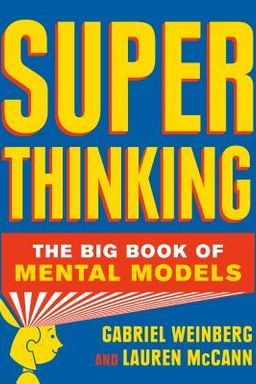
Every day you face complexity—decisions at work, messy social interactions, competing priorities, and swirling news cycles. Trying to reason through each situation from scratch is exhausting and unreliable. Gabriel Weinberg and Lauren McCann’s core argument is that better thinking comes from a toolbox of portable ideas—mental models drawn from science, economics, psychology, and philosophy—that help you make faster, clearer, and more accurate judgments. They call these high-leverage mental models super models because they scale across contexts.
This book is a blueprint for building that toolbox and using it effectively. You’ll learn to form stronger decisions by reasoning from first principles, testing assumptions, managing cognitive biases, anticipating unintended consequences, leveraging time and focus, and designing better experiments. Along the way, Weinberg and McCann weave in lessons from physics, game theory, statistics, and behavioral economics—building a cross-disciplinary latticework of thinking that mirrors Charlie Munger’s philosophy of mental models.
Why Super Models Matter
Complex problems repeat underlying patterns: feedback loops, trade-offs, incentives, and network effects. Equipped with the right conceptual “lens,” you can spot those patterns faster. The model of critical mass—borrowed from physics—helps you see why new social platforms or marketplaces must pass a self-sustaining threshold. Similarly, opportunity cost makes you weigh what you give up when choosing one path over another, and confirmation bias warns you when you’re cherry-picking data.
When you combine such tools across disciplines, you start thinking in systems, not silos. You recognize how incentives shape outcomes, how small feedback loops scale into momentum, and how early assumptions constrain the future—what Weinberg calls “compounding thinking.”
A Multi-Disciplinary Brain
Weinberg and McCann echo Munger’s advice to draw models from many fields. Physics teaches inertia and leverage; economics provides opportunity cost and externalities; psychology explains framing and cognitive traps. Together these models let you run mental “experiments” to anticipate outcomes before committing real resources. The authors’ goal isn’t encyclopedic knowledge—it’s transferable fluency: about 80–90 models account for most reasoning power if practiced across contexts.
Building and Using Your Toolbox
The process is iterative. Start with high-yield models—opportunity cost, compounding, marginal returns—and practice applying them to everyday life. When evaluating a new business idea, check if it reaches critical mass; when debating a project timeline, apply first principles to test which parts are truly necessary. Over time, these patterns become reflexive, like multiplication tables in math. The more you use them, the more they interlock.
Latticework Thinking
Each model acts as a node; connections between them form insight. As with compound interest, applying interlinked models produces exponential gains in judgment.
From Knowledge to Action
Super models aren’t abstract—they become intuition through practice. The authors liken this process to a superhero origin story: you gain an initial power by studying models but mastery through use. Start small—analyze one topic this week with first principles and opportunity cost—then expand. With time, you’ll reduce unforced errors and amplify your ability to learn from feedback, turning thinking itself into a compounding asset.
By the end of the book, you understand not just individual models but a way of thinking that’s self-correcting, adaptive, and antifragile. The reward is practical wisdom—the power to navigate uncertainty with structured creativity and evidence-based confidence.