
Idea 1
You Are Not Your Brain
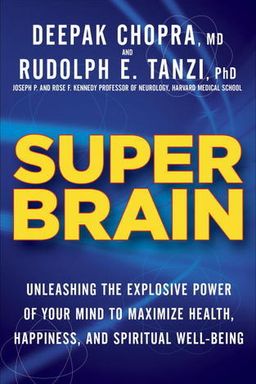
What if your brain were not the commander of your life but the instrument of your mind? In Super Brain, Deepak Chopra and neuroscientist Rudolph E. Tanzi propose a bold vision: the mind is not its brain but its user. You can train, rewire, and even heal your brain through conscious intention. Instead of being a passive passenger ruled by habits, genes, and chemistry, you become the active leader—one who uses awareness to shape thoughts, emotions, and behaviours at a biological level.
The authors fuse Tanzi’s genetic research with Chopra’s spiritual psychology to show that the brain is a dynamic process, not a fixed machine. Neuroplasticity—its ability to reshape itself—is the central proof. This idea reframes human potential: by working with intention and self-awareness, you can become what the authors call a Super Brain, one that serves your growth rather than enslaving you to past conditioning.
The Shift from Passive to Active Mind
For centuries, neuroscience viewed the brain as a hardware device with preset limits: neurons died permanently, aging brought inevitable decline, and genes dominated destiny. Super Brain overturns each of these assumptions. Neuroimaging shows that neurons sprout new dendrites late in life; gene expression shifts in response to environment and meditation; stroke patients recover function by retraining other brain regions. The message: you are not stuck with the brain you have—you are constantly shaping it through thoughts, attention, and experience.
(In Tanzi’s Alzheimer’s research, even damaged neurons show compensatory regrowth, demonstrating this flexible biology.) The mind, as conscious intention, is the force that directs such change. The book’s guiding refrain—“Use your brain; don’t let your brain use you”—captures that reversal. It means learning to notice when you act on automatic pilot and reclaiming leadership over reaction and perception.
Four Roles That Create a Super Brain
To operationalize this idea, the authors describe four roles: leader, inventor, teacher, and user. As leader, you direct your brain through creative commands that invite change, not mechanical repetition. As inventor, you challenge it to learn new skills and form fresh pathways through curiosity and practice—much like the trapeze artists of Cirque du Soleil transforming ordinary bodies into super-acrobats. As teacher, you nourish curiosity and guide your own learning process, choosing engagement over passivity. Finally, as user, you sustain your brain through healthy lifestyle choices, managing stress, sleep, and emotional nutrition.
When all four roles combine, you act as the conscious architect of your neural landscape. The ultimate stage, which Chopra calls the enlightened brain, emerges when you witness your thoughts without becoming them. That detached awareness breaks identification with fear, stress, or ego stories—liberating higher intelligence, empathy, and insight.
Mind and Brain as Reality Makers
Penfield’s neurosurgical experiments, in which electrical stimulation moved patients’ limbs involuntarily, illustrate the core distinction between doing and being done to. You create reality through interpretation, not mere sensation. Awareness allows you to notice the mind’s role in shaping meaning; self-awareness doubles that power by enabling reflection on your own thoughts. The authors distinguish three mental states—unconscious, aware, and self-aware—and show that progress toward self-awareness marks true mastery of the brain.
This insight links neuroscience with ancient philosophy. When the ego insists “I am this way,” it freezes neural learning. When you question that certainty—“Why do I think this way?”—you open new circuits. Each act of witnessing emotion rather than obeying it rewires perception. Reality becomes pliable; emotions like anger or fear become data, not dictators. Through mindfulness, empathy, and curiosity, you shape your internal chemistry toward calm and creativity.
Practical Path of Transformation
Throughout the book, Tanzi and Chopra demonstrate how the same neuroplastic principles underlie memory training, mood regulation, habit change, and even aging. Depression, obesity, and cognitive decline are described as learned brain patterns that can be unlearned through awareness and alternative routines. The Super Brain approach always pairs inner work (thoughts, beliefs, meditation) with outer work (lifestyle, relationships, purposeful activity). This integration makes the program scientific yet humane.
Ultimately, Super Brain is both a practical manual and a philosophy of consciousness. It invites you to see choice where you used to see fate, to treat your brain as a creative partner rather than a mechanical organ. The more intentional your mind becomes, the more responsive your brain grows. What begins as self-care evolves into a new model of human potential—the possibility that through consciousness, biology itself can awaken.