
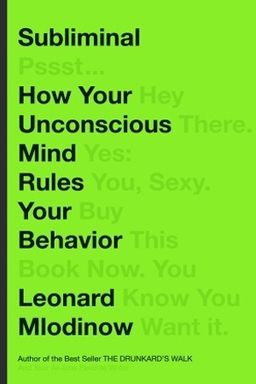
Subliminal cover

Subliminal

by Leonard Mlodinow

Subliminal by Leonard Mlodinow explores the profound influence of the unconscious mind on our everyday behavior. Delving into scientific research and engaging anecdotes, it reveals how unseen mental processes shape decisions, emotions, and social interactions, offering insights to better understand ourselves and others.

The Unconscious Mind Within You

You like to think of yourself as a single, rational mind steering a coherent life. Leonard Mlodinow’s central argument is that this comforting story is incomplete: much of what you perceive, remember, decide, and feel operates beyond your conscious awareness. You live inside a two-tier brain—a fast, automatic unconscious system and a slower, deliberate conscious one. Understanding how these layers collaborate and conflict exposes the hidden architecture of thought, emotion, and behavior.

Drawing on experimental psychology, neuroscience, and real-world case studies, Mlodinow reconstructs the story of the modern unconscious—from the early forced-choice tests of Charles Sanders Peirce to sophisticated brain imaging that reveals activity even when you believe nothing is happening. What emerges is a portrait of the mind as a coalition: a high‑performance unconscious that gathers and integrates sensory and social data, and a limited conscious interpreter that spins narratives after the fact.

From intuition to imaging: finding the hidden layer

Nineteenth-century researchers like Peirce and Joseph Jastrow noticed that people could guess correctly without awareness—the birth of subliminal perception research. Freud later popularized the term “unconscious,” yet lacked the tools to prove its mechanics. Only with technologies such as functional MRI did science witness the unconscious in action. Modern labs can reconstruct images people view, map unconscious face recognition, and trace how unseen signals shape judgments. The “new unconscious,” unlike Freud’s vault of repressed desires, operates as a real-time information processor sculpted by evolution.

Why evolution built a two-speed mind

Your senses provide an overwhelming flood of data—roughly millions of bits per second. Conscious thought can handle only tens. To survive, human brains offloaded the heavy perceptual and emotional labor to unconscious circuits that filter, compress, and interpret. The conscious mind then receives summaries rather than chaos. That trade-off made humans efficient but also prone to systematic errors, biases, and illusions.

Seeing and remembering without awareness

Case studies such as patient TN, a man blind from cortical damage who could nonetheless avoid obstacles, show perception can guide behavior without conscious sight (“blindsight”). Likewise, memory operates as a reconstruction engine. Experiments with eyewitnesses, doctored photographs, and story recall all show that what you remember is not a recording but a dynamic reassembly—an interpretive act shaped by the unconscious mind’s need for coherence. You think you recall an event; often you recall your last telling of it.

Choice, emotion, and the constructed self

When you make decisions—what wine tastes better, which face seems trustworthy, which direction feels safer—the unconscious has already run scenarios before you articulate reasons. Its computations are influenced by cues like packaging, price, facial expression, or posture. Then the conscious mind creates a story explaining the choice, a process researchers call confabulation. Because of this, you often mistake rationalization for reasoning. Even emotions are partly constructed: arousal and context combine to produce feelings that may mislead you about their source.

The social and evolutionary dimension

Your unconscious is deeply social. From infancy you prefer helpers over hinderers, and your mind uses thousands of implicit cues—tone, gaze, micro‑movements, and even gentle touch—to read intent and signal affiliation. The same mechanisms that bind groups together also distort perception through categorization and bias. Evolution equipped these shortcuts to favor kin and allies in small communities; modern life, with its massive and diverse societies, often misfires those instincts.

Core Insight

You are not one story but a collaboration between hidden systems. Understanding their partnership and friction—how the unconscious constructs perceptions, emotions, and choices—gives you leverage to live more consciously while accepting the limits of self-knowledge.

Across the book, Mlodinow shows that appreciating your dual mind has practical consequences. You learn to trust instinct when speed matters, but to verify it when stakes are high; to treat memories as narratives, not archives; and to build empathy for others whose perceptions and biases arise from the same hidden machinery. The “unconscious you” is not a stranger—it is your most loyal collaborator, silently shaping nearly every thought you believe you control.


How Perception Creates Reality

You believe you experience the world as it is, but perception is an active construction. Visual, auditory, and even emotional inputs are edited and stitched together beneath awareness. Mlodinow's exploration of blindsight, visual editing, and subconscious bias reveals that we don’t perceive reality; we build a usable illusion of it.

Seeing without awareness

The phenomenon of blindsight demonstrates how vision works in parallel streams. Patients like TN, whose visual cortex was destroyed, can navigate hallways or detect emotional faces while “blind.” The brain’s subcortical pathways for faces and threats remain operational, guiding action without conscious sight. In everyday life, similar unconscious routes influence your feelings toward people or places before you can articulate why.

The brain as a continuous editor

Your eyes flick about 100,000 times a day. During each movement, the brain suppresses blur, fills gaps, and integrates fragments into a stable scene. It even fabricates what lies in your blind spot. Experiments in phonemic restoration prove your auditory system does the same: when a syllable is replaced by a cough, listeners insist they heard a complete word. These constructive acts help you function in a noisy, fragmented world.

Why unconscious cues dominate first impressions

Because perception is guided by unconscious shortcuts, first impressions form fast and are hard to revise. Split-second cues—posture, pupil dilation, facial expression—trigger affective judgments that color later reasoning. Mlodinow shows how even subtle touches, smiles, or tone shifts alter compliance and warmth ratings. Your experienced confidence that you “see people clearly” is often misplaced.

Practical takeaway

Treat perception as hypothesis, not truth. When judging people, art, or evidence, add deliberate verification steps—notes, replays, or external checks—to counter your brain’s tendency to fill gaps with self-serving stories.

Perception’s constructive nature explains both creativity and illusion. It allows you to imagine, empathize, and innovate, but also to misinterpret. Awareness of this duality is the first step toward wiser observation and less overconfident judgment.


Memory, Narrative, and Invention

Memory feels like a documentary of your life, but it is a story rewritten by the unconscious each time you recall it. Mlodinow combines classic psychology with modern cases like the wrongful conviction of Ronald Cotton to show that remembering is more remembering your last telling than the event itself.

The creative act of remembering

Frederic Bartlett’s “War of the Ghosts” experiments proved how stories become simpler and more conventional with recall. Ulric Neisser's comparison of John Dean’s testimony to Nixon’s tapes shows confidence does not equal accuracy. Memory favors meaning over detail—a capacity adaptive for learning but dangerous in courts or relationships.

Planting and reshaping memory

Psychologists can implant vivid yet false memories through doctored photos or suggestive word lists. Because imagination and memory share neural circuitry, you often can’t tell rehearsal from experience. Change blindness—failing to notice swaps in conversation or scenery—shows your mind records only what it attends to. Your memory’s “editing room” prioritizes coherence over fidelity.

Actionable insight

When accuracy matters, externalize memory. Rely on notes, photos, or recordings rather than confidence. And when emotions run high, recognize that every retelling reshapes your recollection.

Memory’s subjectivity reminds you to practice humility toward your own stories—and empathy toward others whose recollections differ. The point is not that nobody remembers correctly, but that human memory trades precision for meaning, a trade that evolution found worthwhile.


Choice and the Invisible Hand of Context

Everyday choices feel deliberate, but the environment scripts much of your behavior. Mlodinow reveals how subtle context—price tags, portion size, font legibility, or even weather—steers feelings of preference, value, and trust without conscious notice. What seems like free agency often emerges from subliminal cues and shared heuristics.

Subliminal nudges and the brain’s valuation circuits

Studies find identical wines taste better when labeled $90 instead of $10. fMRI scans show identical sensory inputs light up reward areas differently depending on price belief. Pronounceable ticker symbols perform better at IPO; sunshine correlates with market optimism. The unconscious mind continually maps cues onto feelings of value and fluency.

Scripts and social automation

You also follow automatic social scripts. A single word like “because” raises compliance even with meaningless reasons. People treat computers as social actors, mirror teacher expectations (the Pygmalion effect), and react predictably to politeness formulas. Your culture trains these shortcuts to conserve attention; marketers and institutions leverage them to guide action.

Practical checkpoint

Slow decisions down. Mask labels, anonymize evaluations, or seek blind comparisons when authenticity matters. By removing contextual cues, you recover a fraction of true deliberation.

Recognizing context dependence doesn’t make you less human—it makes you more conscious. Society, markets, and relationships all exploit the same scripts; awareness lets you rewrite them in your favor.


Social Minds and Hidden Connections

Human intelligence is social intelligence. Mlodinow demonstrates that the unconscious mind evolved for connection: reading faces, sensing status, bonding through hormones, and feeling literal pain at rejection. From infants preferring helpers to adults swayed by a handshake or voice tone, your brain runs an ancient cooperation‑detection program.

The chemistry of bonding

Oxytocin and vasopressin underlie attachment across species. Prairie voles with dense receptor networks mate for life; their cousins without them remain solitary. In humans, inhaled oxytocin increases trust in games and genetic differences correlate with relationship stability. Touch, mediated by C-tactile fibers, activates emotional brain regions and fosters cooperation even when unnoticed.

Nonverbal communication as unconscious language

Every interaction leaks information. Facial micro‑expressions, gaze duration, and body posture silently convey dominance, interest, or empathy. The visual dominance ratio—how much you look while speaking versus listening—signals status within seconds. Darwin’s Duchenne smile and modern gaze research prove authenticity and hierarchy operate through muscles and milliseconds, not words.

Social pain and survival

The anterior cingulate processes both physical pain and social rejection. Experiments showing Tylenol blunts feelings of exclusion highlight how deeply physical loneliness is. Chronic isolation elevates death risk comparable to smoking. Your need for connection is not psychological weakness—it is biological necessity.

Applied wisdom

Invest in relationships as you would health. When leading teams, attend to rituals and shared goals: belonging fuels performance as much as strategy.

The social brain explains friendship, empathy, and prejudice alike. The same circuits that bind families also create favoritism and in‑group bias, reminding you to design cooperation intentionally rather than assume it.


Bias, Categorization, and Groupthink

Your brain saves energy by sorting people into categories. That shortcut, adaptive for survival, becomes dangerous in complex societies. Mlodinow connects cognitive grouping, implicit bias, and group conflict, showing how minimal distinctions can generate stereotyping and hostility—and how shared goals can reverse them.

The mechanics of categorization

Henri Tajfel’s line‑length experiments showed that labeling two sets made participants exaggerate differences between them. This bias scales up to social life: clothing, accent, or profession trigger assumed traits. Categorization is inevitable; stereotype is its runaway form. Walter Lippmann’s observation that media provides ready‑made stereotypes remains true in the digital age, where algorithms amplify group labels.

Implicit bias: the unseen association

The Implicit Association Test reveals that even well‑intentioned people unconsciously link groups with traits—such as men with science or certain names with competence. Field experiments show identical resumes rated differently by presumed identity. Much discrimination occurs without overt intent, leaving law and ethics lagging behind science.

In‑groups, out‑groups, and conflict

Muzafer Sherif’s Robbers Cave study proved that arbitrary group creation breeds rivalry; superordinate goals, like restoring a broken water supply, dissolve animosity. Tajfel’s minimal‑group paradigm showed favoritism even with random labels. The takeaway is unsettling: you don’t need history to discriminate—mere categorization suffices.

Reducing bias

Expose yourself to individuating evidence—real people defy category averages. Create shared goals that force collaboration across lines. These strategies retrain the unconscious network that fuels prejudice.

Bias is a by‑product of human cognition, not its defect. The challenge is to notice when categories harden into moral divisions and to re‑educate the unconscious through exposure, empathy, and design of inclusive systems.


Emotion, Rationalization, and the Stories We Tell

Feelings and explanations often arrive after their causes. Mlodinow gathers findings on emotional construction, misattribution, confabulation, and motivated reasoning to show that your sense of knowing why you act is partly illusion. Yet these illusions sustain motivation and coherence.

Constructing emotion

Following William James, modern research affirms that bodily arousal precedes conscious feeling. In Schachter and Singer’s Suproxin experiment, uninformed participants mirrored a confederate’s mood because they lacked an explanation for adrenaline’s effects. The bridge study by Dutton and Aron extended this to attraction: fear on a shaky bridge increased romantic interest. Your brain continuously interprets bodily noise into emotion narratives.

Confabulation and choice blindness

Split‑brain studies and sleight‑of‑hand experiments demonstrate your mind’s storytelling reflex. Participants justify choices they never actually made, inventing reasons that fit cultural expectations. The conscious mind values coherence more than accuracy—it prefers being confidently wrong to being uncertain.

Motivated reasoning and the positive illusion

You evaluate evidence like a lawyer arguing for your side. Neuroscientific studies show reasoning recruits emotional circuits. People see themselves as above average, CEOs overpay for acquisitions, and negotiators predict favorable verdicts. These self‑enhancing distortions can be maladaptive—but also fuel perseverance and creativity. Optimism keeps you building bridges you otherwise wouldn’t cross.

Balanced mindset

Harness the energy of positive illusion but check it with structured skepticism: pre‑mortems, outside forecasts, and candid critics ground ambition in reality.

Ultimately, emotions and explanations are creative acts by the unconscious storyteller. Self‑knowledge means treating your own reasons as hypotheses—plausible, sometimes productive, but rarely complete truths.

Dig Deeper

Get personalized prompts to apply these lessons to your life and deepen your understanding.

Go Deeper

Get the Full Experience

Download Insight Books for AI-powered reflections, quizzes, and more.