
Idea 1
Stuffocation and the Search for Meaning
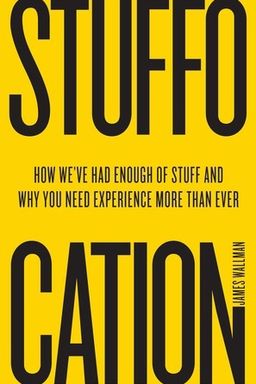
What happens when everything you buy starts owning you? In Stuffocation, James Wallman argues that modern societies are drowning in excess possessions, producing anxiety and fatigue rather than fulfillment. He calls this new malaise “Stuffocation”—a mix of clutter, stress, and loss of meaning caused by overconsumption. Drawing together psychology, economics, and cultural studies, Wallman proposes a way out: replacing materialism with what he calls experientialism—a focus on doing rather than having.
The book traces how you arrived at this point. It opens with the story of Ryan Nicodemus, who packed up his entire home for 21 days to test what he truly used. Like many in the growing minimalist movement, he found freedom in less. But Wallman argues that decluttering is only the symptom’s treatment, not the cure; the real shift is cultural and psychological—a redefinition of success from possessions to lived experiences.
From Material Overflow to Public Health Concern
Clutter is not harmless. Research from UCLA’s Center on the Everyday Lives of Families (CELF) found that typical U.S. homes contain thousands of visible items—so many that garages became unparkable storage. Scientists like Darby Saxbe and Rena Repetti discovered that women who described their houses as cluttered exhibited biological patterns linked to chronic stress. Clutter, Wallman argues, is the domestic version of pollution: an invisible force shaping health and happiness.
He likens Stuffocation to obesity: an abundance once considered a blessing now undermines well-being. Both emerge from ancient instincts—to store food or possessions—that misfire in an age of abundance. Both require cultural reprogramming rather than simple restraint.
How We Became Stuffocated
To explain how excess became desirable, Wallman journeys through history. In the early 20th century, American industrialists faced overproduction. Rather than reduce output, advertisers and economists decided to manufacture desire itself. Figures like Earnest Elmo Calkins and Edward Bernays pioneered “psychological capitalism,” teaching consumers to want what they didn’t need. Planned obsolescence, annual model updates, and decorative redesigns kept the economic engine whirring—and the garage filling.
The culture of “keeping up with the Joneses” soon extended to nations—Richard Nixon’s 1959 “Kitchen Debate” with Khrushchev showcased appliances as ideological weapons. Consumption became patriotic proof that capitalism cared for its citizens. Wallman reframes this as the key pivot: the transformation of production need into cultural virtue.
Behavioral Loops That Keep You Buying
Why do you still crave things you know bring fleeting joy? Wallman integrates insights from behavioral economics—Brian Wansink’s studies on mindless eating—and evolutionary psychology. Humans evolved to hoard calories and resources when available. In a world of scarcity, that impulse ensured survival; in an age of abundance, it fuels shopping addictions. Hedonic adaptation guarantees that each new purchase delivers only temporary satisfaction, while social comparison ensures you’re never done striving.
Advertising exploits this mismatch, orchestrating environments that amplify reward cues. You buy because you’re primed, not because you consciously choose. Wallman emphasizes that Stuffocation is not a moral failing—it’s a mismatch between ancient wiring and modern abundance.
The Perfect Storm for Change
Despite these forces, the tide is shifting. Wallman cites sociologist Ronald Inglehart’s evidence from the World Values Survey showing that materialist values have fallen sharply across industrialized nations. Younger generations value time, meaning, and experiences over possessions. Urbanization (smaller homes), environmental awareness, and digital access (streaming instead of owning) all converge to make material downsizing appealing. Even crises like the 2008 recession intensified reflection on what really matters. The conditions for cultural pivot, Wallman argues, are now in place.
Toward a Life That Means More
Wallman’s core proposition is deceptively simple: happiness comes from experiences, not things. Experiences build memories, shape identity, and foster connection. They are less prone to envy, harder to commodify, and easier to reframe as positive. “Experientialism,” the worldview that places doing above having, becomes his solution to the modern crisis of meaning. It doesn’t demand renunciation like monastic minimalism; it proposes a modern reallocation—fewer objects, richer living.
Throughout the book, you meet minimalists, simple-living advocates, and experience-seekers—from Tammy Strobel in her 150-square-foot home to Cliff Hodges leading wilderness adventures. Wallman shows you that Stuffocation is not solved by subtraction alone, but by reconstructing status, identity, and joy around lived experiences. His journey ends not in deprivation, but in a vision of prosperity measured by time, relationships, and meaning rather than by what clutters your shelves.