
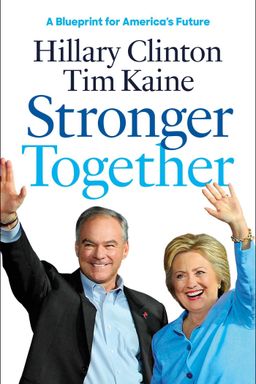
Stronger Together cover

Stronger Together

by Hillary Clinton, Tim Kaine

Stronger Together offers an in-depth look at Hillary Clinton and Tim Kaine''s policy proposals for the 2016 election. It reveals their plans for affordable education, fair wages, economic growth, and global security, providing a comprehensive blueprint for America''s future.

Stronger Together: A Blueprint for an Inclusive America

What would it mean to rebuild America—its economy, its communities, its politics—around the simple idea that we are stronger together? In their book Stronger Together, Hillary Clinton and Tim Kaine set out to answer that question with a sweeping, detailed vision for an America where collaboration, compassion, and equality replace division, greed, and inequality. The authors argue that unity is not just a moral ideal but an economic and national imperative. By working together—across racial, economic, and political divides—the nation can create shared prosperity at home and stronger partnerships abroad.

Clinton and Kaine contend that the United States faces intertwined crises: economic inequality, political paralysis, and social fragmentation. Their solution is not incremental but structural—rebuilding systems so that people, not corporations or the wealthy few, are the heart of policy. The book positions programs like debt-free college, paid family leave, campaign finance reform, and criminal justice reform as both moral necessities and engines of growth. The core argument: America’s greatness has always come from its ability to expand opportunity and inclusion—and that same spirit must guide solutions today.

The Three Pillars of a Stronger America

The book is structured around four major sections—economic growth, national security, social unity, and political reform—but its central themes coalesce around three big ideas. First, an economy that works for everyone. Clinton argues this can be achieved through massive investments in infrastructure, clean energy, small business, and manufacturing, rather than more tax cuts for the wealthy. Second, a nation that leads by example. America’s strength abroad, the authors say, must come from its alliances, not isolationism, and from its compassion, not fear. And third, a democracy that empowers all citizens. They call for overturning Citizens United, protecting voting rights, and ensuring that every American has an equal voice in shaping the nation’s future.

Stories of Ordinary Strength

The book weaves in personal stories—from Flint parents fighting lead contamination to veterans rebuilding their lives after service—to highlight how real Americans embody resilience and interdependence. Hillary shares how her father’s modest upbringing in Scranton and her mother’s struggle as an abandoned child shaped her conviction that “no one gets through life alone.” Tim Kaine recalls his father’s ironworking shop and his own mission work in Honduras, illustrating how faith and labor inform his optimism that government can advance justice.

These anecdotes ground the policy-heavy narrative in human experience: the grandmother caring for a child while supporting her ailing mother, the veteran navigating a flawed VA system, the immigrant striving to learn English and become a citizen. They exemplify the book’s thesis that every American—whether factory worker or entrepreneur, teacher or soldier—has a role in building a more perfect union.

Why This Vision Matters Now

Written during the 2016 campaign, Stronger Together reads as both a political manifesto and a roadmap for post-partisan governance. Its authors confront cynicism directly, acknowledging that many Americans no longer trust government to deliver results. Yet they insist that the nation’s greatest accomplishments—from the GI Bill to the interstate highways to Medicare—came when leaders invested collectively in people’s potential. They argue that democracy functions best when it uplifts rather than divides, protects rights rather than wealth, and listens more than it lectures.

In essence, the book is both moral philosophy and policy handbook. It asks: What does it mean to keep America’s founding promise in an age of global complexity and inequality? Its answer combines empathy with pragmatism: listen to the public, invest in shared success, and never give up on the idea that progress—while slow and messy—is possible when people work together. This spirit of civic optimism, deeply woven into both authors’ personal stories, stands as the antidote to despair and division.


Building an Economy for Everyone

Clinton and Kaine open their agenda with an ambitious promise: to create the boldest investment in good-paying jobs since World War II. They paint a picture of an America where everyone—not just the wealthy—benefits from economic growth. The authors reject trickle-down economics as a failed experiment and instead propose what they call a 'bottom-up and middle-out' approach. Their message: prosperity grows when workers have power, security, and opportunity.

Infrastructure and Innovation

They commit to rebuilding the nation’s infrastructure—the highways, bridges, schools, and broadband connections that make economic life possible. Clinton argues that federal investment will create millions of jobs while strengthening competitiveness. The plan also includes modernizing water systems to prevent disasters like Flint’s poisoned pipes and expanding clean energy technologies to make the U.S. a 'clean energy superpower.' By 2020, every household should have access to affordable broadband; by 2025, half the nation’s electricity should come from clean, zero-carbon sources.

These proposals recall Franklin D. Roosevelt’s New Deal and Dwight Eisenhower’s interstate highway system—massive public projects that reshaped both economy and society. But Clinton updates the vision for the twenty-first century, linking infrastructure to climate resilience and technological equity.

Manufacturing and Small Business

In the face of globalization, the book devotes special attention to manufacturing and small business. The authors highlight successful initiatives like 'Make It in America Partnerships,' which connect local industries, universities, and governments to drive regional innovation. The goal is to rebuild entire supply chains domestically and ensure workers share in the wealth created. Clinton cites Youngstown, Ohio’s additive manufacturing hub as a prototype for the future.

Small businesses—the “job engine of America”—get their own chapter. The plan includes doubling funding for community development financial institutions to extend credit to women-, veteran-, and minority-owned enterprises. For entrepreneurs burdened by student debt, the 'Let’s Start Something' initiative allows them to defer loan payments while launching their ventures.

Tax Fairness and Corporate Responsibility

The authors argue that corporate greed and tax loopholes have eroded trust and opportunity. They call for closing the 'Bermuda reinsurance' loophole, ending inversions (companies shifting headquarters overseas to dodge taxes), and imposing a risk fee on large financial institutions. The 'Buffett Rule' would require millionaires to pay at least a 30% effective tax rate. These measures aim to restore fairness and rebuild public confidence in capitalism’s moral compass.

By combining structural reforms with targeted investments, Clinton and Kaine imagine an economy where prosperity reaches Main Street, not just Wall Street. It’s a deliberate counterpoint to decades of policy privileging profit over people—a call to rewrite the rules of American capitalism around shared gain.


Putting Families First

Clinton calls 21st-century family life 'an old system in a new world.' Most families, she notes, have all parents working, yet workplace policies still assume someone is home full-time. To fix this disconnect, she proposes a suite of policies designed to make work and family compatible rather than competing priorities. Paid family leave, affordable childcare, equal pay, and eldercare support are central pillars.

Childcare and Early Education

They pledge that no family should spend more than 10% of income on childcare. Federal subsidies and tax credits would make high-quality childcare accessible, while initiatives like the RAISE program would improve pay for caregivers. Universal pre-K for 4-year-olds is another cornerstone—rooted in studies linking early education to long-term success. (This aligns with research by James Heckman on early childhood investment returns.)

Paid Family and Medical Leave

The U.S. remains the only industrialized nation without guaranteed paid leave. Clinton’s plan guarantees up to twelve weeks of paid leave for new parents or anyone caring for a sick relative, with two-thirds wage replacement funded without burdening small businesses. The idea echoes policies in countries like Sweden and Canada, seen as engines of both gender equality and productivity.

Equal Pay and Caregiver Support

At its core is the unfinished battle for gender parity. Clinton calls for passing the Paycheck Fairness Act, raising the minimum wage, and ending the subminimum wage for tipped workers. Family caregivers—often women in the “sandwich generation”—would gain a 20% tax credit on up to $6,000 in care costs and earn Social Security credits for time spent caregiving. Through these steps, the authors connect economic equality to family dignity, arguing that supporting families is not just compassionate policy—it’s smart economics.


Making Education Accessible for All

Education, Clinton writes, is 'the key to everything we want to achieve as a country.' The book contends that opportunity must exist from preschool to college, and that cost should never block potential. The flagship idea is the 'New College Compact'—a plan to make debt-free college a reality and reform a system that traps students in lifelong debt.

From Preschool to High School

Every four-year-old should have access to preschool within ten years, the authors promise. Schools should be modernized and teachers paid as if “the future of the country is in their hands—because it is.” They advocate for community schools that combine education with wraparound services, closing achievement gaps for low-income and minority students. Computer science is elevated to 'basic literacy,' with new federal support for coding education.

Debt-Free College

The New College Compact would eliminate tuition for students from families earning under $125,000, and make community college free for all. States would receive federal funding if they reinvest in higher education instead of cutting budgets. A $25 billion fund would support historically Black colleges and minority-serving institutions. Students would work ten hours weekly, fostering responsibility while reducing loans.

Borrowers in debt would get relief through refinancing at lower rates, income-based repayment capped at 10% of income, and a three-month moratorium to help every borrower re-enroll in affordable plans. The goal: to free 40 million Americans from crushing student debt and ignite a new generation of economic mobility.


Health, Wellness, and Dignity

Health, according to Clinton and Kaine, is a right, not a privilege. Building on the Affordable Care Act, they propose expanding coverage, controlling costs, and addressing mental health, addiction, and Alzheimer’s with the seriousness these crises deserve.

Protecting and Expanding the ACA

Twenty million Americans gained coverage under Obamacare, but millions remain uninsured. The authors push Medicaid expansion in all states and propose a public option for every American and Medicare buy-ins for those over 55. Community health centers would be doubled in funding to reach underserved areas, and a new refundable tax credit up to $5,000 would ease out-of-pocket costs.

Mental Health and Addiction

They champion parity between mental and physical health, suicide prevention programs, and integrated care. Addiction is treated as a chronic illness requiring compassion and ongoing treatment, not incarceration. Every first responder would carry naloxone to prevent opioid overdoses. States would qualify for grants if they develop comprehensive prevention and treatment strategies.

A Cure for Alzheimer’s by 2025

The book’s most ambitious health goal is to make an Alzheimer’s cure possible by 2025 through a $2 billion annual investment. Family caregivers would gain tax relief and Social Security credit for unpaid care work. Together, these health initiatives reveal a moral economy grounded in care, science, and shared responsibility.


Defending Democracy and Voting Rights

In the final section, Clinton and Kaine tackle a deeper illness in American life: the erosion of democratic trust. They link stagnant wages and political dysfunction to a system captured by big money and voter suppression. To fix democracy, they propose both structural and cultural repair.

Fixing Campaign Finance

Their first step is to overturn Citizens United through a constitutional amendment and appoint justices who value the people’s right to vote over billionaires’ right to buy elections. A small-donor matching system would amplify ordinary voices, while publicly traded companies and federal contractors would be required to disclose political spending. Clinton promises executive action to enforce transparency if Congress refuses.

Protecting the Right to Vote

The authors describe a “sweeping effort” to disenfranchise poor and minority voters since the Supreme Court gutted the Voting Rights Act in 2013. Their solution: restore the Act’s full power, enact automatic voter registration at eighteen, ensure twenty days of early in-person voting, and guarantee that no one waits more than thirty minutes to cast a ballot. These policies echo the civil rights reforms of the 1960s, modernized for a digital democracy.

Ultimately, Clinton and Kaine close on a note that’s both practical and idealistic: democracy depends on listening. “Americans shouldn’t have to scream to be heard.” Government works when it sees the details of daily life—lead in water, asthma inhalers, student loans—not as small matters, but as the stuff of justice itself.

Dig Deeper

Get personalized prompts to apply these lessons to your life and deepen your understanding.

Go Deeper

Get the Full Experience

Download Insight Books for AI-powered reflections, quizzes, and more.