
Idea 1
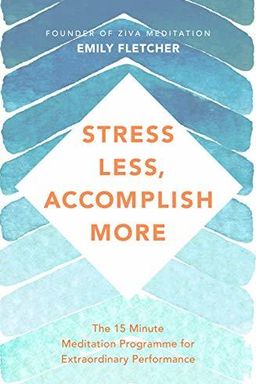
Stress Less, Accomplish More: Unlocking High Performance Through Meditation
What if the secret to doing more, performing better, and aging more gracefully wasn’t another productivity hack—but simply learning to stress less? In Stress Less, Accomplish More, Emily Fletcher argues that the key to high performance lies in mastering meditation designed for real-world achievers, not monks. Having spent years on Broadway before becoming a renowned meditation teacher, Fletcher discovered firsthand that constant stress drains creativity, health, and vitality. Her book teaches how the Ziva Technique—a three-part system of Mindfulness, Meditation, and Manifesting—can transform how you work, think, and live.
Fletcher’s central claim is that stress is not an inevitable price of success but a false idol. “There is no such thing as a stressful situation, only stressful responses,” she writes, drawing on neuroscience and ancient Vedic traditions. The book argues that meditation, properly understood, doesn’t make you passive or detached from ambition—it makes you sharper, more intuitive, and ultimately more productive. By managing your stress at a cellular level and upgrading your brain’s “hardware,” you create time instead of losing it.
Why Meditation Matters for Busy People
Fletcher dismantles the myth that meditation is for people with endless free time or spiritual aspirations. She positions it as a practical performance tool, akin to brushing your teeth—mental hygiene for modern life. Stress activates the body’s fight-or-flight mode, flooding the nervous system with acidic chemicals like cortisol and adrenaline. When those hormones become chronic, they fry the brain’s circuits, erode adaptation energy, and weaken immunity. Meditation reverses that chemistry, producing alkaline bliss molecules—dopamine and serotonin—that repair the body and balance the mind.
Drawing from studies at Harvard, UCLA, and Carnegie Mellon, Fletcher explains that meditation thickens the corpus callosum (the bridge between left and right hemispheres), increasing harmony between analytical thought and creative intuition. The result: better decision-making, emotional resilience, and what athletes call “flow state.” Once stress is reduced, the right brain awakens, and life begins to operate from creativity rather than reactivity.
The Ziva Trifecta: Mindfulness, Meditation, and Manifesting
The book’s structure mirrors Fletcher’s three-part technique. She differentiates mindfulness (managing stress in the present moment), meditation (releasing stress from the past through deep rest), and manifesting (using clarity to design your future). Each serves a distinct neurological purpose. Mindfulness centers awareness in the “now,” meditation cleanses the body of old stress, and manifesting engages gratitude and visualization to shape desired outcomes.
Think of the process as a cycle, she says: mindfulness is the appetizer, meditation the main course, and manifesting the dessert. This combination creates what Fletcher calls “union attained by action hardly taken”—you achieve profound transformation not by forcing stillness but by surrendering effort.
Meditation for Modern Achievers
Unlike monastic meditation traditions, the Ziva approach is built for “householders”—people with jobs, families, deadlines, and ambitions. The technique teaches you to meditate anywhere: on a subway, in an office, or between client calls. The goal isn’t to escape the world but to meet it more elegantly. Fletcher reminds readers, “We meditate to get good at life, not to get good at meditation.” This down-to-earth redefinition makes her system both accessible and scientifically credible.
By training the nervous system to de-excite, you gain deep rest for the body—rest that’s up to five times deeper than sleep—while awakening your brain’s creative capacity. As stress falls away, you recover vast reserves of adaptation energy. In practical terms, you accomplish more with less effort, make decisions with sharper intuition, and stop reacting to life like a tiger attack (her favorite metaphor).
Why These Ideas Matter
We live in a culture that worships busyness and caffeine as proof of productivity. Fletcher shows how this mindset literally “pickles the body,” aging us prematurely and deteriorating cognitive performance. Through meditation, you reset your biological and mental baseline to operate from bliss rather than survival. The payoff isn’t just personal—it ripples out into the world. As she writes in later chapters, healing your own stress heals the collective, replacing fight-or-flight reactivity with empathy and generative creativity.
“Would you be willing to invest 2 percent of your day if it improved the other 98 percent?” Fletcher asks. That’s the promise of Ziva: thirty minutes of daily practice unlocking a lifetime of mental clarity, resilience, and joy.
By combining ancient Vedic wisdom with modern neuroscience, Stress Less, Accomplish More is both pragmatic and profound. Fletcher’s message—stress doesn’t make you productive; it makes you stupid—is backed by data and lived experience. Her ultimate goal is simple yet revolutionary: transform success itself from a product of pressure into a natural outcome of presence.