
Idea 1
Survival, Memory, and the Architecture of Repair
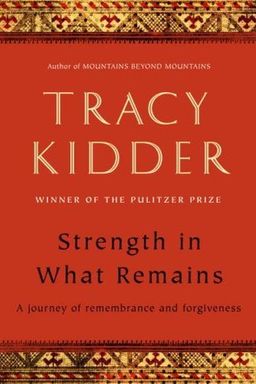
When you trace Deo’s life across war, refugee flight, and reconstruction, you see more than survival—you see the architecture of repair. The book (drawn from Tracy Kidder’s Strength in What Remains) argues that a human life is not just a reaction to catastrophe but a gradual rebuilding that turns vulnerability into vocation. Through Deo’s journey—from massacres in Burundi and Rwanda to medical study in New York and finally the founding of Village Health Works in Kayanza—you witness how trauma, education, kindness, and structural vision combine to make survival meaningful.
At its core, the narrative asks: how do you rebuild when history itself seems bent on erasure? Deo’s answer unfolds through the book in several layers—flight, hardship, networks of rescue, internal silence, intellectual awakening, and purposeful return. You can think of it as an arc from chaos toward creation.
From Violence to Flight
The story begins amid Burundi’s ethnic upheaval. Long histories of Hutu–Tutsi division, hardened by colonial categorizations and post‑independence revenge cycles, frame the outbreak of killings in 1993. Deo, a Tutsi medical student, flees as Mutaho hospital turns into a massacre site. You see the texture of his escape through forests, massacre zones like Murambi, and border rivers such as the Akanyaru and Mubarazi. Each movement depends on minute discernment—accents, birds, smells. Survival here is cognitive and physical improvisation, not heroic quest.
A nameless Hutu woman’s compassion launches the second stage: flight across borders and continents. Deo’s suitcase holds a French dictionary, stethoscope, and textbook—symbols of identity and aspiration. Each airport stop tests his legitimacy; a Senegalese handler named Muhammad ultimately rescues him in New York, affirming that borders are moral tests rather than merely geographic.
Urban Poverty and Help
New York appears less refuge than ordeal. Deo sleeps in parks, delivers groceries for $15 a day, and learns English by necessity. Yet each encounter becomes a fragment of redemption. A porter named Sharon McKenna shelters him and advocates endlessly; Nancy and Charlie Wolf open their home—the “Black Hole”—and eventually sponsor his education. Lawyer James O’Malley secures legal status; Paul Farmer and Joia Mukherjee at Partners In Health (PIH) provide professional inclusion. You recognize a fragile network of mercy—ordinary people improvising what formal systems fail to offer.
These helpers carry moral complexity. Deo’s gratitude mixes with shame; dependency feels like exposure. He hesitates to recount stories due to gusimbura, the Burundian practice of avoiding names of the dead. Help demands speech; speech threatens memory. The result is both healing and uneasy gratitude—a pattern that recurs throughout his life.
Education and Reinvention
Education becomes his stabilizer. From a village contest for a cow to medical studies in Bujumbura, then ESL classes and degrees at Columbia, learning restores coherence. It transforms him from refugee into scholar. Later he joins Columbia’s and Harvard’s public health programs, advancing toward the vision of medicine as social justice—a notion mirrored in Farmer’s concept of structural violence (poverty and inequality embedded in institutions).
Each exam, textbook, and library desk acts as a psychological brace: the rhythm of study replaces the rhythm of fear. This educational persistence converts memory into knowledge and ambition into responsibility.
Trauma, Silence, and Cultural Survival
Deo’s trauma does not vanish—it evolves. Nightmares follow him, and triggers like drums or the word “April” reopen wounds. But cultural silence becomes strategy: gusimbura helps manage pain by limiting speech. Over time, controlled remembrance emerges—he tells selected fragments, then stops. Partners In Health’s community offers a space to narrate responsibly. By choosing purposeful conversation over raw confession, Deo reinvents testimony as collaboration.
This synthesis of cultural restraint and Western therapeutic openness invites reflection on healing across societies: sometimes silence protects; sometimes shared story releases. Deo’s refusal of psychiatric labeling underscores autonomy—his coping belongs to lived experience, not clinical categories.
Purpose and Return
The final transformation occurs when Deo channels survival into service. Reading Farmer’s Infections and Inequalities becomes revelation: illness and injustice are linked. Joining PIH provides a model—treat and prevent simultaneously. He carries that logic home, founding Village Health Works in Kayanza. The clinic grows through local initiative: villagers build roads, committees form, women lead, and donors contribute solar power and computers. “It’s a sunflower seed,” Deo says—small, but bound to grow.
Eventually, the clinic becomes a structural remedy to structural violence. Health care without user fees, local governance, and communal labor symbolize not only reconstruction but moral argument. By integrating memory with material action, the book demonstrates that human resilience can become institutional—a bridge between remembrance and prevention.
From Memorial to Reconciliation
Deo revisits memorial sites like Murambi and Kibimba, confronting bones and slogans—“Never Again.” His insight: progress demands both mourning and creation. Memory must be practiced as empathy, not inertia. In Kayanza, reconciliation happens through shared labor on clinic grounds rather than speeches. You end understanding that forgiveness is work, not words.
The book’s argument in essence
Survival depends on human bridges, memory must be carried not cured, and real healing arises when private pain leads to public purpose. The strength in what remains is not merely endurance—it is the capacity to build meaning after devastation.