
Idea 1
The Strategic Code Behind Legendary Leaders
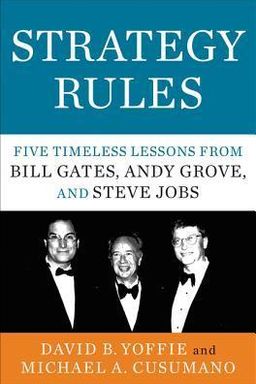
Why do some leaders seem to see the future before everyone else—and reshape entire industries while others struggle to catch up? In Strategy Rules, Michael Cusumano and David Yoffie pull back the curtain on three of the most influential CEOs of the technology era—Bill Gates, Andy Grove, and Steve Jobs—to uncover the shared strategic mindsets that defined their success. The authors argue that these men, despite their contrasting personalities and leadership styles, practiced a consistent set of strategic principles that anyone can learn and apply. They weren’t lucky geniuses or mere visionaries. They were disciplined learners who honed the ability to connect long-term vision with short-term execution.
Cusumano and Yoffie contend that being a master strategist is not about predicting the future, but creating it through systematic decision-making and disciplined action. They identify five universal principles—what they call the “strategy rules”—that shaped Microsoft, Intel, and Apple into enduring industry titans. These rules center around foresight, risk management, platform thinking, tactical competition, and organizational design. The magic lies not in charisma or luck but in pattern recognition: Gates, Grove, and Jobs approached complex decisions using similar mental playbooks.
Learning from Titans: The Context
The book paints vivid portraits of its subjects at pivotal moments. Gates, a pragmatic software coder, turned Microsoft from a scrappy startup into a near-monopoly by envisioning software as the engine at the heart of computing. Grove, a refugee from Hungary turned Intel engineer, transformed a manufacturing company into a global innovation machine through operational precision and paranoia. Jobs, the mercurial showman, reinvented Apple through his obsession with design, simplicity, and customer experience. Each challenged conventions and used strategy not as a theoretical framework but as a practical tool to win wars against uncertainty.
Their combined stories reflect how the speed of technological change amplifies the need for adaptability. The book begins with a candid insight: great strategy is inseparable from great execution. The authors pose the timeless question that students often ask—what matters more, strategy or execution? The answer, echoed by Gates himself, is “neither alone.” Both must reinforce each other in a continuous feedback loop. A poorly executed brilliant idea is worthless, but perfect execution of a flawed strategy is equally fatal. The focus must be on cultivating the ability to marry foresight to discipline.
Why These Rules Matter for You
The book’s framework is not limited to Silicon Valley. It’s a lens for anyone who must navigate change—whether running a start-up, leading a team, or steering a legacy organization. Technology industries serve as a fast-moving laboratory where cause and effect can be observed in years, not decades. As the authors note, “tech companies are the fruit flies of the business world”—highly observable, short-lived, and endlessly instructive. From these experiments, they extract timeless lessons about how to think strategically when stakes are high and information is incomplete.
Each of the five rules represents a facet of strategic mastery:
- Look forward, reason back: Start by envisioning the future you want and then reverse-engineer the steps to get there—anticipating customers, competitors, and industry shifts before they appear.
- Make big bets without betting the company: Be bold but calculated; win large while protecting survival through timing, diversification, and learning from failure.
- Build platforms and ecosystems—not just products: Understand that enduring advantage comes from systems that attract partners, not just one-off innovations.
- Exploit leverage and power—play judo and sumo: Combine agility with strength, using subtle competitive tactics alongside brute force when necessary.
- Shape the organization around your personal anchor: Harness your unique strengths to define culture and execution, while offsetting weaknesses through the right partners and systems.
Through these lenses, Cusumano and Yoffie show how strategic genius is less about intuition and more about disciplined learning. The takeaway is that strategic thinking can be cultivated—by relentlessly asking “what’s next,” by reasoning backward from the future rather than forward from the past, and by building organizations designed to adapt rather than react. Each rule becomes a lens you can apply to your own decisions. As modern leaders like Jeff Bezos, Mark Zuckerberg, Larry Page, and Pony Ma emulate these playbooks, Strategy Rules serves as the field manual for the next generation of innovators.