
Idea 1
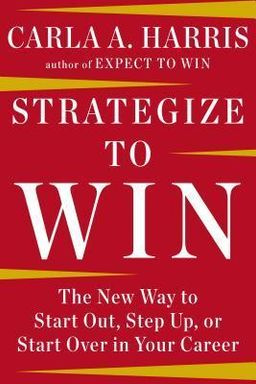
Strategize to Win: Reimagining Your Career Playbook
How can you build a career that not only endures turbulent economic times but also thrives within them? In Strategize to Win, executive leader and author Carla A. Harris argues that success in the modern professional world requires explicit strategy—not luck, loyalty, or longevity. She contends that what used to work—staying with one company for decades and moving quietly up the ranks—has become obsolete. Today, your career must be actively managed like any other investment: adaptable, intentional, and fueled by what Harris calls performance currency and relationship currency.
Harris’s message, built on decades of experience on Wall Street and expanded from her earlier book Expect to Win, is both practical and personal. She offers a roadmap for anyone starting out, stepping up, or starting over in their career. Her goal is to help you not only find fulfilling work but learn how to position yourself for long-term influence—what she calls your professional platform.
Rethinking the Career Ladder
Once, climbing the ladder meant staying inside one company’s four walls for your entire working life—an era when a twenty-five-year tenure at IBM or Chase Manhattan Bank symbolized success. Harris argues that those days are gone. Technology has disrupted industries, flattened hierarchies, and shortened organizational life cycles. Today, you must think of your career as a series of five-year “modules,” each building new content and positioning you for the next phase. You might work for six different companies—or even several industries—but each module should deliberately expand your skills, networks, and exposure. As Harris writes, success is now about movement with intention rather than loyalty for its own sake.
From Content to Currency
In the book’s first section, “Starting Out,” Harris explains why many professionals feel disoriented after graduation or a career setback: they chase jobs instead of content. Content, she says, is the foundation—the building blocks of what you love doing, what stimulates your intellect, and what contributes to growth. By identifying the components that make you eager to work each day (analysis, creativity, teamwork, persuasion), you create a compass to guide your decisions, even when economic conditions are tough. Content fuels motivation and adaptability; jobs come and go.
But mastery of content alone isn’t enough. Once inside an organization, Harris shifts focus to two essential currencies. Performance currency is earned by delivering outstanding work repeatedly; it builds your reputation for execution. Relationship currency is developed through genuine connections that make people want to advocate for you when decisions are made behind closed doors. Over time, performance currency delivers diminishing returns while relationship currency becomes the distinguishing factor for promotions and leadership roles. (Note: Harris’s focus on workplace networks echoes Adam Grant’s “Give and Take,” which explores how strategic generosity enhances influence.)
Navigating Upward and Outward
As careers mature, Harris identifies three major transitions: stepping up, starting over, and managing through change. “Stepping up” means transforming from a strong performer into someone who influences environments, creates new opportunities, and builds teams. Here, communication, perception, and strategic risk-taking become more critical than technical skill. “Starting over” addresses those moments when professionals are “stuck”—disenchanted or displaced—and need to reinvent their trajectories without abandoning their hard-won expertise. Harris prefers the word reposition over “reinvent.” You don’t erase the past; you leverage it.
She also tackles how to manage involuntary change: layoffs, mergers, new bosses, or shifting industries. In these times, your ability to read the signs—what’s being communicated implicitly through silence or behavior—is vital. Leaders will rarely say outright that you’re being sidelined; you must learn to interpret subtle signals, ask better questions, and reposition yourself quickly.
Positioning for Leadership and Legacy
In her final chapters, Harris examines how professionals cultivate self-awareness and executive presence. Every organization has profiles—good soldiers, yes-men, arguers, chiefs—and knowing your own helps you decide where and how you’ll thrive. She urges readers to intentionally design their “professional brand” and align it with environments that value authenticity and contribution. True leadership, she concludes, begins with clarity about who you are and your willingness to leverage and amplify others’ strengths. Her LEADER framework—Leverage, Efficiency, Action, Diversity, Engagement, and Responsibility—offers a blueprint for those ready to lead with integrity and influence.
"Life is a marathon, not a sprint," Harris reminds us. Whether you’re just starting out, leveling up, or starting anew, your career success demands strategy, awareness, and courage. You must plan to win, prepare to win, and then expect to win.
In short, Strategize to Win is a playbook for navigating modern work with purpose and resilience. It’s about shifting your narrative—from waiting to be rewarded to deliberately designing your path. In every chapter, Harris teaches you to think like an architect, speak like a leader, and act like your career depends on it—because, as she argues, it does.