
Idea 1
Strategic Risk Management: Turning Uncertainty Into Advantage
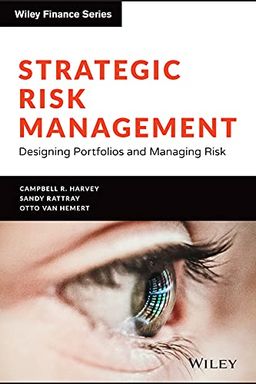
How can you build portfolios that not only survive crises but actually benefit from them? In Strategic Risk Management: Designing Portfolios and Managing Risk, Campbell R. Harvey, Sandy Rattray, and Otto Van Hemert pose this question to every investor who has watched markets tumble and wondered how to stay afloat. The authors argue that true mastery of portfolio design lies not in chasing alpha during calm markets, but in creating strategies that produce what they call crisis alpha—gains during turbulent market conditions.
This book offers a framework that goes beyond traditional diversification. Harvey and his coauthors challenge the long-standing separation between the investment and risk management functions, asserting that they should be deeply integrated. Instead of treating risk control as a defensive side operation, they propose seeing it as a source of opportunity. Through seven analytically rich chapters, they explore tools like trend following, volatility targeting, strategic rebalancing, and drawdown control—and demonstrate how these quantitative techniques can weave risk management directly into the fabric of investment decisions.
The Problem: Investors Treat Risk as an Afterthought
For decades, finance textbooks and portfolio theory have taught investors to maximize returns given a certain level of risk. But as the authors point out, this has fostered an unhealthy obsession with expected return rather than downside resilience. Typical risk management programs operate like fences—keeping risk contained but isolated from day-to-day strategy. This mechanical approach might work during ordinary times, but when crises strike, investors often discover that they’ve misunderstood their vulnerabilities. Harvey’s team argues that the very structure of portfolio design must anticipate crises as an integral part of its core logic.
What Is Strategic Risk Management?
Strategic risk management integrates defensive measures into the investment process itself. Instead of asking, “How do I protect what I have?”, investors ask, “How do I stay adaptive and capture returns when markets falter?” It requires identifying dynamic strategies with the ability to adjust exposure as conditions change—ones that can act as self-repairing mechanisms. These strategies don’t rely on costly insurance, like buying put options, but aim for favorable convexity: they perform better when volatility rises, and worse when volatility falls. In essence, they replicate the payoff of an option without paying its premium.
The Pillars of the Framework
Across its chapters, the book introduces a coherent system: trend following provides crisis alpha by dynamically adjusting to price movements; volatility targeting stabilizes portfolio risk during turbulent periods; strategic rebalancing prevents mechanical buy-low-sell-high traps; and drawdown control ensures that managers adapt when losses mount. Later, the authors use hedge fund evidence to compare systematic managers (the so-called “machines”) with discretionary ones (“humans”), showing that quantitative systems have risk characteristics surprisingly similar to human intuition when used correctly. Finally, the COVID-19 crash of early 2020 serves as an out-of-sample test that validates their methods—especially the power of volatility scaling and trend-based signals to mitigate large declines.
Why It Matters
If you manage your own investments, you’ve lived through market shocks—dot-com crashes, financial crises, pandemics. Each time, portfolios built solely on diversification often failed because correlations between assets shifted dramatically under stress. Harvey, Rattray, and Van Hemert argue that relying on correlation assumptions is insufficient. Instead, we must analyze how strategies like trend following or quality equity factors behave during drawdowns. These strategies have historically offered positive convexity, meaning they can profit in both bull and bear markets—something traditional allocation can’t deliver. Their data, spanning over fifty years, shows that time-series momentum and quality stock selections can protect capital without the crippling cost of explicit hedging.
A Practical Invitation
The authors don’t present risk management as a dense theoretical exercise but as a set of actionable practices. They encourage readers to test their portfolios under historical crises, simulate drawdowns, and adopt real-time adjustments using volatility and trend indicators. Each idea is accompanied by historical evidence from equities, bonds, commodities, currencies, and hedge funds. By blending empirical rigor with intuitive insights drawn from their decades at Man Group—a prominent hedge fund—they make quantitative risk strategies accessible to both professionals and sophisticated individuals.
Key takeaway
Strategic risk management isn’t about avoiding uncertainty—it’s about designing portfolios that thrive on it. By embedding adaptive mechanisms within investments, you move beyond crisis survival toward consistent resilience. Harvey and his coauthors invite you to stop fearing volatility and start viewing it as an ally.
Over the following key ideas, you’ll learn how time-series momentum generates protective returns during market stress, why volatility targeting transforms how we size exposures, how rebalancing can either harm or help, and how drawdown control reveals true manager skill. You’ll also see how both humans and machines tackle risk in surprisingly similar ways. Each concept builds toward the ultimate insight: that when risk management is strategic, uncertainty ceases to be an enemy—it becomes the source of enduring alpha.