
Idea 1
Strategic Kaizen™ and the Power of Flow, Synchronization, and Leveling
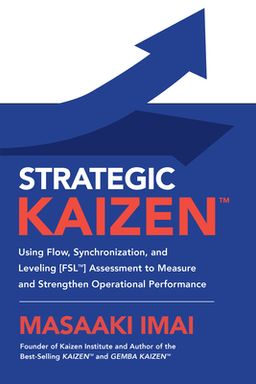
What if the true success of your business had less to do with speed or technology—and everything to do with flow? In Strategic Kaizen™: Using Flow, Synchronization, and Leveling (FSL™) Assessment to Measure and Strengthen Operational Performance, Masaaki Imai contends that most organizations have been managing the wrong game. While leaders chase shareholder returns, technology upgrades, and quarterly profits, they overlook what really drives long-term success: the smooth, synchronized, and leveled flow of operations that continually eliminates waste and delights customers.
Imai’s work completes his lifelong Kaizen trilogy—following Kaizen: The Key to Japan’s Competitive Success (1986) and Gemba Kaizen (1997)—and brings his philosophy full circle. This time, his focus expands from the shop floor to the executive suite. His core argument is sobering yet empowering: 99% of companies in the world remain traditional organizations, plagued by bottlenecks, overcapacity, and a culture that worships financial metrics while ignoring operational reality.
The Missing Dimension in Management
In Imai’s view, modern capitalism suffers from an Achilles’ heel—the absence of operational auditing criteria. Everyone can see a company’s financial results, but no one can measure the operational health that produces those results. This has led CEOs and boards to focus nearly exclusively on short-term profit signals, rewarding shareholder delight at the expense of customer satisfaction. Without recognizing the underlying flow of operations, they cannot make sound, sustainable decisions.
That’s why Imai proposes a radical complement to traditional financial audits: the FSL Assessment—a simple yet transformative diagnostic built around three principles that define every great lean enterprise: Flow (creating smooth, uninterrupted processes), Synchronization (linking processes and timing across all operations), and Leveling (balancing workloads, volume, and pace to minimize variability).
The Philosophy Behind “Flow”
To understand flow, imagine water in a stream. When it moves freely, everything thrives—nutrients circulate, life flourishes, and energy is sustained. When it stagnates, decay begins. Imai applies this metaphor to operations. Wherever work stops flowing—whether due to delays, excessive inventory, or inconsistent scheduling—value evaporates. The FSL framework aims to detect these blockages instantly. A smooth flow requires standardization, cross-functional coordination, and above all, leadership commitment. As Taiichi Ohno, Imai’s mentor and the creator of the Toyota Production System (TPS), said: “Let the flow manage the processes; do not let management interfere with the flow.”
From the Factory Floor to the Boardroom
Imai is not just talking about factories; his focus is organizational culture. He insists that the Toyota Way—built on continuous, daily Kaizen and deep respect for people—applies to any operation, from hospitals to government agencies. What distinguishes high performers like Toyota, Komatsu, or KOA Industries is a willingness to view every process as a flow to be improved incrementally and ethically. In contrast, traditional corporations meet problems with “volume and speed”—working harder instead of smarter, producing more output instead of delivering more value.
Through case studies like KOA’s transformation from over-automation to human-centered lean production, or Yokomori Manufacturing’s shift from chaotic metalwork to level, synchronized flows, Imai shows that Kaizen is not a one-time project—it’s cultural rewiring. CEOs must themselves lead the flow. They must “go to gemba,” observe where value is created, and ensure that information, materials, and people move together smoothly toward the customer.
Why This Matters Today
At a time when AI, automation, and digital transformation dominate business conversations, Imai reminds us that technology without discipline simply multiplies waste. The techniques of just-in-time production, heijunka (leveling), jidoka (intelligent automation), and kanban (visual signals) are not relics of an industrial age—they are timeless principles of operational harmony. What destroys organizations, he warns, is not complexity itself but the abandonment of flow to chase abstract growth.
“Traditional companies employ maximum resources for minimum outputs; lean companies employ minimum resources for maximum outputs.”
—Masaaki Imai, paraphrasing Taiichi Ohno
For leaders tired of transient efficiency initiatives, Strategic Kaizen™ offers a permanent compass. It challenges CEOs to measure not just their profits but the very oxygen of their business: how well value flows to the customer. The ultimate message of the book is clear—you cannot audit excellence with spreadsheets. You must see it, touch it, and nurture it through disciplined daily improvement, starting at the gemba and guided by FSL.