
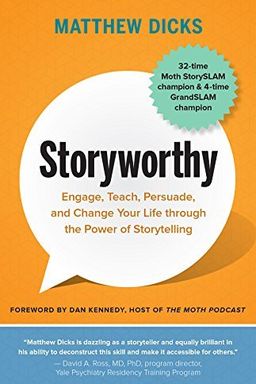
Storyworthy cover

Storyworthy

by Matthew Dicks

Storyworthy, by Matthew Dicks, unlocks the secrets to captivating storytelling. Learn how to craft engaging narratives that highlight transformative moments and resonate with audiences. This book offers practical techniques to enhance communication skills, perfect for personal and professional growth.

The Architecture of Storyworthy Living

How can you transform everyday experiences into compelling stories that connect and endure? In Storyworthy, Matthew Dicks argues that storytelling is not only a performance art but a method for living more consciously. His central claim: when you learn to spot, capture, and shape your own story moments, you don’t just become a better storyteller—you become more alive in your own life.

Dicks teaches that true storytelling begins with daily awareness. You start by noticing life’s narrative texture: tiny shifts in emotion, realization, and change. These micro-moments, he says, are story’s heartbeat. From that awareness, you build craft tools to express transformation clearly and engagingly, whether your audience is one person or a thousand.

The Core Habit: Homework for Life

Dicks’s foundational practice is Homework for Life. Each night you ask, “If I had to tell a five-minute story from today, what would it be?” You log one or two lines in a spreadsheet—just the seed, not the full tale. Over time, this builds an archive of moments, sharpens perception, and lengthens your experience of time. Students report feeling more present and significant simply by noting what mattered each day. (He compares this habit’s transformation to meditation: five minutes daily that expands decades of memory.)

Crash and Burn: Unlocking the Subconscious

If Homework for Life cultivates reflection, Crash & Burn unleashes discovery. In these freewriting sessions, you write without judgment for ten minutes, chasing associations. When a new idea “crashes” in, follow it; when you blank, keep your pen moving. Later you harvest promising fragments. The method reclaims forgotten stories—an object like a grape can excavate childhood memories, jobs, and emotional wounds in ten minutes. It’s introspection through speed, expanding your bank of raw story material.

The Five‑Second Moment: The Story’s Heart

Every story, Dicks insists, hinges on a five‑second moment—the instant of emotional transformation. It’s when you realize, decide, or change irreversibly. In his crash story “This Is Going to Suck,” that moment comes as hospital doors open and he sees his friends, realizing he has family. (Similar to Robert McKee’s concept of “value reversal,” but distilled to its microsecond form.) Without this pivot, you have a mere anecdote; with it, you have meaning.

Craft: Structure, Arc, and Suspense

Once you know the moment of change, craft begins. You build structure through but/therefore patterns (each beat must cause the next), begin near the end to compress time, and create stakes using the Elephant, Backpack, Hourglass, Breadcrumbs, and Crystal Ball tools. You want listeners to wonder and care, not merely observe. Humor becomes glue between high-stakes beats, and surprise—through planted bombs and contrasts—turns empathy into electricity.

Ethics, Honesty, and Emotional Truth

Emotional truth outranks literal chronology, but ethics demand restraint. Dicks defines five “permissible lies”: omission, compression, assumption, progression, and conflation. Each reshapes memory without altering meaning. You may collapse time or combine minor characters, but never invent what didn’t exist. His rule is firm: lie for clarity, not for self-protection. Use craft to illuminate truth, not distort it.

Cinematic Clarity and Emotional Reach

Always tell stories in physical space—give location so the audience sees a mental film. Anchor scenes in tangible settings and use present tense to transport listeners. Start with movement (“I’m walking toward the porch”) and let visual context carry emotion. Even large-scale stories, like near-death experiences or public dramas, depend on small human cores: one hand held, one word spoken. Tell the small truth inside the big event; that’s what listeners remember.

The Promise of Storytelling

Ultimately, Storyworthy isn’t just about performance—it’s about living with narrative vision. Dicks’s methods reshuffle memory, clarify identity, and deepen connection with others. Teachers, parents, executives, and ordinary people gain more than stories: they gain empathy, mindfulness, and self-understanding. The nightly spreadsheet, weekly Crash & Burn, and ethical craft rules form not just a storytelling system but a philosophy of noticing, meaning-making, and transformation.


Homework for Life: Daily Story Seeds

Homework for Life is Dicks’s simplest and most transformative discipline: five minutes a day to record one storyworthy moment. You note a date and a brief description—two lines, no more. The purpose is not writing stories but collecting raw life seeds. As days accumulate, you learn to notice subtle emotional beats you’d otherwise miss. (Comparable to journaling, but focused strictly on transformation.)

Why It Works

The habit succeeds through minimal friction. A nightly alarm or pairing with an existing ritual keeps you consistent. The act trains perception: you begin seeing micro‑changes—expressions, sentences, interruptions—that form story pivots. The spreadsheet becomes a searchable archive for future storytelling themes such as “marriage,” “work,” or “grief.” People who practice feel time slow down and meaning magnify; missing entries feels like losing days of life.

Mining Patterns and Emotional Insight

Patterns emerge. Dicks discovered recurring marital habits by filtering spreadsheet entries—turning a domestic annoyance into a funny, reflective story. Small entries accumulate into perspective shifts. The process builds self-recognition: one student cried realizing, “My life matters.” The result is both archive and therapy: awareness through systematic noticing.

Five Rules to Keep It Alive

Keep entries under two lines; do it nightly; treat the list as treasure; allow recovered memories; and remember: consistency dwarfs intensity. Five minutes nightly yields decades of insight.

Homework for Life builds the foundation for all later storytelling habits. It’s how ordinary people become observers of extraordinary meaning in their own days.


Crash and Burn: Excavation by Pen

Crash & Burn is the creative counterweight to Homework for Life: if one collects curated moments, the other explodes associations. Dicks calls it “dreaming at the end of your pen.” You write nonstop for ten minutes, chasing tangents and refusing self‑censorship. Then you harvest fragments to find story leads. It’s structured chaos meant to uncover hidden memories and emotional strands.

The Rules of Freedom

  • Don’t get attached—if a new idea arrives, pivot instantly.
  • Don’t judge—record everything, including embarrassment.
  • Keep the pen moving—list numbers or colors if you stall until thoughts return.

One demonstration begins with “grape.” Ten minutes later Dicks’s notes reference grape juice, a Mello Yello bottle, a pond, a lifeguard job, crimes at sea, train tracks, and a letter from his father. Each jump exposes buried emotional data; afterward he underlines vivid fragments and extracts multiple story ideas. It’s psychologist-style excavation through words.

Harvesting the Gold

After the timer, you reread and mark any line that sparkles. Ask what surprised you, what location surfaced, what emotion that memory carried. Those become actionable story seeds. (Julia Cameron’s “Morning Pages” pursue a similar goal, but Dicks adds post-session harvesting, turning chaos into creative yield.)

When you combine Crash & Burn weekly with Homework for Life nightly, you become an archaeologist of your own mind—a system of daily surface capture and deeper subconscious dig, together forming a perpetual generator of storyworthy material.


The Five‑Second Moment: Transformation Engine

Dicks builds his entire storytelling theory around the five‑second moment—the instant of irreversible inner change. The audience may remember laughter or action, but what endures is emotion transformed. Every true narrative compresses years into seconds: recognition, acceptance, love, loss, or faith. Your job is to find that pulse and tell everything that illuminates it.

Spotting the Moment

Ask yourself, “What changed in me?” In film, Alan Grant’s evolution in Jurassic Park crystallizes when he saves two children and drops his fossil claw. Indiana Jones’s spiritual shift in Raiders of the Lost Ark occurs when he closes his eyes and believes. In Dicks’s real life, his porch encounter with a widower reshaped his understanding of loneliness; his crash taught community; his arrest sparked faith. Change is always internal, even if events are external.

Crafting Around the Pivot

Once located, everything else serves it. Your beginning should reveal the opposite state; your scenes should cause each other through buts and therefores; and your suspense should make audiences anticipate emotional resolution. If you can’t state your five‑second moment in one sentence, you don’t yet have a story—just recollection. Refining that sentence gives you a navigational compass for editing, pacing, and clarity.

Dicks’s Rule

Every story exists to make one moment crystal clear. Everything that doesn’t serve that clarity belongs in the cutting room.

Mastering the five‑second moment is mastering relevance. It transforms random memories into resonant meaning—proof that change, not circumstance, makes stories immortal.


Crafting Story Arcs and Raising Stakes

Once you know what changed and where the five‑second moment lives, you must engineer movement toward it. Dicks’s structural tools keep audiences emotionally invested and ensure each story flows from cause to consequence rather than random sequence. They transform anecdotes into gripping arcs.

Start Near the End

Begin close to the climax and in the opposite emotional state. If your ending reveals connection, begin in isolation. Physical proximity to the five-second moment keeps energy tight. (He shifts the “Boca Raton rental” beginning forward from airport to car counter to maintain focus.)

Drive with But and Therefore

Replace “and” with “but” and “therefore.” These words create opposition and consequence—causation that locks the audience into narrative rhythm. A line like “I loved Heather since sixth grade, but she was never mine” instantly carries tension that “and” cannot. Trey Parker’s scene rule (every beat causes the next) echoes Dicks’s technique of continuous propulsion.

Raise Stakes and Surprise

Dicks frames five devices for suspense: Elephant (obvious need), Backpack (shared plan), Breadcrumbs (future tease), Hourglass (slow reveal), and Crystal Ball (fearful prediction). Used lightly, they make listeners need to know what happens. Surprise grows from concealment: hide emotional bombs in jokes or clutter so their detonation stings. The story’s rhythm becomes tension → shock → heart.

Structure and stakes exist to serve one purpose—to make transformation felt. Without those tools, stories meander; with them, they grip and release like living movement.


Truth, Ethics, and the Permissible Lies

Storytelling is emotional truth told with crafted honesty. Dicks admits we all alter memory but insists on moral boundaries. You may shape but not fabricate. His five permissible lies—omission, compression, assumption, progression, and conflation—let you refine narrative without betraying fact.

The Five Permissions

  • Omission: remove distractions that don’t serve emotional truth.
  • Compression: tighten time or geography for clarity.
  • Assumption: fill forgotten sensory gaps with plausible detail.
  • Progression: reorder events to make emotional arcs legible.
  • Conflation: distill long periods of change into one representative instant.

Ethical Guardrails

Lie for the audience, not yourself. Never manipulate details to look better or reduce culpability. Treat memory’s flexibility as artistic material and moral responsibility. (He compares it to documentary editing: rearranging for pacing but preserving authenticity.) If changes affect reputation or truth of feeling, disclose them offstage. Storytelling remains an act of trust; protect that trust fiercely.

Moral Compass

Emotional honesty beats factual precision—but only when used humbly. Your audience will forgive compression, not deception.

The ethics section anchors Dicks’s entire philosophy: storytelling is art built on integrity, and truth handled responsibly becomes universal resonance.


Cinema, Humor, and Human Scale

Dicks’s craft rules translate sensory immersion and emotional balance into techniques any teller can learn. Great stories look and sound real; they also breathe through contrast—humor against tension, small humanity inside large drama.

Cinema of the Mind: Location and Present Tense

Every memory should occur somewhere. Opening with location instantly creates mental film (“I’m on my grandmother’s porch” rather than “My grandmother was wonderful”). Set backstory inside physical places so the movie never stops. Use present tense for immediacy; shift to past for summary or perspective. Avoid rhetorical commentary that breaks immersion. You’re a director of imagination—reset spatial anchors often so the audience stays inside your world.

Humor by Structure and Contrast

Comedy in storytelling is mechanical, not mystical. The Milk Cans and Baseball method stacks expectation and saves the funniest surprise for last. The Babies and Blenders rule fuses incongruity—pairing what doesn’t belong—to elicit laughter. Humor should frame heartfelt material, not replace it. Place jokes before intensity (to win trust), before catastrophe (for contrast), and after dark turns (for relief). Ending on emotion, not gag, preserves depth.

Small Human Cores

Even when stakes are huge, search for a relatable kernel. In his car-crash story, Dicks centers on his friends in the waiting room, not the accident itself. Ordinary gestures of love translate extraordinary events into empathy. Avoid over-redemption; leave endings slightly frayed—real life seldom resolves perfectly. That imperfection keeps stories alive after the telling.

By blending cinematic visualization, humor’s rhythm, and the intimate human scale, you craft experiences audiences can see, laugh at, and feel as their own.


The Purpose and Power of Storytelling

Why tell stories? Because storytelling, according to Dicks, reshapes both communication and self-perception. His mission isn’t show business; it’s transformation. He’s seen principals mourn lost journal entries, parents reconnect through shared memory, and professionals revitalize careers using story architecture. Storytelling makes persuasion human—it converts data into empathy.

Universal Utility

  • Teachers and attorneys clarify points through narrative rather than jargon.
  • Parents record family memory and teach vulnerability.
  • Therapists use story to help patients reframe identity.
  • Ordinary people employ story as reflection and connection.

Authenticity: The Dinner Test

Your story should be one you’d tell honestly over dinner. The stage version may be polished, but it must remain recognizably conversational. Exaggerated theatrics and false grandeur alienate audiences. True storytelling equals vulnerability plus change, delivered in authentic tone. (Dicks’s “Dinner Test” recalls Ira Glass’s rule: “the same person offstage and on.”)

Storytelling, practiced Dicks’s way, becomes a lifelong skill: better communicator, deeper human, careful observer. It’s performance for self-knowledge and connection—a daily craft that makes you visible to yourself and to others.

Dig Deeper

Get personalized prompts to apply these lessons to your life and deepen your understanding.

Go Deeper

Get the Full Experience

Download Insight Books for AI-powered reflections, quizzes, and more.