
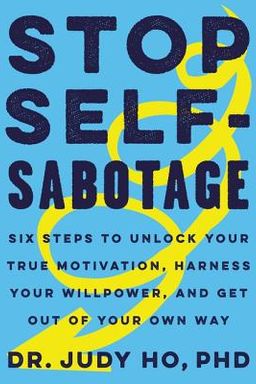
Stop Self-Sabotage cover

Stop Self-Sabotage

by Dr Judy Ho, PhD

Stop Self-Sabotage by Dr. Judy Ho provides a scientifically-backed six-step guide to identifying and overcoming self-defeating behaviors. With practical exercises and real-life examples, the book empowers readers to transform negative patterns into pathways for achieving personal and professional goals.

How to Stop Getting in Your Own Way

Why do we so often undermine the very goals we claim to want most? Whether it’s skipping the gym after a week of good workouts, saying something that derails a relationship, or procrastinating on a project you care about—self-sabotage creeps in subtly, yet persistently. In Stop Self-Sabotage, clinical neuropsychologist Dr. Judy Ho argues that self-sabotage is not a mysterious moral failing but a survival strategy gone awry. Our brains evolved to avoid danger as powerfully as they pursue reward, but when that mechanism runs unchecked, we start protecting ourselves from growth too.

The central idea of Ho’s book is that undermining your own success is a learned behavioral pattern built from beliefs, fear, and the need for control. The good news is that—because these patterns are learned—they can be unlearned. Drawing on clinical research, case studies, and behavioral science, Ho offers a six-step method for identifying the psychological triggers behind self-defeating choices, disrupting them in the moment, and building new habits grounded in your core values. She argues that “self-sabotage is not about laziness or lack of willpower but about misplaced threat protection.” Change, to our brains, can feel as dangerous as a saber-toothed tiger once did.

The Brain’s Survival Wiring

Ho roots her framework in evolutionary psychology. Human motivation is governed by two competing drives: the pursuit of reward—fueled by dopamine—and the avoidance of threat—driven by the brain’s fear circuitry, particularly the amygdala. Ideally, these drives strike a balance. But under stress, the threat-avoidance system can override the reward pursuit system. You think you’re being cautious; in fact, you’re shrinking your world. This imbalance often creates what psychologist Kurt Lewin called the approach–avoidance conflict: when the closer you move toward something you want, the more you fear the risk that comes with it. Ho points out that this conflict is ancient biology meeting modern complexity.

The Four Core Drivers: L.I.F.E.

In her clinical experience, Ho traced most self-sabotage back to four interacting forces she abbreviates as L.I.F.E.: Low or Shaky Self-Concept, Internalized Beliefs, Fear of Change or the Unknown, and Excessive Need for Control. These shape the “operating system” you’ve been using—often since childhood. For example, a critic parent can seed internalized beliefs like “I’m never good enough,” while unpredictable life experiences can forge an obsessive need for control. Each element distorts how you assess threat versus opportunity. The result is behavioral patterns that feel familiar, even comfortable, yet keep you stuck.

Throughout the book, Ho illustrates these principles with evocative case studies. Beth, the accomplished attorney who can’t maintain her weight loss, and Jack, the smart professional who never leaves his “dead-end” job, both embody common self-sabotage patterns: habitual avoidance disguised as rational choice. Their minds equate discomfort with danger, leading them to overestimate threat and underestimate their capacity for change.

Turning Awareness into Change

Ho’s six-step model is practical and scaffolded. It begins with identifying triggers and retraining thought patterns (through methods borrowed from cognitive behavioral therapy), then transitions into behavioral tools grounded in operant conditioning. From early chapters on mapping triggers to later ones on “Replacement, not Repetition” and “A Value a Day Keeps Self-Sabotage Away,” Ho integrates psychology, neuroscience, and coaching. She translates abstract therapy into exercises you can journal through—such as the “Thought Record” to dissect negative thinking or the “If/When–Then” strategy (adapted from Peter Gollwitzer’s implementation intentions research) to plan automatic goal-supporting actions before you’re tempted to stray.

Values as the Cure for Self-Defeat

The culmination of her system connects self-sabotage not merely to flawed habits, but to values disconnection. When your goals aren’t anchored to your personal values—like autonomy, contribution, or creativity—you lose motivation and revert to comfort-seeking. Genuine fulfillment, she reminds us, comes less from pleasure and more from pursuing what psychologist Abraham Maslow called “self-actualization.” In that sense, Ho’s program helps you evolve from seeking hedonic happiness (avoiding pain and chasing temporary feel-good states) to eudaimonic happiness—living a life of purpose and growth even when it’s uncomfortable.

Why This Matters

Ultimately, Stop Self-Sabotage challenges a cultural obsession with positivity and instant success. It asks you to see discomfort as data, not danger. By understanding self-sabotage as the brain’s well-meaning but outdated protection plan, you can trade self-criticism for compassion and curiosity. Whether your struggle is procrastination, fear of intimacy, or inconsistent self-discipline, Ho’s framework empowers you to become your own behavioral scientist—observing, experimenting, and reprogramming your habits. What emerges is not just productivity, but peace: a self whose actions align with its values.


The Science of Self-Sabotage

Dr. Judy Ho grounds self-sabotage in the interplay between two primal drives: seeking reward and avoiding threat. Our brains evolved to treat uncertainty and potential pain as existential risks. The snag? In the modern world, the threats we avoid—rejection, failure, discomfort—aren’t life-threatening but psychological. Still, your body reacts as if that awkward conversation or missed workout were a charging predator.

Dopamine vs. Cortisol

Reward-seeking behaviors are reinforced by dopamine—released when you eat, get praise, or check an item off your list. This system motivates you to act toward goals. However, the moment your brain perceives a possible threat, another chemical, cortisol, floods in. This stress hormone shifts priorities away from progress and toward protection. The problem isn’t stress itself but chronic misfiring: modern triggers—emails, deadlines, dating apps—continually activate threat avoidance. Over time, reward pursuit shrinks while threat avoidance dominates, producing paralysis, procrastination, or anxiety.

Approach–Avoidance Conflict

Psychologist Kurt Lewin’s approach–avoidance conflict helps explain why your motivation crashes mid-goal. Initially, approach dominates—you’re excited to join the gym or apply for a new job. But as you near change, discomfort looms: effort, rejection, expectations. Avoidance takes over, convincing you the reward isn’t worth it. Ho’s case of Beth, the lawyer who stalls her health journey, illustrates this: her mind inflates the “threat” of discipline and downplays the reward of vitality. For evolution, safety trumped success; the same instinct now causes self-sabotage.

The Role of Memory and Prediction

Fear-based memories strengthen self-sabotage. You vividly remember past humiliation but rarely past triumphs. That uneven recall biases your future predictions—you anticipate threat before opportunity. Ho describes this as your mind’s “threat overestimation engine,” continually refreshing itself through experiences of criticism, loss, or failure. The brain retrieves these memories faster than positive ones because, biologically, it assumes doing so could save your life. Managing self-sabotage therefore begins with challenging those quick, distorted predictions and cultivating awareness of how much you overlearned from pain versus success.

“Self-sabotage isn’t self-destructive—it’s self-protective gone rogue.”

By reframing self-sabotage as outdated threat management, Ho invites readers to engage curiosity rather than shame. When you understand your brain’s biology, failures stop being moral defects and become opportunities to rewire behavior. Recognizing this pattern is the first step to reclaiming control over your motivations.


The Four Elements of L.I.F.E.

Dr. Ho identifies four psychological forces that drive self-sabotage—Low or Shaky Self-Concept, Internalized Beliefs, Fear of Change or the Unknown, and Excessive Need for Control. Together, they form the acronym L.I.F.E., reminding you that the habits undermining you are part of how you’ve learned to live. Each element functions like an invisible script dictating your reactions when stakes rise or uncertainty looms.

Low or Shaky Self-Concept

This is your self-image: how firmly you believe you’re capable and deserving. People with shaky self-concept outsource their worth to achievements or approval. When they succeed, they self-sabotage to restore familiar mediocrity—because success feels unsafe. Beth’s lifelong belief “I’m not built for fitness” drove her to overeat under stress, reinforcing failure. (Carol Dweck’s Mindset parallels this idea, showing how fixed beliefs about ability curb growth.) Strengthening self-concept means tracking competence and internal wins, not external praise.

Internalized Beliefs

These are inherited stories about what’s possible or safe—often absorbed unconsciously from parents, culture, or early authority figures. Beth’s mother’s constant dieting and resignation (“Maybe I’m just meant to be heavy”) became Beth’s default script. Likewise, if you watched caregivers fear risk, you may equate ambition with danger. Unlearning internalized beliefs requires examining whose voice you’re obeying. Ask: Is this truly my belief, or someone else’s survival strategy masquerading as wisdom?

Fear of Change or the Unknown

The brain favors predictability over happiness. Habitual discomfort feels safer than unfamiliar joy. This fear often hides under rational excuses (“I’m too busy to job hunt”). Ho calls out that comfort zones aren’t comfortable—they’re simply familiar cages. Becoming aware of how novelty triggers stress lets you treat that stress as a sign of growth, not danger. Behavioral psychologist Susan David calls this “emotional agility”: moving through discomfort without fleeing it.

Excessive Need for Control

Control soothes uncertainty but can strangle opportunity. If you must know every outcome before acting, spontaneity—and connection—die. Alice, another of Ho’s examples, micromanaged her boyfriend to preempt rejection. Her grasping behavior produced the very abandonment she feared. Balance means trusting your adaptability more than your predictions. The paradox is that loosening control often gives you more real control—over your reactions, not others’ actions.

When you identify which L.I.F.E. elements dominate your patterns, you gain leverage. Awareness doesn’t remove them overnight, but it exposes the triggers behind your resistance to change and prepares you for the book’s systematic steps to reprogram them.


Finding and Disarming Triggers

Self-sabotage begins not with action but with thought—automatic, fleeting, and usually negative. Ho calls these self-sabotage triggers, cataloguing six of the most common distortions drawn from cognitive behavioral therapy: Overgeneralizing/Catastrophizing, “Shoulds,” Black-and-White Thinking, Mind Reading, Discounting the Positive, and Personalization. These mental shortcuts shape how you interpret events, which in turn dictates your emotions and behavior.

The Six Trigger Patterns

  • Overgeneralizing/Catastrophizing: Drawing sweeping conclusions from one event (“I failed once, so I always will”).
  • Shoulds: Imposing rigid rules on yourself or others that leave no room for humanity (“I should be perfect at this”).
  • Black-and-White Thinking: Viewing life in dual extremes—success or failure—with no middle ground.
  • Mind Reading: Assuming you know what others think (“They must think I’m stupid”).
  • Discounting the Positive: Downplaying compliments or achievements, preserving self-doubt.
  • Personalization: Interpreting neutral events as reflections of your worth (“They’re quiet—it must be my fault”).

Spotting the Invisible

Because these thoughts are fast and familiar, you often don’t notice them. Ho’s exercises—like “ET-Squared” (Event–Thought–Trigger tracing) and daily timed thought check-ins—slow the mind down to catch recurring patterns. One client, Jack, realized his chronic procrastination stemmed from Mind Reading (“They’ll think I’m unqualified”) paired with Catastrophizing (“If I fail one interview, I’ll never find work”). Once conscious of the pattern, he could begin reframing thoughts rather than obeying them.

“Thoughts are not facts—they’re hypotheses waiting for evidence.”

The more often you label your triggers, the less power they hold. Recognizing that a thought like “I’ll never be good enough” is just electrical activity—not prophecy—creates enough distance to choose a better response. Awareness transforms rumination into data for change.


Reprogramming the Thought–Feeling Loop

Once you can name your triggers, Ho teaches how to disarm them. Step 2 of her program, “Deactivate Your Triggers and Reset the Thermostat,” introduces practical cognitive-behavioral tools to intercept the sequence from thought to emotion to behavior. Events don’t make you miserable; your interpretation does. Changing those interpretations breaks the feedback loop keeping self-sabotage alive.

Question the Thought

The first method is Socratic questioning: treating thoughts as hypotheses to test. In the “Examine the Evidence” exercise, you ask: What proves or disproves this thought? Is it a complete picture? Has this always been true? This technique—borrowed from Aaron Beck’s cognitive therapy—helps deconstruct exaggerations. When Alice panicked because her boyfriend didn’t reply instantly, her thought “He doesn’t care about me” shifted to “He’s probably in a meeting.” Skepticism replaces certainty, cooling emotional heat.

Modify and Reframe

Next comes cognitive restructuring. Tools like “Play Devil’s Advocate” and “Yes, But” help you swap pessimistic conclusions for balanced ones. If you think “I blew my diet,” the reframe becomes “Yes, I overate at dinner, but I’ve eaten healthy all week and can make a good choice at lunch.” This approach doesn’t deny mistakes; it contextualizes them.

Deemphasize Thought Power

Sometimes logic fails to quiet emotion. In those moments, Ho borrows from Acceptance and Commitment Therapy using a technique called defusion—learning to see thoughts as passing mental events, not truths. Adding phrases like “I’m having the thought that…” creates distance and weakens identification. Her client Jack practiced saying, “I notice that I’m having the thought that I’m not good enough.” Just this linguistic shift reduced anxiety and disrupted rumination. (Psychologist Steven Hayes, who pioneered ACT, similarly teaches “thank your mind for the thought” to reclaim agency.)

Regulating Emotion

Ho’s metaphor of a “thermostat reset” captures how feelings can return to balance once thoughts are managed. Exercises like “Physicalize the Emotion” (visualizing emotions as tangible objects you can resize) and “Opposite Action” (doing the opposite of what the feeling urges) regulate both emotion and physiology. Acting opposite to fear—say, going for that interview instead of avoiding it—teaches your nervous system that uncertainty won’t kill you. Over time, thought–emotion awareness becomes second nature, removing the need for self-sabotaging defenses.


Breaking Behavior Loops with the ABC Model

In Step 3, “Release the Rut,” Ho introduces behavioral psychology’s classic framework—the ABC model—to show how self-sabotage persists through reinforcement. When a behavior provides even momentary relief, it strengthens, repeating even if it yields long-term harm. The ABCs stand for Antecedent, Behavior, and Consequence.

Antecedents and Triggers

An antecedent is anything that prompts action: a feeling, event, or environment. Janie, a talented advertising executive, chronically procrastinated on big projects. Her antecedents were subtle—seeing unwashed dishes or unopened mail triggered convenient detours. Deeper still was a distal antecedent: a poor performance review that had threatened her confidence weeks before. Each distraction reduced anxiety momentarily, reinforcing the cycle.

Reinforcement and Relief

Ho distinguishes between positive and negative reinforcement. Positive adds pleasure (binge-watching feels good); negative removes discomfort (dodging the report relieves tension). We repeat what rewards us, even if the reward is simply not feeling anxious right now. Over time, the brain learns: avoidance is safety, productivity is pain. Ho uses Janie’s story to illustrate how fleeting relief entrenches maladaptive behavior.

Rewriting the Chain

Tracking ABC sequences clarifies where to intervene. You can’t always remove antecedents like criticism, but you can choose new behaviors and engineer new consequences. In Janie’s revised chain, anxiety (A) leads to making a mini plan (B) instead of binge-watching, producing accomplishment and calm (C). This turns reinforcement into an ally. Finding your own patterns—what precedes, what follows—turns vague guilt into solvable design.

“Every self-sabotaging behavior had a logic once—it worked to protect you. Now you can teach your brain new logic.”

Behavioral awareness demystifies what felt random or moral. You realize that willpower isn’t the only tool—environment design, antecedent planning, and consequence tracking can transform patterns that once ruled you unconsciously.


Replacing Repetition with New Habits

Awareness is powerful, but substitution seals change. In Step 4, “Replacement, Not Repetition,” Ho introduces self-regulation science—building habits that override impulse through structured planning. Her focus is twofold: strengthening motivation through mental contrasting and protecting willpower through implementation intentions. Together, these form the evidence-based MCII technique used widely in behavioral research.

Mental Contrasting

Adapted from Dr. Gabriele Oettingen’s work, mental contrasting invites you to imagine your goal vividly—then immediately contrast it with real obstacles. This pairing of desire and difficulty creates productive cognitive dissonance that mobilizes you to act. Danny, who struggled with overeating, described his future self as energetic and proud, then confronted obstacles: boredom, guilt, nightly snacking. The gap between vision and reality sparked the resolve to bridge it. Unlike blind positivity, this method couples hope with honesty.

Implementation Intentions

Good intentions crumble under stress unless they’re automated. Enter the “If/When–Then” plan—specific commitments linking trigger to response. Example: “If I crave sweets after dinner, then I’ll make tea instead.” By encoding exact cues, you reduce decision fatigue and ensure the right action happens when willpower wanes. Research shows such plans triple goal follow-through (as noted by psychologist Peter Gollwitzer). Danny designed multiple: drawing when bored, walking when anxious, freezing cookies out of sight. His impulses lost power because new behaviors were rehearsed and ready.

Building Willpower as a Muscle

Ho aligns with Roy Baumeister’s “ego depletion” model: willpower fatigues with overuse but can strengthen with training. By practicing self-regulation in small doses—pausing before reacting, following micro plans—you expand endurance. Replacement happens not by suppressing old habits but by giving your brain something better to run instead.


Values as Fuel for Change

Lasting transformation requires more than mechanics; it needs meaning. In Step 5, Ho teaches that self-sabotage thrives in a vacuum of purpose. When your goals drift from your values—the beliefs giving life coherence—motivation evaporates. Align your actions with what truly matters, and willpower renews itself automatically.

Eudaimonic vs. Hedonic Happiness

Ho draws on Aristotle and positive psychology to distinguish fleeting pleasure (hedonic happiness) from deep fulfillment (eudaimonic happiness). Chasing comfort and avoiding pain—a hallmark of self-sabotage—feeds the former but starves the latter. True satisfaction arises from pursuing values that express your best self: integrity, compassion, mastery. Pain becomes purposeful when in service of growth.

Clarifying Core Values

Ho’s “Values Card Sort,” adapted from William R. Miller’s research, guides you to rank thirty-three possible values—like honesty, curiosity, or community—into most, moderate, and least important. You then reflect on a “peak moment,” a time when life felt rich and right, to discover which values were active. For Toby, his peak moment volunteering at a holiday food drive illuminated his highest values: connection, contribution, and respect. Recognizing that his isolation contradicted those values spurred him to reengage socially.

Values in Daily Practice

Values are compass points, not destinations. Ho suggests tangible reminders—a playlist for courage, a photo symbolizing growth—and daily “values check-ins”: listing how your actions matched your top three values today. Over time, this reflection aligns your goals naturally. When effort serves purpose, discipline stops feeling like deprivation. Instead of fighting yourself, you become your own ally in living meaningfully.


Designing Your Blueprint for Change

The book’s final step combines all previous lessons into a single visual plan called the Blueprint for Change. Think of it as an architectural drawing of your ideal behavioral ecosystem. It ties together your values (the foundation), your goal (the structure), your triggers (the wiring), and your new habits (the operating system).

Constructing the Blueprint

You start by listing your five top values and writing your S.M.A.R.T., values-based goal beneath them. Next, map your L.I.F.E. factors at the base, acknowledging which insecurities still influence your decisions. Above these, chart your old ABC chain—events, thoughts, feelings, behaviors, consequences—and beside it, write new “If/When–Then” replacements. Finally, visualize the new outcomes: how progress will feel, look, and ripple outward. The blueprint serves as both a motivator and diagnostic tool when old patterns resurface.

Reviewing and Reinforcing

Ho urges you to place this blueprint somewhere visible and revisit it daily. Each review reinforces neural pathways for your replacement behaviors—much like mental rehearsal in sports psychology. She also recommends randomly selecting one element (a value, a trigger, an intention) each morning to focus on. When overwhelm hits, this micro-focus keeps momentum alive.

Blueprint as Living Document

Because life evolves, the blueprint evolves. Updating it biweekly maintains conscious engagement and prevents relapse into autopilot. Over time, rewriting old scripts becomes reflexive: procrastination cues planning, anxiety cues breathing, doubt cues connection to values. The blueprint crystallizes the ultimate lesson of Ho’s program—that self-sabotage loses power when awareness, compassion, and structure work together.

Dig Deeper

Get personalized prompts to apply these lessons to your life and deepen your understanding.

Go Deeper

Get the Full Experience

Download Insight Books for AI-powered reflections, quizzes, and more.