
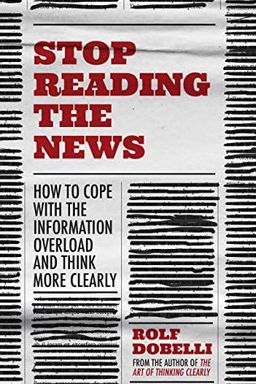
Stop Reading the News cover

Stop Reading the News

by Rolf Dobelli

Stop Reading the News by Rolf Dobelli explores how abstaining from news media can lead to a healthier, clearer, and more meaningful life. By rejecting the constant flood of information, you can regain focus, reduce stress, and prioritize what truly matters.

Stop Reading the News: Reclaiming Clarity and Calm

When was the last time you checked your phone for breaking news—and felt calmer afterward? Probably never. In Stop Reading the News, Swiss philosopher and writer Rolf Dobelli asks a provocative question: what if we simply stopped consuming the news altogether? His answer: we’d become happier, more focused, wiser, and freer. This isn’t an attack on journalism, but a manifesto for mental clarity in the age of information overload.

Dobelli argues that the daily news cycle is the psychological equivalent of junk food. It delivers addictive bursts of novelty, fear, and outrage but leaves us intellectually malnourished. Like sugar to the body, news briefly stimulates us, but it also erodes our attention span, clouds our judgment, and poisons our peace of mind. He contends that to think clearly and live well, you must go cold turkey on news consumption—or, at least, drastically reduce it.

The News Addiction Trap

Dobelli describes his own descent into news addiction. As a young man he believed that reading multiple newspapers made him worldly and intelligent, a participant in the grand events shaping civilization. Yet over time, he noticed something unsettling: despite thousands of hours spent poring over headlines, he didn’t understand the world any better. Instead, his mind felt fragmented and anxious. When the Internet arrived—with PointCast, RSS feeds, and infinite scroll—his habit became compulsive. Eventually, he recognized that he’d become a ‘news-aholic.’

Breaking free wasn’t easy. Like a recovering alcoholic, he went through abstinence, cravings, and guilt. But once he quit, his mental clarity soared. He realized that the news serves largely as entertainment pretending to be relevance—it excites our senses while distorting our understanding of reality. The feeling of being 'informed' is an illusion.

Why News Fails to Enlighten

Dobelli exposes the fallacy that modern citizens need constant updates to stay educated or democratic. Historically, democracy thrived without the daily news: people debated ideas through books, pamphlets, salons, and public discussions long before Twitter or CNN. Today’s flooding of information, he argues, hasn’t improved discourse—it’s degraded it. The shorter and louder the news gets, the shallower our thought becomes. Instead of cultivating civic insight, we cultivate emotional reactivity and polarization.

To illustrate, he contrasts news with slow, rich forms of knowledge—books, documentaries, long-form articles. These formats demand time and concentration, allowing readers to explore causes and contexts instead of reacting to mere surface events. News is a flood of disconnected dots; understanding requires connecting them. But since journalists rarely have the time or space to investigate deeper, the dots remain unjoined. You end up with trivia, not wisdom.

Psychological and Physical Costs

News consumption triggers multiple psychological biases: confirmation bias, hindsight bias, and availability bias, all of which distort judgment. These cognitive distortions make us feel certain about false beliefs, anxious about improbable risks, and obsessed with irrelevant stories. For instance, we fear terrorism more than heart disease because it’s vivid in the media, even though statistically it’s far less dangerous. The media’s focus on sensational events rewires our brains for shallow attention and chronic stress.

And the harm isn’t just mental. Dobelli cites research showing that constant exposure to negative news floods the body with cortisol and adrenaline, weakening immunity and shortening lifespan. We’re biologically tuned to notice threats, so the media’s parade of horror hijacks our survival instincts for profit. Every 'breaking headline' triggers the fight-or-flight response. Over time, stress accumulates until your health deteriorates.

Living Without News

To counter this, Dobelli prescribes radical abstinence: unsubscribe from newsletters, delete apps, stop watching TV, and choose books instead. For those hesitant, he suggests a thirty-day detox—just one month without any news. Most participants discover that they miss nothing important. Afterwards, they reclaim an entire month each year in saved time, and their focus deepens. If something truly significant happens, trusted friends or experts will tell you.

Dobelli’s vision is not anti-information, but pro-meaning. He calls for ‘slow journalism,’ ‘constructive journalism,’ and conversational knowledge—the kinds of deep exchanges that enrich thought. He even imagines ‘news lunches,’ where people meet over meals to share one deeply researched story each, instead of gossiping about headlines.

A Manifesto for the Mind

In essence, Stop Reading the News challenges our modern faith in information itself. It claims that the constant pursuit of updates doesn’t make you smarter—it makes you scattered. Wisdom comes from slow thinking, long reading, conversation, and reflection. Dobelli’s message resonates with thinkers like Nicholas Carr (The Shallows) and Yuval Noah Harari (21 Lessons for the 21st Century), who also warn against digital overload. His manifesto invites you to step out of the storm—to prioritise depth over breadth, mastery over distraction, health over anxiety.

Ultimately, he asks: would you rather be well-informed or well-formed? In choosing the latter, you opt for peace of mind, clarity, and a richer understanding of life beyond the constant noise of global headlines.


News Is Mental Junk Food

Dobelli’s core metaphor—'news is to the mind what sugar is to the body'—captures the entire psychological dynamic of modern media consumption. Like sugary snacks, news is easy to digest, instantly gratifying, and catastrophically addictive. At first it tastes good: the thrill of a new headline or scandal makes you feel alive and connected. But the intellectual nutrition is almost zero. Over time, this sugar rush destroys your capacity for deep thinking.

How the Addiction Works

News triggers dopamine—our brain’s reward chemical—every time we encounter novelty. Whether it’s a crisis, celebrity divorce, or technological breakthrough, each new item feels significant. But the more you consume, the more you crave. Dobelli compares this to the progression from harmless indulgence to full-blown dependency. Modern technology—push notifications, pop-ups, infinite scroll—has weaponized this craving, making abstinence almost impossible. As with sugar, the supply is cheap and omnipresent, while restraint demands self-discipline.

The Illusion of Relevance

As newspapers evolved from early pamphlets into global media giants, their fundamental fraud remained the same: they sell novelty disguised as relevance. A coup, a tweet, a celebrity breakup—all are packaged as essential knowledge, when in truth they have no practical effect on your life. This illusion was tolerable when newspapers arrived once a day; now the 24/7 cycle constantly floods your consciousness. 'Breaking news' is rarely relevant—only 'broken attention' is guaranteed.

Dobelli reminds us that the first printed newspapers in the 17th century were entertainment products disguised as information services. Today’s news industry just scales that trick digitally. The world’s complexity can’t fit into 280 characters or thirty-second clips. Yet the media keeps serving up sugar-coated bits that derail genuinely nutritious thinking the way candy crowds out vegetables.

Recovering from Mental Diabetes

To detox, Dobelli recommends a radical abstinence approach. Delete news apps, cancel subscriptions, stop watching television bulletins, and carry real books when traveling. You’ll regain attention span and reclaim hundreds of hours per year. The process might feel like withdrawal—nervousness about missing something important—but soon you’ll discover a powerful truth: nothing critical ever depended on your constant news intake. Your friends, colleagues, or the community will pass along truly relevant facts.

Key message

Stop confusing information quantity with understanding quality. Like sugar, news seduces with instant satisfaction but leaves you drained and intellectually obese. Only slow, deliberate learning—books, essays, genuine conversations—provides the nourishment that leads to clear thinking.


Cognitive Distortions: How News Warps Reality

The reason news damages thinking begins with human psychology. Our brains evolved for survival, not insight. They exaggerate threats, seek confirmation, and prefer vivid stories to abstract truths. News exploits these quirks ruthlessly. Dobelli shows how the daily stream of headlines strengthens our cognitive biases, distorting both perception and decision-making.

Confirmation Bias

Confirmation bias makes you interpret information in ways that reinforce your existing beliefs. News outlets tailor content to predictable political or emotional alignments, cementing ideological echo chambers. Instead of challenging your assumptions, each scroll or click deepens mental rigidity. Dobelli calls ideologies “self-built prisons”—and news is their jailer, feeding the mind with affirming snippets while filtering out contradiction. The cure? Seek counterarguments consciously, and debate with people who disagree—ideally face-to-face, not through comment threads.

Hindsight Bias

News simplifies complex causal chains into cheap ‘because of X’ explanations. After a market crash, journalists point to one reason—say, interest rates—ignoring hundreds of interacting factors. Dobelli likens this to students who think the French Revolution happened for three textbook reasons, as if history were linear and tidy. Hindsight bias gives us the illusion of comprehension, making future events seem predictable when they’re not. The antidote, he says, is humility: read long analyses or talk to experts who understand systems, not anecdotes.

Availability Bias

Perhaps the most dangerous distortion. Because vivid stories are memorable, we judge them as frequent and important. Terrorism feels common because it’s televised. Plane crashes seem constant because they’re spectacular. Meanwhile, invisible risks—like ocean acidification or antibiotic resistance—barely register. Dobelli echoes Nassim Taleb’s example: nobody reports on prevented disasters, only dramatic ones. Prevention, he writes, should win Nobel Prizes but rarely catches attention. Avoiding news helps recalibrate your sense of risk toward reality instead of spectacle.

Takeaway

Understanding the world demands stepping out of the circus of emotion-driven reporting. When you stop feeding your biases with headlines, you rediscover uncertainty—a prerequisite for wisdom.


The Hidden Costs of Consuming News

Even if news doesn’t make you irrational, it still wastes your scarcest resource: time. Dobelli calculates the lost hours of news consumption as staggering—between fifty-eight and ninety-six minutes daily. Add refocusing time after each interruption, and you lose a full month per year. Multiply by billions of people, and news becomes a global sinkhole of human productivity.

Time as a Finite Commodity

Dobelli quotes Seneca: people are miserly with money but reckless with time. News takes advantage of this asymmetry. It turns brief entertainment into chronic distraction, nibbling away at your workdays and evenings. Worse, haunting images—accidents, scandals, disasters—linger in the subconscious, keeping your mind from meaningful tasks long after you’ve closed your browser.

Attention as the New Currency

Information is abundant; attention is scarce. Every headline competes for it, monetized through ads and algorithms. Dobelli observes that because attention can be traded for profit, the news industry cultivates addiction deliberately. The more you click, the more your anxiety and distraction pay their bills. He suggests treating time and attention as sacred commodities: allocate them to learning, creating, and thinking instead of to the endless churn of trivial events.

The Global Waste

Dobelli’s most striking calculation compares media distraction to tragedy. After the 2008 Mumbai terrorist attacks, billions watched coverage for hours, wasting millions of human lifetimes collectively. He argues that the news industry unintentionally magnified the terrorists’ reach. The media didn’t just report the atrocity—it became an accomplice by amplifying fear. Likewise, hours spent lamenting celebrity deaths or disasters serve neither wisdom nor compassion—they just drain global mental energy.

Practical insight

Reclaim time by instituting a news-free experiment: free your calendar from compulsive scrolling, and watch your productivity, serenity, and focus expand immediately.


How News Hijacks Your Body and Mind

Your body suffers when your brain feeds on bad news. Dobelli invokes evolutionary psychology: humans survive by overreacting to threats. Negative information activates our sympathetic nervous system, releasing stress hormones like adrenaline and cortisol. Yet modern news bombards us with manufactured threats hourly, leaving the body trapped in a permanent stress loop.

Negativity Bias in Action

We respond twice as strongly to negative stimuli as to positive ones—a phenomenon observed even in infants. Media companies exploit this bias because fear sells. Hence headlines like 'Danger,' 'Crisis,' 'Collapse.' Each triggers hormonal reactions that weaken immunity and invite disease. Professor Graham Davey, cited by Dobelli, found that exposure to violent TV news induces anxiety and sleep disorders, similar to mild PTSD symptoms. Chronic viewers become irritable and desensitized, mistaking global chaos for personal peril.

Stress, Willpower, and Procrastination

Stress erodes willpower—the mental energy that drives responsible action. Under stress, you procrastinate more and seek quick distractions, often by consuming still more anxiety-inducing news. A vicious cycle forms: the more news you read, the more stressed you become; the more stressed you become, the more news you crave. Dobelli calls this spiritual self-poisoning. Escaping requires conscious abstinence and replacing news time with reflective habits—journaling, reading philosophy, or walking outdoors.

The Health Payoff

Half of American adults report health symptoms from news-induced stress, from anxiety to digestive issues. Dobelli’s antidote echoes the Stoic practice of distinguishing between matters you can influence and those you can’t. You can affect your health, relationships, and work—but not a president’s tweet or a war on another continent. Cut off psychological exposure to uncontrollable events. That single act, he insists, will lengthen your life and enhance its quality.


News Creates Fake Fame and Shrunken Selves

Dobelli broadens his critique from personal psychology to cultural pathology. In the modern media system, fame has detached from competence. The news manufactures celebrities whose only achievement is being visible. This distortion shrinks our sense of human worth, leaving us anxious and envious.

The Rise of Fake Fame

Historically, reputation was tied to achievement or power: Aristotle earned honor by brilliance; emperors by rule. Modern media broke that link. Stars, influencers, and pundits become famous 'for being famous.' Dobelli contrasts people like talk-show hosts and pop stars with true heroes such as Donald Henderson, the epidemiologist who eradicated smallpox. Despite altering human destiny, Henderson barely appeared in news headlines—the story was too complex, too unsexy. Fake fame displaces authentic achievement.

Hyper-Comparison Culture

Constant exposure to beautiful, rich, and powerful figures drives status anxiety. Psychologist Michael Marmot’s research shows low social status worsens health and longevity. News magnifies this effect, flooding us with unreachable comparisons. You feel inferior not just within your work, but globally—against billionaires, athletes, and models. Because negative emotions count double compared to positive ones, even celebratory coverage drains happiness. The antidote is to retreat from comparison entirely. Focus on your own circle of competence.

Becoming Whole Again

Without the barrage of celebrity stories, you’ll rediscover a realistic sense of scale. You’re no longer smaller than the world—you’re part of it. True dignity arises when success metrics shrink from global to local, when your worth depends on mastery and kindness rather than visibility.


News Undermines Democracy and Wisdom

Can a democracy survive without the news? Dobelli boldly claims it can—and might even thrive. He argues that the news has degraded civic discourse more than enhanced it. Historically, democratic revolutions—from Athens to 18th-century France to America—flourished through long discussion, not brief updates. Books, pamphlets, and salons carried ideas deeper than any Twitter thread.

Two Kinds of Journalism We Need

Dobelli differentiates between investigative journalism and explanatory journalism. The first exposes corruption or wrongdoing (like Woodward and Bernstein’s Watergate investigation). The second clarifies the mechanisms behind events. Both require time, expertise, and independence—qualities destroyed by the speed-driven “breaking news” model. Instead of dozens of shallow stories per day, he advocates for deep reporting that may take weeks or months but genuinely enlightens readers.

Why Superficial News Hurts Civic Life

The constant race for clicks turns journalists into performers competing for attention. Their headlines simplify complexity into outrage, polarizing societies into echo chambers. This undermines rational decision-making in elections and public policy. Dobelli’s analogy: a stadium crowd stands on tiptoe to see better, forcing everyone else to do the same. The result is fatigue, not clarity. The media ecosystem produces noise instead of knowledge.

Rebuilding Discourse Without News

Dobelli envisions a cultural shift—toward conversations, expert long reads, and ‘news lunches’ that revive intellectual exchange. Imagine professionals sharing one researched topic over a meal, exploring causes and consequences in depth. This ancient salon model restores dialogue and balance, turning democracy from a shouting contest into a thoughtful discussion. When you opt out of news, you don’t abandon democracy—you rescue it from hysteria.


How Life Feels Without Headlines

After years of abstaining from news, Dobelli reports three outcomes: remarkable peace, sharper thought, and deeper happiness. Initially, going news-free feels rebellious—like defying a king. But soon, you realize the king was imaginary. Society doesn’t collapse when you stop reading headlines; you simply stop participating in its anxiety economy.

The Emotional Shift

You’ll sense quiet at first—a void where the noise used to be. Then clarity arrives. Decisions feel easier. Thoughts flow longer. Meetings and conversations become richer because you’re not mentally juggling trivia. Dobelli describes smiling through social small talk, pretending to know the latest, then noticing something profound: he hadn’t missed anything that mattered.

The Broader Realization

Like the beheading of King Charles I, the act of quitting news feels historic—you dethrone an institution built on perceived necessity. Life proceeds perfectly fine without it. The Thames still flows, the sun still rises, bread still bakes. The world carries on seamlessly. The sense of liberation is immense—a confidence that your mind belongs to you again.

Final invitation

Stop reading the news not because it’s evil, but because it steals the life you could spend thinking, creating, and connecting. Once you break free, you won’t miss the headlines—you’ll miss wondering how you ever thought they mattered.

Dig Deeper

Get personalized prompts to apply these lessons to your life and deepen your understanding.

Go Deeper

Get the Full Experience

Download Insight Books for AI-powered reflections, quizzes, and more.