
Idea 1
Stop Overthinking and Start Living
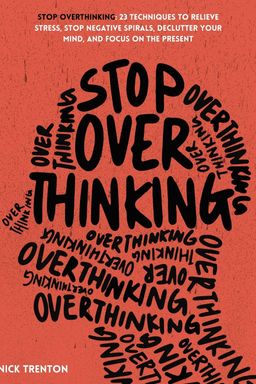
Have you ever found yourself lying awake at night, replaying conversations, analyzing decisions, and feeling trapped in a spiral of thoughts that seem impossible to escape? In Stop Overthinking, Nick Trenton argues that our greatest source of stress and unhappiness is not what happens in life itself—but how we endlessly think about it. He contends that overthinking is the modern plague of mental wellness: our constant analysis, self-doubt, and mental ‘replays’ consume our energy, distort our perception of reality, and keep us stuck in patterns of anxiety and indecision.
Trenton’s core argument is simple yet powerful: the ability to think is humanity’s greatest gift, but the inability to stop thinking is its greatest curse. Thought is meant to clarify, but overthinking confuses. The solution, he posits, is not to ‘think less’ but to think better—to reclaim control of your own mental processes through awareness, emotional regulation, and practical, structured techniques. Overthinking isn’t merely a bad habit; it’s the visible symptom of deeper disorders of anxiety, poor stress management, and distorted mental models.
Why It Matters in Everyday Life
We’re living in an era where constant stimulation, comparison, and information overload make mental stillness almost impossible. Whether it’s worrying about the future, analyzing social media interactions, or revisiting old mistakes, we’re locked in a feedback loop that robs us of peace. Trenton invites readers to imagine how much lighter life could feel if we could stop drowning in thoughts and instead direct attention toward purposeful awareness.
The Anatomy of Overthinking
The first chapter, illustrated through the story of James—a man who spirals from worrying about a minor health issue to catastrophizing entire scenarios—shows how quickly benign thoughts can snowball into panic. Trenton explains that overthinking turns our cognitive strengths against us. When our minds try to ‘solve’ every possible outcome, they flood us with hypotheticals and ‘what ifs,’ trapping us in a loop of analysis paralysis. This phenomenon, he explains, is driven by the overlap between anxiety and rumination: we feel compelled to think because it feels productive, but the process rarely leads anywhere.
The author identifies three major pillars that sustain overthinking: the self, the environment, and mental models. Our genetic predispositions to anxiety make some of us more vulnerable; our stressful environments add fuel to the fire; and our distorted mental frameworks—how we interpret control, threat, and self-worth—act as amplifiers.
From Causes to Consequences
Trenton emphasizes that overthinking is not just a mental process but a physiological one. When we remain in fight-or-flight mode, our bodies experience chronic stress, leading to fatigue, muscle tension, insomnia, and burnout. Mentally, we become self-critical and indecisive. Socially, our relationships suffer under irritability and withdrawal. The book’s first chapter acts as a reality check: overthinking is corrosive—it attacks every part of life, body, and mind.
The Path to Mental Clarity
So how do you stop the storm? Trenton organizes his method into practical systems that help you restore balance. In later chapters, he proposes powerful frameworks like the 4 A’s of Stress Management—Avoid, Alter, Accept, and Adapt—to regain control of stressful situations. He introduces sensory grounding (the 5-4-3-2-1 technique), journaling methods to declutter thoughts, and principles drawn from cognitive behavioral therapy (CBT) such as identifying and restructuring distorted thoughts. The book culminates with five transformative attitudes that define emotional mastery: focusing on what you can control, what you can do, what you have, what you need, and the present moment.
Why This Approach Works
Trenton’s perspective blends psychology and practicality. He treats overthinking not as a disease but as a maladaptive response—a natural mental behavior gone rogue. His solution is a blend of awareness and discipline: learning to notice the mind’s wanderings without judgment and training it to pivot toward grounded, purposeful action. The comparison to works like Eckhart Tolle’s The Power of Now and Mark Manson’s The Subtle Art of Not Giving a F*ck is clear—each explores how our internal narratives, rather than our external realities, dictate emotional outcomes—but Trenton’s focus is especially pragmatic and technique-driven.
A Promise of Practical Freedom
By the end of the book, you realize the goal is not eliminating thought but transforming your relationship with it. You learn to step outside loops of rumination, label your cognitive distortions, reset through sensory grounding, journal your triggers, relax your body through autogenic and muscle techniques, and visualize yourself in calm control. Most importantly, you develop attitudes that anchor you in reality, where stress is neutral and your perception determines peace. Trenton gives readers not just advice, but a toolkit to achieve mental clarity through structured, conscious living—the antidote to a world of mental clutter.