
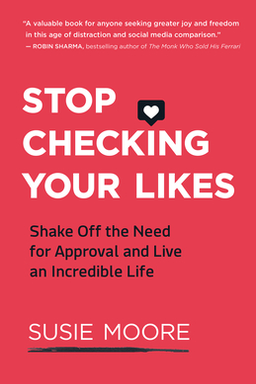
Stop Checking Your Likes cover

Stop Checking Your Likes

by Susie Moore

In ''Stop Checking Your Likes,'' Susie Moore provides actionable advice to free yourself from the grip of external validation. Learn to build self-worth, manage criticism, and pursue a life filled with confidence and fulfillment.

Stop Seeking Approval and Start Living Freely

Why do you spend so much time worrying about what people think of you—checking how many likes you get on social media, overanalyzing every glance at work, and chasing validation that never lasts? In Stop Checking Your Likes, life coach Susie Moore argues that the modern obsession with approval is holding you hostage. The real path to confidence, happiness, and freedom, she contends, comes from learning to stop looking outward for validation and start finding it inward. Moore’s book isn’t simply another self-help guide; she calls it a “sanity book,” designed to help you rediscover the authentic self you’ve lost in a world of judgment and comparison.

Moore proposes that your life can instantly expand when you untie yourself from the need to please others. She understands this deeply: she grew up in chaos, living in women’s shelters and surviving an abusive, addicted father. From those beginnings, she built a successful career and international coaching practice—not because she was armed with perfect credentials or luck, but because she learned to approve of herself when no one else would. Her anecdotes—from being locked out as a child by “dad and the hookers” to hustling her way into high-paying tech sales and eventually becoming a bestselling author—illustrate how detaching from public opinion can transform your reality.

The Cost of Approval-Seeking

The book opens with a relatable setup: the endless refresh for likes, hearts, and digital thumbs-up. Moore compares our dependence on such metrics to aliens watching bewildered humans check tiny glowing screens to measure self-worth. Seeking external validation has become so habitual we don’t even realize we’re doing it—but she warns that its cost is massive. It robs us of our real joy, creativity, and independence. The moments you sacrifice authenticity for approval—from staying in a miserable marriage because of what the neighbors might say to choosing a safe career that impresses your parents—represent mini deaths of the self. Moore wants you to reclaim that self by refusing to look for “permission” anymore.

Freedom as an Inside Job

Throughout the book, Moore repeats a central truth: freedom begins when you stop letting other people’s opinions define you. You were born with an “undeletable permission slip” to live freely, she writes. In practice, this means forgiving your parents for their flaws and rewriting the beliefs you inherited, recognizing that no one really knows what they’re doing (not even the most polished executives), embracing imperfection, and learning the art of saying “So what?” to rejection or criticism. These practices aren’t easy, but they yield true sanity. In Moore’s terms, “true success means choosing freedom—freedom from needing others’ approval and freedom to pursue who you are and want to become.”

Why This Book Matters Now

Moore’s message lands perfectly in the age of social media and status anxiety. When life feels curated for an audience, her invitation to stop performing and start being is restorative. With humor and personal transparency, she dismantles perfectionism and shows you how to find joy through radical self-approval, confidence, laughter, and perspective. Comparable in tone to Brené Brown’s vulnerability teachings and Wayne Dyer’s intuitive wisdom, Moore’s approach is more conversational and coaching-oriented—peppered with stories, “direct messages,” and practical prompts like “What’s missing?” and “What would change if you fully approved of yourself?”

In this guide, you’ll discover how childhood conditioning fuels adult insecurity, how no one else truly knows what they’re doing, how self-worth exceeds worldly validation, and how loving your flaws and embracing humor can make life lighter. You’ll learn to transform rejection into resilience, to ask boldly for what you want, and to remember that you are already perfectly enough. Ultimately, Moore’s book becomes a declaration: you don’t need a single external like to know you’ve “got this.” The act of recognizing your own worth is the only validation you’ll ever need.


Your Parents Effed You Up—Go for It Anyway

Susie Moore opens her first chapter by quoting poet Philip Larkin: “They f*** you up, your mum and dad.” But instead of blaming them, she invites you to go for it anyway—to forgive them, understand them as flawed humans, and recognize how their insecurities became your inherited beliefs. Moore’s childhood—marked by poverty, shelters, and an addictive father—illustrates how parental patterns shape self-image. Yet she insists these origins don’t define you; they prepare you.

Inherited Beliefs and Early Conditioning

According to Moore, we absorb our parents’ stress, fears, and values without noticing. Her mother’s lessons—don’t cling to men, never be jealous, save money, relax—mixed with darker teachings like “hardship is necessary.” Her father, smart but addicted, taught joy, humor, and compassion even amid chaos. Moore uses these contradictions to show how every family imprints both gifts and harms. The key is curiosity: instead of asking “What’s wrong with me?” she urges you to ask “What happened to me?” That question reframes trauma into context and enables growth.

Breaking the “Approval Trap”

So much dysfunction, Moore says, comes from caring too much about the “they”—the societal voice telling you who to be. Her example of wearing cast-off clothes as a child and feeling shame around classmates captures the pain of seeking approval. As adults, we still try to please the “they”: choosing safe careers, abiding by family expectations, or marrying for image rather than love. Moore reminds you that “no huge success story comes from someone who blended in.” Freedom arises when you stop needing ancestral and cultural endorsement.

Finding Power Through Choice

Moore’s breakthrough came when she found an old self-help paperback, The Magic of Thinking Big, at fifteen. That 50-pence purchase altered her mindset: life is made of choices, and every choice expands or contracts your possibility. Her mantra—“What you’re not changing, you’re choosing”—appears throughout the book (echoing Wayne Dyer’s and Viktor Frankl’s philosophies). Instead of repeating destructive patterns, she urges you to question inherited beliefs: do they serve you now? Replace limiting scripts like “hardship is necessary” with empowering ones like “ease is allowed.”

Ultimately, Moore believes that parental flaws illuminate your own freedom. You can love them without living like them. You can thank them for their lessons and still buy the metaphorical red coat they warned against. And you can recognize that forgiveness and autonomy are the highest forms of rebellion—a rebellion that leads to joy, not resentment.


No One Else Knows What They’re Doing, Either

In one of her most reassuring chapters, Moore dismantles the myth that everyone else has life figured out. Through stories of clueless bosses, anxious executives, and even NASA scientists with dating insecurity, she shows that no one truly knows what they’re doing. Success, she argues, isn’t about certainty—it’s about consciously deciding to act despite uncertainty.

Learning as You Go

Moore recounts how she built a robust career without formal credentials or contacts. When she was asked to sell political advertising in Washington, D.C., despite barely knowing what Congress was, she dove in, learned on the fly, and generated $3 million instead of her $500,000 target. The lesson: capability grows through application, not prior permission. Her motto—“Winners are just willing to not know and still go”—echoes Ricky Gervais’s wry line, “No one else knows what they’re doing, either.”

The Problem with Impostor Syndrome

Moore explains impostor syndrome as the universal fear of being exposed as inadequate. High-achieving women, she notes, suffer it most because they’re socialized to question themselves. She illustrates with examples—from Martha Stewart’s jail time to Michelle Obama’s miscarriages—that everyone battles imperfections behind the scenes. Comparing your insecurities with others’ polished surfaces is futile because “nobody posts their fears on Instagram.” (This idea aligns with Brené Brown’s notion of embracing vulnerability as courage.)

Follow Your Inner Alerts

Your intuition, Moore says, is a “cosmic computer” wired to guide you better than external approval ever could. When her client Melissa realized she spent more time pinning outfits than selling insurance, that restless impulse led her to become a stylist. Inner alerts—those subtle tugs of boredom or longing—signal what truly belongs to you. By following them, you strengthen your intuitive intelligence, even if society demands credentials. The only wrong move is ignoring your own wisdom.

No one knows everything, and no one gets to grant you power. You already have it. Moore’s antidote to self-doubt isn’t hustle—it’s relaxation. She asks readers to “trust your inner cosmic computer” and realize that calm confidence itself is magnetic. When you stop waiting to feel ready, doors you never imagined start opening.


How to Always End Up on Top

Moore’s secret to success is deceptive in its simplicity: stop fixating on others’ strengths and tune into your own. She observes that admiration and envy are signs of hidden self-recognition—traits you notice in others usually mirror your own potential. Everyone has diamonds in their pocket, but most people never realize it because they’re comparing their worth with someone else’s jewelry.

Revaluing Your Own Strengths

Through the story of helping a stay-at-home mom rediscover her professional talents, Moore shows how undervaluation stems from invisibility. The woman first listed only “being on time” as her skill; with Moore’s probing, she uncovered traits like calm under pressure, innovation, and problem-solving—all highly valuable in the workplace. The process mirrors Simon Sinek’s principle that knowing your “why” is essential for confidence. When you focus on contribution over comparison, you naturally rise.

The Lunchbox Analogy

Moore uses her childhood memory of comparing school lunches to show how comparison skews perspective. Adults do the same—comparing relationships, finances, or bodies instead of noticing their own full “lunchbox.” The chic blogger you envy may have debt, health issues, or a shaky marriage. She recommends listing “What I’ve Got” to see your unique assets—a gratitude-infused inventory that destroys envy through evidence of abundance.

Practice Appreciation, Delete Distraction

Social media fuels the illusion that others are perpetually ahead. Moore’s solution: delete apps for a month and note the emotional change. Her clients often report more happiness than receiving cash windfalls. Reflecting Aesop’s fable “The Cock and the Jewel,” she reminds you to prize what’s precious to you rather than seeking pearls that belong to someone else’s story. When you double down on your own strengths—like Tom Brady playing football, not tennis—you naturally end up on top.


The Power of Saying 'So What?'

Moore calls “So what?” the most liberating phrase on earth. It’s not apathy—it’s clarity. When criticism, exclusion, or failure arise, your simple “So what?” neutralizes their power. She learned the phrase from her mentor Fiona after receiving an online insult. The offhand dismissal instantly deflated her anger. She realized, as Fiona implied, that most pain stems not from events themselves but from the meaning we attach to them.

Caring Less Without Being Careless

“So what?” isn’t irresponsibility; it’s perspective. Moore lists dozens of scenarios—from being snubbed to screwing up dinner—where this mindset frees you. By caring less, you paradoxically gain more composure and charisma. Humans mirror emotional tone; when you don’t make a big deal, others relax, too. She recalls comforting kids as an au pair: when she laughed instead of gasped at their falls, they stopped crying sooner. Emotional mimicry works the same way in adults.

No One’s Watching

Contrary to our paranoid self-consciousness, Moore insists the world is too self-absorbed to watch or judge you. A woman she met at a birthday dinner told her, “I tried so hard to be perfect when I was your age—and then I realized no one was watching.” This anecdote captures Moore’s prescription: exhale. Most people worry more about their own flaws than yours. Adopting this understanding turns social anxiety into lightness and joy.

Reframing Fear and Failure

Moore demonstrates that fear of judgment, not failure itself, causes misery. Whether it’s divorce, losing a job, or being ghosted, she shows that the event alone is tolerable—the guilt or embarrassment around others’ reactions causes suffering. Her examples of friends fearing what colleagues will think prove that the opinion trap drives most stress. When you master the “So what?” mindset, you become “dangerously free”—a calm, untouchable force aligned with truth rather than approval.


Loving Yourself—Especially When You Don’t 'Deserve' It

Moore flips the usual self-esteem advice. You don’t earn love through perfection—you love yourself because you’re human. “No one ever hated themselves into anything good,” she writes. And her theory holds up: when you stop criticizing yourself, others mirror that respect. This chapter is about radical self-approval, from body confidence to self-forgiveness, illustrated through her own story and her mother’s lifelong journey toward contentment.

Stop Self-Sabotage through Self-Criticism

Moore’s colleague Jenny convinced her fiancé she had “big legs” by constantly repeating that flaw until he believed it too. Self-deprecation repels affection. She urges you to stop fishing for reassurance and act like the prize you are. Confidence attracts alignment, while criticism attracts pity and fatigue. Citing Louise Hay’s mantra—“Try approving of yourself and see what happens”—she reframes self-love as both spiritual and practical.

Tools for Self-Approval

Moore offers daily techniques: mirror affirmations (“I love you, [your name]”), listing accomplishments (“Twelve Magic Moments”), and visualizing your childhood self (“Loving Little Me”) to cultivate compassion. She even founded a “Childhood Picture Posse” with friends who text photos of their younger selves to remind each other to be kind. These tactile rituals reinforce worth and dissolve shame.

Approval as Generosity

Moore’s conclusion is striking: loving yourself isn’t vanity—it’s generosity. People who approve of themselves spread warmth effortlessly. Self-approval creates contagious confidence, uplifting everyone you encounter. Her mother’s story—scarred by a childhood fire yet later crowned “Granny” at a local school—embodies resilience and grace. Loving yourself, Moore insists, is both self-care and world-care. Without it, no external achievement can fill the void.


Great News: It’s Your Fault

Moore’s provocative declaration—“It’s your fault”—isn’t about guilt. It’s about reclaiming power. When you admit responsibility, you claim agency over change. Borrowing insights from Viktor Frankl and Wayne Dyer, she argues that accountability is the foundation of freedom. Nothing shifts until you stop blaming others for circumstances you can influence.

Victim Loops vs. Accountability Loops

Moore defines two psychological cycles. In a victim loop, you repeat negative patterns while denying responsibility (“I can’t help it”). In an accountability loop, you own your role and act decisively. Her story of leaving a gambler husband illustrates the transformation. Guided by her counselor’s words—“Don’t underestimate your competence”—she realized that staying was a choice. Once she accepted her power, she left, creating a life of independence and dignity.

Responsibility as Liberation

When you see every choice as your creation—from your job to your relationships—you unlock control. Moore reframes “It’s my fault” as “It’s my choice.” She uses real-life examples: blaming unfair bosses, bad partners, or stressful lives keeps you weak; reframing them as lessons makes you antifragile (a concept from Nassim Taleb). Accountability turns suffering into strategy.

Freedom through Perspective

Moore’s signature question—“What you’re not changing, you’re choosing”—becomes your compass. When you catch yourself complaining, ask who owns your power. She encourages listing three options for every problem, proving that alternatives always exist. By replacing blame with curiosity, you graduate from helplessness to mastery. As she concludes, “Freedom means taking responsibility for your life, even the messy parts you avoided.”


Fall Madly in Love with Rejection

Moore transforms rejection into spiritual exercise. Every “no” is temporary, she reminds you, and it’s rarely personal. She learned resilience through early exclusion—from not being invited to a school pool party to being fired from her first job. Each rejection reshaped her, guiding her toward alignment. Her motto: rejection isn’t punishment; it’s redirection.

Reframing the ‘No’

In sales jobs, Moore once endured dozens of ignored emails and curt responses. Instead of internalizing failure, she treated every “no” as a step closer to “yes.” That mindset drove her to financial success and later media fame. She cites stories of Walt Disney and Colonel Sanders who turned repeated rejection into empire-making momentum. What happy people know, Moore says (quoting Dan Baker), is that our fears all reduce to two roots: “I am not enough” or “I don’t have enough.” Recognizing those buckets dissolves anxiety.

The Sour Grapes Trick

Borrowing Aesop’s fable of the fox and the grapes, Moore teaches “reframing rejection.” If you weren’t picked, maybe those “grapes” were sour anyway. She vividly recalls reframing losses—the overpriced job, the unfit apartment—as blessings in disguise. Each missed chance protected something better. This playful perspective converts bitterness into relief.

Letting Go of Past Hurts

Rejection, Moore insists, exists only in memory. If you’re reliving a snub from last week, you’re self-rejecting in the present. Shift focus to the moments going right and realize that once you loosen your grip on “why me?”, peace arrives naturally. You can’t pursue your next great thing while clutching old “nos.” Rejection is a tool sent to refine—not deny—you. Love it, laugh at it, and step ahead untouchable.


Let It Be Easy

The closing concept of Moore’s book is her life philosophy: let it be easy. She believes most of our stress is self-imposed, generated by “stressful thoughts,” not the world itself (echoing Wayne Dyer’s insight). Ease isn’t laziness—it’s intelligence. When you remove unnecessary tension, you create space for opportunities, creativity, and grace.

The Art of Making Life Simple

Moore challenges you to replace your “to-do” list with a “get-to-do” list, shifting obligation into gratitude. When overwhelmed, ask two magic questions: “How can I make this easier?” and “What’s essential here?” Whether you’re giving a presentation, detoxing from bad habits, or confronting a partner, reducing chaos strengthens clarity. Keep only what’s essential and treat the rest lightly—an application of minimalism to happiness.

Opening to Possibility

Moore uses examples like her spontaneous media submissions and career transitions to demonstrate that ease invites breakthroughs. Opportunities often sit undiscovered because stress blinds us. When she pitched articles online without overthinking, she quickly became published on major platforms. Life’s serendipity flows, she says, through calm openness—not anxious striving.

Appreciation as Antidote

Finally, Moore introduces “Open Those Arms Wide,” a ritual to cultivate gratitude. Imagine losing everything—your home, limbs, or loved ones—and then feeling relief when you realize they’re still here. That gratitude grounds ease. She concludes with bold simplicity: belief and appreciation magnetize joy faster than hustle ever could. Let life be glorious, not grueling, because effort magnified by joy outperforms effort made in misery.

Dig Deeper

Get personalized prompts to apply these lessons to your life and deepen your understanding.

Go Deeper

Get the Full Experience

Download Insight Books for AI-powered reflections, quizzes, and more.