
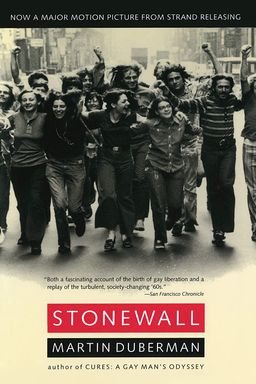
Stonewall cover

Stonewall

by Martin Duberman

Stonewall offers a vivid retelling of the 1969 protests that ignited the LGBTQ rights movement in America. Through the lives of six activists, Martin Duberman reveals the fierce struggle and remarkable courage that led to greater acceptance and equality. This definitive history is both a tribute and a call to action.

Lives as History: Personal Revolutions Behind Stonewall

How do individual lives become history? In Stonewall, historian Martin Duberman argues that the story of gay liberation emerges not from anonymous forces but from deeply personal journeys. He builds the book as six interconnected portraits—Craig Rodwell, Yvonne Flowers, Karla Jay, Sylvia Rivera, Jim Fouratt, and Foster Gunnison Jr.—whose lives together trace the emotional, social, and political currents leading to the 1969 Stonewall uprising. Each figure embodies a distinct intersection of class, race, gender, and ideology, allowing you to understand the decades-long build-up to collective defiance.

Using biography as historical method

Duberman’s approach is radical for its time: he replaces sweeping generalizations with personal detail. Instead of writing “the” history of gay people, he reconstructs lived experience through interviews, archives, and oral testimony. This method forces you to live inside institutions, families, and bars as his subjects did—feeling both repression and awakening. He insists that history happens where emotions, shame, and courage collide. Each contradiction—Craig’s perfectionism and audacity, Yvonne’s pride and isolation, Sylvia’s marginalization and fire—reveals the movement’s moral depth. In focusing on persons, Duberman resists reducing activism to an abstract timeline; you see how motives, wounds, and chance encounters shape public acts.

From formative childhoods to early identity

All six lives begin far from politics. Duberman reveals how institutional childhoods and family discipline trained people in both obedience and rebellion. Craig’s experience at Chicago Junior—where intimate male friendships coexisted with corporal punishment—makes you understand how shame became the seedbed of later defiance. Yvonne’s household in New Rochelle, dominated by her scholar mother, models discipline and creativity but leaves her uneasy about desire. Sylvia’s early trauma—a mother’s suicide and an ambivalent grandmother—casts her onto the street at eleven, teaching her survival in a hostile world. Karla’s relative safety at elite schools produces confidence that later meets sexism head-on. Across these stories, childhood is not destiny but training in the emotional languages of secrecy, resistance, and care.

Subcultures as rehearsal for politics

Before there was organization, there were subcultures. Bars, theaters, bookstores, and drag shows become both refuge and crucible. Caffè Cino and the Living Theater give Jim Fouratt and others a stage for creative boldness. Yvonne finds jazz clubs that mix racial politics and erotic freedom, even as racism lingers inside the gay scene itself. Craig’s Oscar Wilde Memorial Bookshop blends commerce, counseling, and activism—quietly turning culture into infrastructure. These spaces teach people their own value, offering small rehearsals for public defiance even as they reproduce class and racial hierarchies. You realize that liberation began not with manifestos but with relationships in smoky rooms and noisy streets.

The movement takes form

As the 1960s progress, these personal experiments harden into organizations. Mattachine Society, ONE, and the Daughters of Bilitis refine strategies of respectability—defined dress codes, lawsuits, public pickets—while new radicals agitate for visibility. Craig Rodwell’s Annual Reminder at Independence Hall and Dick Leitsch’s 1966 “sip-in” reveal a generation learning choreography for protest. Foster Gunnison’s careful recordkeeping anchors their legacy, but also exposes movement fragility: disputes over who counts as representative fracture cooperation. The question—assimilate or rebel?—haunts every meeting. Duberman shades each personality into these ideological contrasts, showing how activism grows from temperament as much as logic.

Intersectionality and internal tension

Parallel to organizational history is the painful truth that class, race, and gender never disappear. Yvonne Flowers encounters exclusion from white lesbian bars even as she builds Black lesbian social networks through jazz performance. Karla Jay pushes feminist consciousness into male-dominated spaces that often patronize women. Sylvia Rivera and Marsha P. Johnson invent survival politics—STAR House—only to find mainstream activists ignoring trans street youth. Homosexual oppression, Duberman insists, is never singular: it always entangles racism, sexism, and poverty. These entanglements forecast both the power and fractures that would characterize post-Stonewall politics.

The night that changed everything

When the June 1969 police raid on the Mafia-run Stonewall Inn detonates into resistance, you already understand why. Federal agents undercut the usual payoff network; the crowd—including Sylvia Rivera, Jim Fouratt, Craig Rodwell, and countless unnamed queens and bar-goers—has simply had enough. The uprising’s chaos transcends single leadership. It fuses the culture of defiance born in bars, theater, and feminist circles into a collective act of refusal. Eyewitnesses disagree about details, but Duberman’s method—intertwining these six voices—makes the event feel both personal and inevitable. The riot is history’s convergence point between lived grievance and public courage.

From explosion to organization

After Stonewall, the energy hardens into new identities: the Gay Liberation Front, the Gay Activists Alliance, and later women’s and trans collectives. Craig urges commemoration through Christopher Street Liberation Day (the first Pride March, June 28, 1970). Jim and others bring Yippie theatricality to political “zaps.” Karla and Redstockings highlight lesbian visibility through Lavender Menace protests. Meanwhile, the surveillance state—FBI files, infiltration rumors, Red Squad eavesdropping—continues to cast suspicion. The transition from riot to ritual, from paranoia to parade, marks the complex birth of public gay citizenship.

What Duberman asks of you

The cumulative lesson is moral as well as historical: movements live through people who are inconvenient, visionary, and contradictory. To grasp gay liberation, you must hold together Sylvia’s hunger and holiness, Craig’s obsession with order, Yvonne’s artistry, Karla’s feminism, Jim’s theatrical zeal, and Foster’s bureaucratic precision. Together they prove that identity politics was never abstract—it was built from lived bodies negotiating power, love, and survival. Duberman offers no myth of unity. Instead, he leaves you with a method: to see large social change by listening closely to small, vivid lives.


Forming Selves in Hostile Worlds

The early chapters trace how childhood institutions, families, and early encounters construct the grammar of identity. These stories remind you that queer consciousness doesn’t spring from politics—it emerges from coping with contradiction. Each subject grows up managing repression, secrecy, or love that feels both dangerous and defining.

Institutions as training grounds

Craig Rodwell’s Chicago Junior School, a model reform institution, becomes an unwitting incubator of gay identity. Same-sex intimacy thrives in an atmosphere of rigid discipline and Christian moralizing; the boys’ nightly explorations reveal both yearning and fear. Karla Jay’s Bromley Institute mirrors this with female friendship and soft policing of difference. You see how such spaces train emotional double vision: affection mixed with guilt, secrecy paired with solidarity.

Families and fracture

Family narratives deepen that emotional blueprint. Yvonne’s mother Theo, proud and intellectual, becomes her both mentor and censor—instilling ambition and silent shame. Sylvia’s grandmother provides faith without full love. Foster’s affluent family teaches restraint, precision, and caution that morph into his later archiving and organizational control. Childhood for all of them is less about trauma than apprenticeship in strategic self-concealment.

Intersectional beginnings

Duberman emphasizes how class and race complicate this growth. Sylvia’s Puerto Rican background and Yvonne’s Black identity expose them to compounded prejudice long before sexuality enters the conversation. Yvonne’s familiarity with jazz and Black middle-class expectations teaches code-switching; Sylvia’s poverty teaches improvisation and community reliance. You come to see that by the time these figures discover sexual orientation, they already possess social survival tools that become political instruments later on.

Core idea

Formative environments produce emotional fluency—a readiness to interpret shame and repression, to choose between silence and confrontation. Political activism is the mature form of that early emotional literacy.

What these childhoods teach you is how identity builds out of contact with authority: each beating, sermon, or reward sows the tactics of later rebellion. The activist who challenges a police raid first learned to read power, often as a frightened child discovering who they could trust. Duberman’s subjects therefore make you see liberation as a lifelong syllabus in surviving structures meant to contain you.


Subculture as Refuge and Resistance

As you move into adulthood with Duberman’s six, the landscape shifts from classrooms to bars and theaters. Cultural subspaces—often commercial, sometimes criminal—become laboratories of freedom and contradiction. They teach self-expression but encode hierarchy; they heal loneliness while reproducing social wounds.

Barrooms and cabarets

For Yvonne Flowers, Harlem jazz clubs like the Bon Soir and Lenny’s Hideaway become both career and sanctuary. They nurture style, confidence, and erotic play across race and class lines. Yet those same clubs reveal the racism of the larger gay scene: Black women face exclusion in white Village bars, proving that queer solidarity is never automatic. For Sylvia Rivera and her sisters of the street, bars and sidewalks are home, economy, and school; these spaces train improvisation and courage but also expose them to arrest and violence.

Theater and creative community

In downtown theaters—Caffè Cino, the Living Theater—you watch culture and politics mingle. Jim Fouratt’s acting work gives him social capital, performance skills, and practice at controlled transgression. These venues normalize queer presence through art, creating small publics where visibility feels possible. The creative avant-garde becomes the emotional rehearsal for the political avant-garde.

Books and memory

Craig Rodwell’s Oscar Wilde Memorial Bookshop becomes the first openly gay bookstore, serving as a library, counseling center, and recruitment node. His careful curation of intellectual and activist texts turns consumer space into public pedagogy. Meanwhile, Foster Gunnison’s archival zeal ensures that these ephemeral lives won’t vanish. Cultural preservation itself becomes political resistance.

Interpretive insight

Subculture functions as both shield and seedbed—protecting individuals from the straight world while generating the language, art, and contacts that will later sustain collective revolt.

When you regard these spaces as social infrastructure rather than sideshows, you see how cultural life stretches toward politics. Every jazz tune, play, or book counter display is a rehearsal for public pride. Duberman’s achievement is to make you respect the mundane labor of cultural survival as history’s first protest march.


Repression, Surveillance, and Law

Even before Stonewall, conflict with the state defines the boundaries of possibility. The mid-century gay world survives through payoffs, euphemism, and constant negotiation with police power. Duberman shows how visibility and legality are both weapons and vulnerabilities for activists.

Police corruption and the bar economy

At Stonewall Inn, Mafia owners run a profitable but precarious operation, paying thousands weekly to local precincts. Patrons buy overpriced, watered-down drinks under unsanitary conditions, exchanging danger for the mere right to dance together. This economy of vice depends on collusion: once payoffs falter, raids erupt. The June 1969 bust, triggered by a federal liquor investigation, happens precisely because that chain of protection breaks. That structural corruption—not one night’s madness—fuels the explosion that follows.

Respectability and protest

Earlier activists like Frank Kameny and Craig Rodwell practice lawful dissent—picket lines in suits, “sip-ins,” and courtroom challenges. They pursue what Duberman calls grassroots legalism, learning to test the limits of visibility without inviting obliteration. The State Liquor Authority’s defeat in the Julius’ bar case demonstrates the incremental gains such tactics achieve: small rulings that erode entrenched discrimination. Yet these very acts test activists’ nerves; visibility can equal arrest, and every legal step forward occurs under surveillance.

Infiltration and paranoia

As movements grow, the state responds with spying. The FBI, BATF, and NYPD’s Special Services plant informers and compile dossiers, mistaking theater meetings for subversion. Rumors—like accusations that Jim Fouratt is a government agent—fracture unity. These suspicions result in self-policing cultures that echo the closets activists tried to escape. The struggle for trust becomes as critical as the fight for rights.

The legal and clandestine threads converge at Stonewall: a corrupt bar economy, federal meddling, and a generation fed up with humiliation. Duberman’s research reframes the riot not as chaos but as historical inevitability when systemic exploitation meets a new ethic of defiance.


The Stonewall Flashpoint

Duberman reconstructs the Stonewall uprising with narrative precision, displacing myth with multiplicity. The June 27–28, 1969 raid begins like countless others, but refuses to end on schedule. Patrons, tired of surrender, push back. The crisis exposes accumulated rage from years of harassment, poverty, and moral policing.

The sequence of events

At 1:20 A.M., detectives storm the bar, arrest employees, and herd cross-dressed patrons toward vans. Outside, a crowd gathers—street kids, drag queens, lesbians, and neighborhood residents—chanting, jeering, throwing coins. When a woman resists arrest or a queen’s heel hits a police officer (accounts vary), the line breaks: police barricade themselves inside, and the crowd takes over Christopher Street. The Tactical Patrol Force arrives, but the rebellion reignites for multiple nights. Duberman’s composite storytelling captures both terror and triumph.

Who made history

Among the crowd stand Sylvia Rivera and Marsha P. Johnson, visible symbols of defiant Queens; Craig Rodwell and Jim Fouratt turn observers into historians, spreading word to media and movement networks; unnamed street youths sustain the confrontation. No single hero dominates because collective fury drives the event. This democratic chaos is its genius—the eruption of community where none officially existed.

Historical meaning

Stonewall marks the instant when private grievance becomes public power. It fuses years of cultural rehearsal—bars, theaters, feminist debates—into direct confrontation with the state. Its messiness, not its myth, gives it historical reach.

Duberman disperses heroism across his six biographical threads to insist that social movements are ecosystems, not monuments. By refusing closure—showing contradictory memories and emotions—he preserves the riot’s human scale. What endures is not who threw the first brick but how fear turned into solidarity on a summer night in New York.


Liberation, Division, and Pride

After the smoke of Stonewall clears, the challenge becomes organizing the freedom it symbolized. Here Duberman shows transformation and fracture: from underground cells to public parades, from consensus to ideological schism. Liberation expands but unity dissolves.

From homophile to liberationist

Older homophile leaders—Kameny, Leitsch, Foster Gunnison—cling to respectability: suits, legality, and slow reform. Younger radicals—Jim Fouratt, Craig Rodwell, Martha Shelley—reject decorum for revolution. The Gay Liberation Front aligns with feminists, Black Power, and antiwar activists; the Gay Activists Alliance splits off to pursue focused “zaps.” The Credentials Committee battles, convention disruptions, and ERCHO collapse illustrate institutional disintegration as passion accelerates.

Feminism and internal critique

Karla Jay navigates between Redstockings, GLF, and DOB, articulating lesbian feminism’s demand for space inside the movement. Women push for separate dances, funding, and acknowledgment; actions like the Lavender Menace protest force the women’s movement to confront its own exclusions. The lesson is that without gender awareness, even liberation reproduces patriarchy. Yet these frictions also broaden the agenda beyond sexuality to the social systems that regulate all identity.

Street queens and radical care

Meanwhile, Sylvia Rivera and Marsha P. Johnson turn defiance into social service through STAR House—a precarious shelter for trans and homeless youth. Their survival work dramatizes the moral question haunting the movement: will liberation include its poorest and most visible members? STAR’s eviction underscores how revolutionary compassion collides with economic reality.

Commemoration and continuity

Craig Rodwell channels volatile memory into a unifying ritual: Christopher Street Liberation Day, June 28, 1970. Two thousand marchers walk from the Village to Central Park chanting “Gay Power.” Despite fear and tension between radicals and moderates, the parade proves public visibility can transform isolation into culture. Annual Pride marches institutionalize that lesson, converting riot energy into civic identity.

By ending with commemoration, Duberman closes the circle. The six portraits—once separate—merge into a chorus claiming space in history. Stonewall’s power lies less in victory than in continuity: survival turned memory, memory turned movement. Through these lives, you learn that liberation is never a finished chapter but a daily rehearsal in courage and inclusion.

Dig Deeper

Get personalized prompts to apply these lessons to your life and deepen your understanding.

Go Deeper

Get the Full Experience

Download Insight Books for AI-powered reflections, quizzes, and more.