
Idea 1
Finding Meaning Through the Stitches of Life
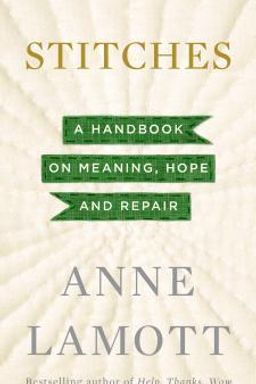
How do you find meaning when life unravels — when tragedy, loss, or sheer everyday chaos pull apart the fabric of your world? In Stitches: A Handbook on Meaning, Hope, and Repair, Anne Lamott invites you into a profoundly honest, often humorous exploration of what it means to keep going when life falls apart. She argues that meaning is not something we find once and for all — it’s something we stitch together, bit by bit, moment by moment, from the tattered remnants of grief and grace.
Lamott contends that life is messy, unpredictable, and sometimes unbearably cruel, but small acts of repair — kindness, community, laughter, everyday rituals — are where we find healing. The book fuses memoir, spiritual reflection, and storytelling to explore how we make sense of catastrophe, how friendship and creativity save us, and how God or grace shows up in life's ragged seams.
Life as a Patchwork
At the heart of Lamott’s vision is the metaphor of sewing, quilting, and mending. Whether she’s patching curtains with her friend Neshama or describing her struggles with grief and sobriety, Lamott sees our lives as a quilt of mismatched squares — some bright, some dark, many torn. Their beauty comes not from perfection, but from how we piece them together. Life, she insists, is not something whole that gets broken, but something incomplete that you keep patching with love.
When Lamott describes her friend stitching together two ruined curtains into a new piece — funky, uneven, but radiant with personality — she offers a vivid image of how broken people and broken stories can be refashioned into something surprisingly beautiful. “You just keep taking the next stitch,” she writes, “and the next one, and the next. Without stitches, you just have rags. And we are not rags.”
Meaning Amid Chaos
Lamott’s project begins with a blunt admission: “It can be too sad here.” From mass tragedies like Sandy Hook to personal losses — the death of her best friend Pammy, the slow decline of friends to illness — she explores what we can possibly make of a world where suffering seems both inevitable and unfair. She suggests that while you may not be able to make sense of life, you can still make love visible through what she calls “stitches” — small daily actions that reconnect us to others and to hope. Teaching Sunday school, cooking a meal, making art with children, or showing up for someone in despair — these become sacred gestures.
This echoes wisdom traditions everywhere: the Buddhist focus on mindfulness and compassion, the Christian call to be “Jesus’ hands,” even the humanist insistence on community as salvation. For Lamott, these are all ways of doing the same thing — taking another stitch in the torn fabric of life. The meaning isn’t in fixing what’s broken but in choosing to start again, to sew around the edges of chaos.
Grace in Small Things
Lamott’s humor and humility come through in anecdotes both funny and tender — her clumsy sobriety journey, her flawed parenting, her tendency to overthink life at 10 p.m. But under the laughter is a quiet theology of grace. Grace, for her, is not cosmic drama; it’s the ordinariness of being loved, noticed, and helped. It’s a friend fixing your curtain, a spiritual mentor answering your late-night question, or your dog shredding fabric and somehow leaving you with a story worth telling. Meaning, she argues, often hides inside the ridiculous.
As she writes of her community — both the sober misfits who helped her recover and her church of eight people singing loudly off-key — Lamott shows that grace moves most freely where people admit they are a mess. You don’t need to have your act together to belong; in fact, you belong because you don’t.
Why the Stitches Matter
Lamott is not offering a system for happiness but a practice for enduring: find small rituals that hold you up. She calls this the “embroidery thread” of grace — the color that unifies all the clashing patches of life. This may be prayer, patience, coffee and birds, or the rhythm of daily chores. The world, she says, will keep handing us mismatched squares — sea-foam upholstery next to plaid — but if we stitch them with love, they somehow “go together.”
Ultimately, Stitches is about finding meaning through participation—not intellectual explanation. When you stand beside someone at their tragedy, when you sing even if you’re out of tune, when you make something small and good, you are helping to rejoin the fabric of the world. There will always be holes; the miracle is that we keep repairing them anyway.
For readers who feel frayed by grief, depression, or the confusion of modern life, Lamott’s voice is a companionable hand on the shoulder. She doesn't fix the sadness; she makes it bearable by reminding you that all of us are patching something together, learning how to be “good enough again.” As she concludes, “The search is the meaning.” And, she hints, as long as you keep searching — and stitching — you are already home.