
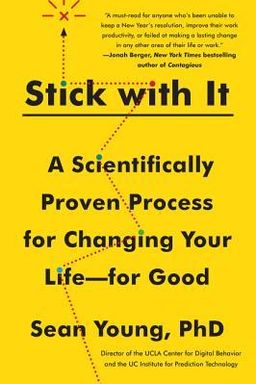
Stick with It cover

Stick with It

by Sean D Young

Stick with It offers practical, science-backed strategies for breaking bad habits and achieving personal goals. Through real-world case studies and behavioral research, Sean D. Young guides readers on a journey to lasting change, empowering them to conquer challenges and fulfill their dreams.

The Science of Sticking With Change

Why do most people abandon their diets, resolutions, and goals just days or weeks after starting them? In Stick with It, UCLA psychologist and researcher Sean Young offers a compelling answer: lasting change doesn’t depend on willpower or personality but on science. His core argument is that you don’t need to become a new person to change your life—you need to understand and use the psychological forces that drive human behavior. He contends that these forces, once harnessed, can triple your success in maintaining habits, achieving goals, and influencing others to do the same.

Young introduces what he calls the SCIENCE Model, an acronym for seven psychological forces that support lasting change: Stepladders, Community, Important, Easy, Neurohacks, Captivating, and Engrained. Each represents a core scientific principle drawn from years of peer-reviewed research in behavioral psychology, neuroscience, and social influence. When used together, they create the conditions under which change doesn’t just begin—it sticks.

Why People Don’t Stick With Change

Young begins with gripping examples that show how dramatically persistence varies. He describes daredevil Nik Wallenda persevering through years of grueling preparation to walk a tightrope across the Grand Canyon, compared to the ordinary struggles of people who can’t manage to floss regularly or stop hitting snooze. What separates the disciplined few from everyone else? Not innate motivation, but an invisible structure of supportive psychological forces. Young explains that forty percent of our behaviors are habits, but most self-help focuses only on that slice of life; his model targets the remaining sixty percent driven by social, emotional, and cognitive forces we can learn to master.

From Dreams to Steps: Change as a Process, Not a Personality

Most conventional advice tells you to change your personality—be more confident, more disciplined, more charismatic. Young dismisses this as misguided. Personality, he argues, is largely fixed. What works is changing your process. By breaking goals into small, achievable steps (Stepladders), enlisting supportive social groups (Community), and removing unnecessary obstacles (Easy), you can reshape behaviors without battling who you are. His book integrates insights from health research, business innovation, and medicine to show that the same principles apply whether you’re trying to exercise consistently, increase customer loyalty, or help patients adhere to medication.

The Seven Forces of Lasting Change

Each chapter of Stick with It deepens one letter of the SCIENCE model. Stepladders teaches incrementalism: small, quantifiable actions create momentum. Community reveals the hidden power of social contagion—how surrounding yourself with supporters or role models multiplies commitment. Important explains motivation through personal significance (health, money, relationships). Easy removes friction by simplifying routines. Neurohacks offers mental shortcuts that reverse conventional wisdom—acting first to change thinking later. Captivating urges creating rewarding feedback, and Engrained shows how repetition makes behaviors automatic.

Young’s voice is equal parts scientist and coach, blending case studies—like musician Brad Delson’s rise with Linkin Park or patient stories from addiction treatments at UCLA—with the rigor of academic research. Each story exemplifies one or more forces in action. For example, the “HOPE” community study, which helped at-risk men get tested for HIV, demonstrated how Community produced a twofold increase in lasting behavioral change through online peer leadership. Across domains—from health to corporate engagement—the same pattern appears: the more SCIENCE forces applied, the higher the rate of success.

Why This Matters for You

Young emphasizes that lasting change isn’t just about motivation—it’s about structure. If you’ve ever wondered why resolutions evaporate by February, it’s likely you focused on willpower without designing an environment that makes change easy, rewarding, and socially reinforced. Using his model, you can engineer your surroundings and habits so success becomes automatic. It’s a message both empowering and scientific: you don’t fail because you’re lazy, but because you’re outmatched by poorly aligned psychological forces. Once you align them, persistence becomes natural.

Key takeaway

Lasting change comes from leveraging seven psychological forces—not sheer determination. As Young’s research shows, when Stepladders, Community, Important, Easy, Neurohacks, Captivating, and Engrained combine, your likelihood of success can increase by nearly 300 percent.

The chapters that follow unpack each force with practical stories and exercises, showing you exactly how to apply them in your life and work. Whether you’re building a new business or breaking a bad habit, Young’s science-backed framework gives you the tools to stick with whatever matters most.


Think Tiny: Stepladders and Incremental Progress

The first force in Young’s SCIENCE model—Stepladders—is deceptively simple. It teaches that success depends on starting tiny. You might believe you already take small steps toward your goals, but Young argues that most people’s steps are still too big. His stepladder model of “Steps, Goals, and Dreams” clarifies why shrinking them even further can be transformative.

From Grand Canyon Walks to Daily Tasks

Young opens with a vivid story of Nik Wallenda, who practiced for years to walk a tightrope across the Grand Canyon. Though his feat seems extraordinary, Wallenda actually applied everyday psychology: he broke immense risks into small, precise routines. Likewise, Brad Delson of Linkin Park succeeded not by chasing the dream of stardom, but by focusing on weekly goals—writing songs, scheduling rehearsals, completing specific tasks. Both men mastered incremental progress, transforming an overwhelming dream into doable steps.

Dreams, Goals, and Steps: How Small Is Small?

Young defines dreams as long-term ambitions requiring three months or more, often never achieved before; goals as short-term, one-week-to-one-month outcomes; and steps as actions taking less than two days. The sweet spot for success, he found, lies in planning one-week goals composed of daily or two-day steps. When his students used such micro-goals, their productivity soared. The pleasure of continual progress releases dopamine—a reward chemical—creating self-reinforcing momentum.

Supporting this, behavioral economics research on delay discounting shows people value immediate gains more than distant rewards. By shortening the time gap between action and payoff, stepladders counter our impatience. In one study of overweight women, those who focused on day-to-day eating behaviors lost more weight than those fixated on long-term dreams of slimness. The “dreamers” even gained weight.

Reflection and the Power of Self-Efficacy

Stepladders also include reflection—celebrating each completed step. These small acknowledgments boost what psychologists call self-efficacy: belief that you can change. Whether it’s a runner adding two miles per week or a beginner musician learning one verse at a time, celebrating micro-wins builds confidence to keep going. Reflecting turns progress into proof.

Application in Life and Business

Young demonstrates that stepladders work everywhere—from education to entrepreneurship. Fitbits and fitness apps succeed because they show measurable daily steps and reward small wins. Companies like MyFitnessPal use incremental onboarding—offering only two options on the first screen, three on the second, four on the third—to guide users gradually. This design mirrors the stepladder principle and explains why such apps retain more users.

Key takeaway

Stepladders transform overwhelming goals into achievable steps. By focusing on small, immediate actions and reflecting on progress, you rewire your brain to crave sustained success instead of distant dreams.

If you want to create lasting change—whether running marathons, launching a start-up, or learning a new skill—start microscopic. As Young shows, the smaller your first step, the larger your eventual leap.


Harnessing Social Influence: The Power of Community

Young’s second force, Community, reveals why change rarely happens in isolation. From cults to health groups, people are shaped by social magnets—groups that attract and bind their members. If you think you’re independent and unaffected by peer influence, Young’s research might surprise you: both good and bad behaviors spread socially.

Cults, Addiction, and Social Magnets

The chapter begins with the story of sociology professor Janja Lalich, who joined a militant political cult despite her education and intelligence. Her transformation wasn’t from ideology alone but from immersion in a close-knit group where belonging overrode logic. People commit themselves when communities satisfy psychological needs—trust, belonging, self-worth, reward, empowerment. Young calls this the “social magnet.”

This magnet also powers positive change. Alcoholics Anonymous, Weight Watchers, and CrossFit succeed because they turn solitary struggles into shared missions. First-time members find others cheering their progress and expecting participation. Eventually, accountability shifts from willpower to community energy.

Building Lasting Communities

To create lasting behavioral change, communities must be active and nurturing. In Young’s HOPE study, online groups of African-American and Latino men at high risk for HIV dramatically increased testing rates—more than double those of a control group. Peer leaders encouraged participation and empathy, turning what had been a stigmatized topic into a shared cause. Engagement remained above 80 percent even fifteen months later.

Young’s formula for successful communities includes six ingredients: trust, fitting in, self-worth, social magnet, reward, and empowerment. When at least 15 percent of members actively nurture connections (as peer role models), the group sustains itself naturally. Businesses and educators can apply the same principles: replace passive audiences with participatory peers.

Applying Community Beyond Health

Young extends the concept to business innovation. Engineer Matei Zaharia built Spark, a faster data-processing tool, but needed users. Instead of marketing broadly, he built a “meetup community” of passionate engineers who learned from one another. That social magnet transformed Spark into an industry leader. In contrast, Dos Equis beer’s viral “Most Interesting Man” campaign built huge online communities but failed to increase real purchases—because it attracted joke-sharers, not brand loyalists. Sam Adams succeeded by cultivating an authentic tasting community around enjoyment of beer, not advertising.

Key takeaway

Community magnifies motivation. Real engagement requires trust, empathy, and shared stakes—not just social noise. Surround yourself with people who embody your desired change, and the social magnet will pull you forward.

Whether you’re pursuing health, career success, or creative goals, you can’t stick alone. Find—or create—a community that celebrates progress, shares accountability, and turns effort into belonging.


Finding Motivation Through What’s Truly Important

The third force—Important—asks a simple question: is the change meaningful to you? If not, it won’t last. People act consistently only when behavior aligns with something they value—health, relationships, wealth, legacy. Young illustrates this with emotional contrasts between his two grandmothers, revealing how importance can sustain life itself.

The Grandmothers and the Meaning of Life

Doris Felner lived for her family; when her daughter died, that purpose vanished, and she declined rapidly. Beatrice “Billie” Young, by contrast, lived for passion—art, exercise, music—and thrived decades after losing her husband. Both shared similar health and genes, but Billie’s driving importance kept her alive. The lesson: when change connects with deep personal significance, persistence follows.

The Big Three Motivators

Research shows three universal motivators: money, social connection, and health. Each triggers a sense of importance differently. In Mexico’s Oportunidades program, giving cash directly to poor families (especially mothers) transformed long-term poverty behaviors by making healthier living financially essential. Likewise, studies from Harvard’s Grant project found that deep relationships—not income—best predicted lifelong happiness. And health crises or recovery, as seen in Young’s cousin with Crohn’s disease, often reveal what finally matters enough to spur change.

Creating Importance When It’s Missing

But what if something isn’t naturally motivating? Young suggests “future self” visualization, echoing Hal Hershfield’s research in which people who saw aged versions of themselves invested more in retirement. Tying abstract goals to tangible emotional significance converts distant outcomes into urgent importance. This method parallels Robert Cialdini’s “commitment and consistency” principle, but Young grounds it in neuroscience: visualizing your future self activates empathy toward your own needs.

Applying the Force of Importance

To apply Important, identify the deepest why behind your goal. Are you running for fitness or to play with your kids? Saving money to feel secure or to fund a passion? The more emotionally charged the “why,” the stronger the motivation. Sales expert Tom Pugmire uses emotional storytelling, not logic, to make insurance important to clients. He challenges customers to imagine losing savings or family security, triggering emotional urgency—and long-term commitment.

Key takeaway

Lasting change requires meaningful motivation. Link your actions to what genuinely matters in your life—people, health, purpose—and you’ll move from fleeting effort to enduring engagement.

Young’s insight: people aren’t lazy—they just lack a reason strong enough to care. Build importance first, then layer other forces on top. Once something feels vital, difficulty fades.


Make It Effortless: The Force of Easy

If something is hard to do, you probably won’t keep doing it. Young’s fourth force—Easy—captures this reality: people repeat behaviors that are simple and accessible, not those that require friction. To change sustainably, you must eliminate obstacles from your environment and design effortless pathways toward success.

Lessons from Trader Joe’s

Joseph Coulombe’s redesign of the grocery chain Pronto into Trader Joe’s demonstrates how ease breeds loyalty. Instead of overwhelming customers with 50,000 product choices like traditional stores, he offered about 4,000 curated items, mostly house-branded. Fewer decisions meant simpler shopping and faster commitment. This principle—choice limitation—turned Trader Joe’s into an enduring success, proving that reducing complexity increases stickiness.

Three Scientific Paths to Easy

1. Control the environment: Change surroundings to make good behaviors default. Smokers who removed cigarettes from their homes were likelier to quit. Alcohol and drug use increase when outlets are nearby; move them farther away or remove cues, and consumption falls.
2. Limit choices: Too many options paralyze decision-making. Experiments show consumers prefer six jam flavors over twenty-four; fewer choices lead to more purchases. Simplify to amplify.
3. Create a road map: Provide clear guidance so action requires no thought. Students given a map to vaccination clinics were far likelier to get shots than those just told where clinics were located. Clarity eliminates inaction.

Avoiding Overconfidence and Complexity

Young warns against two thinking traps: the Curse of Knowledge and the Day Trader Effect. Experts assume others understand what they know, making systems too complex. Meanwhile, individuals overestimate their own predictive abilities, leading to unrealistic plans. Simplifying processes combats both. Einstein’s dictum that “the simplest idea is usually the best” echoes Young’s call for design minimalism.

Designing Ease in Everyday Life

Small details can transform daily effort. President Obama and Mark Zuckerberg wear near-identical outfits to minimize decision fatigue; Google rearranged food displays so healthy choices are easiest to reach, cutting candy consumption. Amazon’s Prime subscription and Dash Reorder feature exemplify frictionless convenience—automatic actions replacing conscious decisions.

Key takeaway

Simplify ruthlessly. Change becomes sustainable only when good actions are easier than bad ones. Design your environment so success requires less effort than failure.

Young’s rule of thumb: apply the “E-Trade Test.” If your plan isn’t so easy a baby could do it—as in their ad campaign—it’s too complicated. Make ease your secret weapon against procrastination and relapse.


Act First, Think Later: How Neurohacks Reset Your Brain

In one of the book’s most fascinating chapters, Young flips conventional psychology upside down. Instead of changing your thoughts to change your actions, Neurohacks change your actions so your thoughts catch up. This simple reversal works because the brain seeks consistency between what it does and what it believes.

Real Stories of Transformation

Take Mauricio Estrella, who replaced a password with “Forgive@h3r” after a painful divorce. Typing that word daily built forgiveness into his routine; within weeks he let go of resentment, and later used “Quit@smoking4ever” to end his addiction. Each small behavioral cue rewired his brain. Benjamin Franklin used a similar tactic, borrowing a rival legislator’s book to make him an ally—proving that action can transform relationships faster than persuasion.

The Science Behind Neurohacks

Neurohacks rely on two psychological principles: self-perception theory (we infer who we are from what we do) and cognitive dissonance (we adjust beliefs to match behavior). If you start acting social, your brain concludes you’re an outgoing person. If you regularly help others, it decides you’re generous. Acting differently first is faster than thinking differently first.

Physical, Emotional, and Social Neurohacks

Young divides neurohacks into five categories: behavioral, body movement, physiological and emotional, speech, and cognitive. Examples abound:
- Nod while listening to others—you’ll agree more.
- Write goals with your dominant hand to feel confident.
- Smile by holding a pencil between your teeth—your mood will lift.
- Rephrase “don’t cheat” to “don’t be a cheater”—linking action to identity increases honesty.
- Focus your thoughts—mind wandering away from a task signals disengagement.

Applying Neurohacks to Life

Young’s own stories show neurohacks in action: by traveling penniless across South America, he confronted his deepest fears and redefined himself as resilient. Participants in his health studies used small physical changes—like beginning physical therapy or volunteering—to reset mindsets from helpless to hopeful. Even religious rituals, he notes, use neurohacks through repetitive speech and movement to engrain belief and belonging.

Key takeaway

You don’t think your way into new behavior—you behave your way into new thinking. Neurohacks are quick shortcuts that reset self-identity through action.

Use neurohacks as an immediate starter for change: smile before you feel happy, volunteer before you feel generous, or speak as if you already believe. Your brain will need to stay consistent—and soon, belief follows behavior.


Make It Rewarding: Captivating and the Psychology of Pleasure

Young’s sixth force—Captivating—explains why you stick with what delights you. Humans, like cats or pigeons in Skinner’s early experiments, repeat behaviors tied to rewards. But unlike caged animals, humans crave rewards that engage emotion, meaning, and anticipation. To make behaviors last, they must be exciting or satisfying enough to repeat endlessly.

The Addictive Power of Engagement

Young contrasts “extreme couponers” who buy unneeded items for the thrill of saving—a micro-addiction rewarding itself. The principle applies widely: social media scrolling, metal detecting, online gaming. Each delivers unpredictable dopamine hits—the core of captivation.

Designing Rewards That Stick

To make change captivating, rewards must feel important, personalized, and emotional. Conventional motivators like money work only to a point—after about $75,000 yearly income, their emotional effect plateaus (as Daniel Kahneman found). Fear-driven incentives fail because they produce avoidance, not enjoyment. What works are positive, intrinsic experiences: social recognition, autonomy, progress.

Quick Fix and Trick Fix

Quick Fixes provide immediate reinforcement—like a dog treat given right after sitting. Humans need instant feedback too: visual progress bars, “sent” sounds after emails, or applause after finishes. Trick Fixes use intermittent rewards, as seen in gambling or unpredictable praise, which create stronger long-term engagement. Casinos and loyalty programs exploit this effect, and you can too—by rewarding yourself occasionally rather than constantly.

When Rewards Go Wrong

Overjustification, Young warns, can ruin intrinsic joy. Studies show kids who loved coloring lost interest when paid for it—the reward corrupted the natural pleasure. The same mistake happens when employees receive money for work they already love, reducing motivation. Instead, make the activity itself rewarding, like learning a language through favorite songs or gamifying progress meaningfully (as Paul Wolfowitz did while mastering Indonesian).

Key takeaway

To captivate yourself or others, design rewards that are emotionally engaging, personally meaningful, and occasionally unpredictable. Pleasure sustains persistence better than fear or obligation.

Young’s practical challenge: inject fun into the right thing. Make doing good feel as satisfying as indulgence. When progress itself becomes enjoyable, habits stop feeling like work.


Repetition and Routine: Making Behavior Engrained

The final force in Young’s SCIENCE model, Engrained, addresses how lasting change becomes automatic. The human brain loves efficiency: once you repeat something enough times, it hardwires the pattern for future ease. This neural encoding creates habits, but also explains addiction and prejudice. The key is to engrain the right behaviors through strategic repetition and environment design.

How the Brain Learns Repetition

Young cites neuroscience showing that repeated signals—even subliminal ones—strengthen neural circuits. In experiments where people saw Chinese characters flashed too quickly to recognize, they later preferred those familiar images. The brain associates repetition with safety and liking. Similarly, soldiers’ rigid routines engrain automatic responses; musicians drilling patterns do the same. Consistency breeds comfort.

Rewiring Through Routine

Engraining can rebuild broken habits, as seen in Gabrielle Giffords’s miraculous recovery from brain injury. Through repetitive speech therapy and daily cues—music, counting, naming—her brain rewired itself. Repetition created new neural pathways that replaced damaged ones, proof that even physical trauma can’t block habit formation when effort repeats.

Tools for Repetition: Meditation and Magnetic Behaviors

Young highlights meditation as another engraining mechanism: practicing daily strengthens attention networks, builds resilience, and reduces stress. Veterans with PTSD regained composure through steady meditative routines. Another method, the “magnetic behavior,” pairs a new action with an existing one—like putting on running shoes right after waking up—to link habits neurologically. Olympic swimmer Michael Phelps used such a ritual of arm-slapping and music to trigger competition focus automatically.

Key takeaway

Repetition engrains behavior in your brain’s wiring. Practice rituals daily, pair new actions with existing habits, and consistency will turn effort into instinct.

To make change last, repeat it consistently and link it to stable cues—time, place, or context. Over time, your brain will automate effort, moving transformation from conscious struggle to unconscious routine.


Applying the SCIENCE Model: Lasting Change in Action

In his final chapter, Young brings the seven forces together through his SCIENCE Model of Lasting Change. This model organizes strategies according to the kind of behavior you want to change—automatic, burning, or common. Different problems require different combinations of the seven forces, just as different tools suit different repairs.

The Three Types of Behavior

Automatic behaviors happen unconsciously—like nail biting or reflexively checking your phone. To change these, use Easy, Engrained, Neurohacks, and Captivating. Modify the environment, replace triggers, and condition new impulses.
Burning behaviors involve strong, conscious urges—addictions, obsessions, cravings—and require similar tools plus Community for support.
Common behaviors are everyday choices: exercising, working, studying. They respond best to all seven forces combined.

Real-World Applications

Young’s vivid case studies show how applying SCIENCE works. Josh Nava overcame ADHD-driven inconsistency by using Community and Stepladders through daily Instagram woodworking posts. Army recruiter Joshua Morrison stays productive with Community, Stepladders, and Engrained routines that define military efficiency. Even technology addicts like Charlie Bracke used Easy and Community—replacing smartphones with flip phones and joining therapy networks—to beat compulsions.

Beyond Habits: The Science vs. Willpower Myth

Young critiques traditional “habit science,” rooted in B.F. Skinner’s animal conditioning, for oversimplifying human behavior. People aren’t rats reacting to levers—they’re complex, social beings influenced by conscious and unconscious forces. His model replaces “habit” with “behavior type,” combining neuroscience, social psychology, and motivation into a comprehensive framework. Your job isn’t to rely on willpower but to design systems that enlist multiple forces simultaneously.

Key takeaway

Lasting transformation depends on matching the right forces to the right behaviors. Automatic, burning, and common actions each demand different tools—combine them strategically for maximum impact.

Young ends with an empowering message: change isn’t random; it’s mechanical. Identify your behavior type, apply the proper forces, and repeat until success feels natural. Like the leaf in his closing metaphor, humans are moved by forces—but unlike leaves, we have brains that can choose which way the wind blows.

Dig Deeper

Get personalized prompts to apply these lessons to your life and deepen your understanding.

Go Deeper

Get the Full Experience

Download Insight Books for AI-powered reflections, quizzes, and more.