
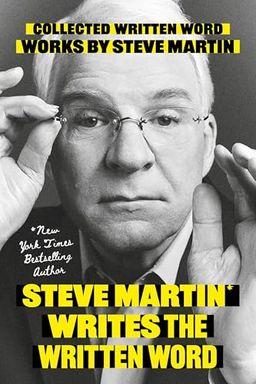
Steve Martin Writes The Written Word cover

Steve Martin Writes The Written Word

by Steve Martin

The comedian brings together previously and newly published words he wrote such as “strudel,” “Filofax” and “socks.”

Comedy, Craft, and Compassion

Comedy, Craft, and Compassion

How do you turn stand-up instincts into sentences that can stand alone? In this collection of fiction, sketches, and satirical essays, Steve Martin argues that comedy on the page depends not on your face or timing but on the deliberate arrangement of words. He contends that the page is both more tyrannical and more generous than the stage: you lose the pause and the smirk, but you gain the subtle micro-timing of punctuation, syntax, and the reader’s private tempo. To make that work, you must understand how craft, satire, and compassion braid together.

Across the book, you move between comic frames (“A Public Apology,” “Mars Probe Finds Kittens,” “Times Roman Font Announces Shortage of Periods”), playful manuals (“Writing Is Easy!”), and intimate fiction (Shopgirl and The Pleasure of My Company). You learn that Martin’s humor is architectural: he builds clear premises, escalates with specific detail, and then tilts your expectations with a humane afterglow. The laugh rarely comes alone; it carries a trace of ache.

From Stagecraft to Sentencecraft

Martin shows you how performance habits translate, then must be restrained. On stage, a “cat handcuffs” bit relies on silence and rising indignation; on the page, you must encode those beats into punctuation and clause length. Editing becomes direction: you cut to clarity because a reader can’t see your raised eyebrow. His TV shorthand (“SONNY ENTERS SONNY / Hi, Cher.”) and his film work on The Jerk train him to prize economy and rhythm. The governing test is his wry rule: “On the page, there is no face.”

Satire as Social X-ray

You see satire expose rituals by exaggerating their logic. The faux contrition of “A Public Apology” lampoons PR remorse by listing misdeeds that crest from silly to grotesque. Mock-news pieces like “Mars Probe Finds Kittens” parody scientific caution and press hype; a four-mile coil of string to amuse Martian kittens for $6 trillion punctures our appetite for splashy headlines. Language itself becomes a target: a Times Roman spokesman frets over a global period shortage, reminding you that tiny marks steer cultural tone. (Note: This precision without malice recalls The New Yorker’s tradition of dry, premise-driven humor, though Martin’s cadence remains distinctly his.)

Intimacy, Power, and the Small Life

When Martin turns to fiction, he leans into melancholy and the ethics of closeness. Mirabelle in Shopgirl maps Beverly Hills from the Siberian exile of Neiman’s glove counter; her private art drawer, Serzone tablets, and second-story window without a view embody how a life can be full of people yet starved for recognition. Power creeps in through gifts and cancellations: Ray Porter’s watch and paid loan soothe and bind; Jeremy’s slow-cooked tenderness grows into the care Ray withholds. Martin favors the accrual of small moves over grand pronouncements because that is how intimacy, consent, and dependence actually play out.

Anxious Brains, Designed Spaces

In The Pleasure of My Company, Daniel Pecan Cambridge copes by turning the world into math and routes. Curbs, opposing driveways, and a sanctified 1,125 watts of light are not quirks; they’re a survivable architecture. Magic squares, Tepperton’s Pie essays (submitted as both Daniel and “Lenny Burns”), and the daily Rite Aid pilgrimage prove that making small, odd projects can restore agency. Even missteps — lacing Philipa’s drink with Inderal and then a quaalude — force you into moral weather: kindly intent can warp into control without you noticing. Media exploits that same slippage, as Crime Show recuts Daniel’s embarrassment into public entertainment.

Why This Matters to You

If you perform, you learn where to put the beat in a comma. If you write satire, you learn to pick a clean frame (apology, report, letter), escalate exact details, and let the tone stay dry. If you love fiction, you learn that the human scale — a glove drawer, a wattage ledger, a four-tile curb gap — can carry your whole heart. And if you live with anxiety or middle-age fog, you learn that humor, ritual, and craft are not distractions; they are workable tools for making meaning. (In the key of Thurber and Wodehouse, Martin mixes silliness with sympathy, but his compass is American West Coast melancholy: diffuse light, storefronts, and people trying to be decent.)

Core Argument

Words can do what a face once did — deliver timing, reveal character, and carry feeling — if you build the right structure. Comedy, in Martin’s hands, becomes a method for seeing clearly and caring precisely.


From Stage to Sentence

From Stage to Sentence

Martin explains why performing chops help on the page — and why you must retrain them. On stage, your pause, glare, and rising indignation do half the work. In print, you bake those beats into syntax. The practical pivot is ruthless: prune excess, tighten clauses, and let punctuation carry rhythm. You move from “selling” a line to “building” one.

Timing Without a Body

To translate a “cat handcuffs” escalation into prose, you swap breath for commas and eye-rolls for em dashes. Short sentences mimic clipped incredulity; long periodic ones create the slow-roll joke. Ellipses become trailing thought; colons become tiny drumrolls. The page gives you micro-timing advantages the stage can’t: a reader’s eye can linger, double-back, or jump ahead, so you must place your beats where the eye will naturally pause. (Note: This echoes George Saunders’s advice that prose rhythm is score-like; Martin adds performer’s pragmatism.)

Revision as Rehearsal

Martin treats drafts like run-throughs. His TV habit — “SONNY ENTERS SONNY / Hi, Cher.” — burns away fluff. In print, the dictum “on the page, there is no face” becomes a test: if a joke depends on you, cut it; if it rests on the sentence, keep refining it. His movie-drafting on The Jerk underscores collaboration as sharpening tool: repeated reads reveal where dialogue is posture versus truth.

Choosing and Shifting Genres

Genre carries expectation. He leans comic and premised in New Yorker bits, then pivots to melancholy in Shopgirl and The Pleasure of My Company. That shift isn’t betrayal; it’s muscle expansion. Fiction lets him mine emotional truth without confusing it with public fact. Mirabelle’s charcoals or Daniel’s magic squares feel real because they’re made exact — a performer’s eye for prop and gesture repurposed as detail.

Practical Page Tools You Can Use

Use punctuation as choreography. Control timing with sentence length diversity: follow a gust with a gasp. Make nouns do work—“Neiman’s glove counter” lands harder than “her job.” In humor, lock the premise and escalate specifics (“kittens” need trillions in string). In feeling, stack precise routines (Serzone tablets, Time Clock Café, bedtime “waking dreams”). Delete anything that assumes your face. If you hear yourself saying, “This kills when I do it,” stop; if the line doesn’t live alone, it won’t live at all.

Performance Instincts, Properly Tamed

Keep what performance gives you: audience empathy, beat sense, escalation. Lose what it tempts: mugging on the page, over-explaining, telegraphing your punchline. Martin’s hybrid stance — director of his sentences, actor for their rhythms — shows you how to make prose that feels alive without asking readers to supply your face.

Craft Bottom Line

Write like a director blocking a scene. Every comma is a step, every dash a glance, every paragraph break a blackout. If the mechanics are visible, the magic can happen invisibly.


Satire’s Working Parts

Satire’s Working Parts

Martin’s satire is premised, precise, and emotionally cool. He picks credible public forms — apology, press report, open letter, style guide — then pushes their internal logic until the seams split. The result makes you laugh and see: rituals of contrition, media hype, and literary ego are exposed without cruelty. You can adopt this approach in your own writing by selecting a familiar container and letting details do the heavy lifting.

Choose a Clean Frame

“A Public Apology” imitates the cadence of celebrity contrition. The frame is legible in two lines, so every new confession lands fast. Likewise, “Mars Probe Finds Kittens” sounds like breaking news; “Times Roman Font Announces Shortage of Periods” reads like a typographic bulletin. The frame’s believability is your entry ticket; once inside, you escalate.

Escalate with Specificity

Martin builds crescendos by stacking concrete oddities. An apology starts with a sweepstakes fib and climbs toward “sex with a hundred-and-two-year-old turtle.” The kitten story moves from behavior logs to a four-mile ball of string priced at $6 trillion. The typographic panic touts Hebrew “backward periods” as a reserve. Each detail keeps your curiosity primed because it is both surprising and inevitable given the premise. (Note: This mirrors The Onion’s headline-to-body rigor.)

Target Rituals, Not People

The satire doesn’t sneer at individuals; it lampoons systems: PR staging, science-by-press-conference, literary credentialing. “An Author Responds” mocks the fragile dance between critic and author by offering absurd bibliographies (The Golden Treasury of Europe and Yur-hup, Y’all Come!) while calmly ‘correcting’ ridiculous errors (the Eiffel Tower isn’t a tugboat). The joke lands because it preserves human dignity while puncturing pretense.

Make Language Part of the Joke

Martin lets punctuation and diction carry comedy. The mock-font spokesman in “Times Roman…” frets like a central banker; ellipses “go rogue”; exclamation points dilute seriousness into mania. In “Writing Is Easy!,” advice sneaks in through parody: lower your IQ by fifty to write dialogue that sounds like people; steal three sentences from a novel to beat blockage (translation: emulate to find voice). Intellectual parodies literalize abstractions (Schrödinger’s cat becomes Elvis briquettes), honoring the idea while deflating pomposity.

Apply It Yourself

Pick a ritual (performance review, HOA letter, startup pitch). Mimic its tone exactly. List three plausible details, then three increasingly unhinged but internally consistent ones. Keep your voice dry and your verbs plain. End with a line that glances back at the premise and twists it once. If you feel angry, cool it; precision makes satire sharper than heat does.

Satiric Ethos

Be exact, escalate, and stay humane. The joke should reveal the system’s truth, not your superiority.


Mirabelle’s Quiet Cartography

Mirabelle’s Quiet Cartography

Shopgirl maps loneliness in a city of surfaces. Mirabelle, a glove-counter clerk at Neiman’s, lives among people yet travels interiorly. Martin builds her world from small anchors: a second-story apartment without a view, a cat that slips in and out, charcoal drawings fixed and photographed into a portfolio. The effect is intimate rather than grand; you feel how minor routines hold a life together.

Work as Stage and Cage

At the glove counter — “the Siberia of Neiman’s” — Mirabelle leans over glass with one leg cocked, performing friendliness for customers. The monotony becomes anesthetic and stabilizing; repetition brings comfort even as it forecloses social mobility. Martin refuses melodrama; instead he shows how the small mastery of arranging gloves can both soothe and stall. (Note: This pattern echoes Raymond Carver’s attention to working rhythms, though Martin’s tone is warmer.)

A Private Creative House

Her charcoal drawer is a sanctuary. Finished pieces, fixed and photographed, tether inward talent to outward hope. A crouching child in Pompeii mirrors Mirabelle’s draw toward nineteenth-century melancholy. Art, for her, is not escape; it is a precisely sized room where loneliness is ordered. You see how private creation can prefigure public courage, even if it begins with a single small portfolio.

Patronage, Distance, and Consent

Ray Porter buys gloves, clears debts, and flies east for Thanksgiving; he also withholds commitment. His gifts carry double edges: ease wrapped around expectation. Jeremy, by contrast, evolves from a fumbling laundromat date into someone who learns patience and style on the road. Lisa weaponizes sex as commerce. The triangle isn’t lurid; it’s granular. A canceled trip, a blouse, a watch, a tender phone call — these micro-moves draw the moral map more clearly than speeches about love.

Depression as Part of the Weather

Mirabelle’s Serzone (and later Celexa) is not a plot garnish; it shapes day-to-day choice. Medication distances pain but doesn’t erase history. Doctor visits, waiting rooms, and bedtime “waking dreams” supply the novel’s gentle clinical rhythm. Martin’s empathy arrives in the spacing: he alternates clinical fact with soft human scene so you can recognize the labor of recovery without voyeurism.

What You Can Learn

If you write about ordinary people, build them from exact rituals. Let economics and geography nudge desire and consent. Avoid declaring themes; show how a watch closes distance and a canceled flight reopens it. If you live a small life (as most of us do), Mirabelle teaches you to respect your rituals without letting them become your limits. Small art, made regularly, can enlarge a room no one else can see yet.

Mirabelle’s Compass

Attention, not drama, changes a life. Attend to work, to gifts, to pills, to drawings — the map appears.


Power, Money, and Consent

Power, Money, and Consent

Martin threads a clear question through romantic plots: when does generosity shade into purchase? Ray Porter’s benevolence eases Mirabelle’s life; it also buys proximity without the honesty of commitment. In parallel, Daniel Pecan Cambridge’s “helping” sometimes becomes control — slipping Inderal and later a quaalude into Philipa’s drink to soothe stage fright. The book invites you to hold conflicting judgments at once: be grateful for help, suspicious of its terms.

The Slow Accrual of Power

Power rarely arrives in a single stroke. It gathers through small asymmetries: who pays, who cancels, who withholds clarity, who controls the space (the restaurant, the wattage, the flight itinerary). Mirabelle’s financial precarity and longing make her flexible in ways that serve Ray’s convenience. Jeremy’s growth offers a contrast: when he learns patience and attention, he creates room rather than closing it. Lisa’s predations show the same math running in a different direction: manipulate until dependence forms.

Ethical Gray Meets Comic Light

Daniel’s dosing of Philipa unfolds like farce but carries serious charge. His intention — to soothe — slips into paternalistic control, and then into something plainly wrong when he adds the quaalude. Martin refuses a sermon; he lets consequence and conscience speak. Daniel tapers off, guilt-ridden, while recognizing how easy it was to cross a line under the cover of care. (Note: This is moral realism in comic clothes, more akin to Anne Tyler’s gentle complications than to satiric gotchas.)

Heroism, Also Complicated

Elsewhere, Daniel throws himself between Teddy and a violent ex-husband — a clear, bright act of courage. Yet even here, Martin shades the scene with communal logistics: Clarissa hides out, Lorraine curses and strategizes legal paths, Brian improvises. Protection isn’t always lawful, and righteousness doesn’t preclude later mess. You learn to honor bravery while acknowledging the tangle it leaves.

Consent as Ongoing Practice

Consent, in Martin’s world, isn’t a checkbox. It’s a living negotiation shaped by money, age, mood, medication, and timing. A paid loan may feel like kindness and like a claim; a dimmed lamp can invite or control. The practical lesson for you: watch for power’s tiny signatures. If a choice suddenly gets easier because someone else absorbed the cost, ask what invisible invoice might follow.

Ethical Takeaway

Good intentions don’t immunize you from harm. Track effects, not just motives, and renegotiate when small imbalances start to stack.


Daniel’s Designed Life

Daniel’s Designed Life

Daniel Pecan Cambridge is a neurotic everyman whose rituals become architecture. Curbs, opposing driveways, and the sanctified total of 1,125 watts are his survival kit. Martin externalizes anxiety by making ordinary infrastructure carry psychic weight, so you can see how a mind remakes space to stay functional. What looks like quirk is actually craft — a designed life that lets him move.

Rituals as Scaffolding

Daniel’s routes depend on matching driveway cutouts; a Land Cruiser blocking a lip equals paralysis. Kinko’s copiers must be touched to feel integrated; acoustical tiles and textured ceilings become counting projects that soothe. When Philipa asks to dim the lights, his wattage arithmetic tangles with intimacy. These acts aren’t cute; they’re bulwarks against panic. (Note: Martin avoids caricature by giving Daniel concrete logic for each rule.)

Relationships as Mirrors

Elizabeth the realtor magnetizes Daniel’s fantasies; she embodies polish and distance. Clarissa, the student-therapist, draws out his caretaker side as he helps with Teddy and wayfinding. Zandy at Rite Aid becomes partner and anchor, turning a fluorescent aisle into a social hearth. Each woman reveals a version of Daniel’s agency — from idealizing, to provisional competence, to domestic steadiness.

Plot as Exposure Therapy

The Tepperton’s Pie essay contest pulls Daniel into public life, including the identity game of also entering as “Lenny Burns.” Winning under both names lampoons authenticity while rewarding honest craft about being average. Crime Show reenlists him as a suspect for spectacle, showing how TV repackages awkwardness. Granny’s death and inheritance unmoor him emotionally even as they grant security, proving that money stabilizes logistics, not grief.

Making as Medicine

Daniel’s giant 256-box magic square is more than math; it’s a prayer for pattern. Filling the grid, he discovers that every correct local choice fits a global order — a metaphor for trusting that small, right acts add up. The final sum (491,384) becomes symbolic closure. Likewise, drafting two essays, plotting curb-safe routes, and practicing tiny crossings build a ladder out of paralysis.

Your Takeaway

If anxiety narrows your world, design it. Count something, route something, build a square, write under a playful alias. Make the project just bigger than your fear. When you can’t move a Land Cruiser from the driveway, change the path or leap the curb with a friend’s hand on your elbow. Momentum, not perfection, remakes the map.

Pattern Insight

External order calms internal noise. Build the order you need, one bulb, one box, one crossing at a time.


Media, Prestige, and Form Play

Media, Prestige, and Form Play

Martin delights in mixing forms — sketch, list, mock letter, script, news bulletin — to show how institutions package meaning. The pallette isn’t decorative; it’s diagnostic. Each form carries its own built-in vanities, so by imitating them he can expose how attention, prestige, and spectacle distort real life. You learn to read media’s seams and to play them for comic truth.

Television’s Appetite

Crime Show takes Daniel’s awkward incident and reenacts it with bloodstained parkas and waivers — proof that TV prefers drama over nuance. The camera flattens context; the schedule edits conscience. Martin isn’t scolding; he’s showing the conversion rate by which private embarrassment becomes content. The audience laughs, the sponsor rolls, and the person inside the story gets smaller.

Literary Life, Gently Skewered

“An Author Responds” parodies the critic–author tango. By listing ludicrous sources and breezy corrections, Martin shows that authority in letters can be performative — confidence masquerades as correctness. “The Hundred Greatest Books That I’ve Read” and the phenomenon of “Shouters” (people who read books aloud in public) riff on canon-making and attention-seeking, hinting that culture often becomes a mirror for our hunger to be seen with the right objects in hand.

Corporate Culture as Stage

The Tepperton’s Pie contest collapses literature into branded event. A corporate sponsor, faux-populist guidelines, and a cash prize create instant celebrity. Daniel’s double win — as himself and as “Lenny Burns” — highlights identity as performance. Are you realer under your name or under your style? Martin declines to moralize; he lets the absurdity do the teaching.

Scripts, Skits, and Timing

A piece like “I Love Loosely” appears as a full sketch with stage directions. That choice reminds you that some jokes need cues, entrances, and exits to keep their snap. By setting the form on the page, Martin invites you to hear an audience that isn’t there — and to appreciate how different genres house different rhythms. (Note: It’s a meta-lesson in why not all comedy compresses to prose the same way.)

How to Use This in Your Work

If you make things, pick a form that sharpens your point. Want to critique hype? Use a press release. Want to show intellectual vanity? Write a footnoted letter with ridiculous citations. Want to celebrate a friend? Script a sketch to hear the beats. Form isn’t wrapper; it’s leverage. Play with it to discover what your subject really does when the house lights come up.

Form Principle

Every genre hides a bias. By imitating the form faithfully, you can surface the bias comically and clearly.


Melancholy, Memory, and Small Rituals

Melancholy, Memory, and Small Rituals

Under the jokes, Martin keeps a gentle lamp on human frailty. “Changes in the Memory After Fifty” catalogues daily slips — car keys in your right hand you can’t find — and offers comic coping that doubles as practical care: pencil marks for bathroom trips, labeled ginkgo bottles. You laugh, then you relax; the piece reframes small failures as common, survivable weather.

Medication and Mercy

In Shopgirl and The Pleasure of My Company, antidepressants and beta-blockers aren’t plot gadgets; they are part of the breathing. Serzone or Celexa temper despair; Inderal settles tremors; none cancel history. Martin’s scenes — clinic waiting rooms, the private ritual of swallowing — make medical life feel lived rather than preached. Empathy comes from spacing: a dose, then a drawing; a refill, then a quiet night. (Note: This keeps the work from veering into “issue novel” territory.)

Jasper’s Nose-Level Empathy

A dog’s-eye vignette with Jasper compresses miscommunication, loyalty, and yearning into an animal sensorium. The FedEx man is a target; Granny Fogel is saintly; Dr. Fogel’s scolding wounds. When Jasper’s bark flips into a baritone “We’re Having a Heat Wave,” art redeems embarrassment with a laugh and a pat. The piece teaches you that viewpoint alone can generate tenderness: when you stand at nose level, human foibles look both funny and forgivable.

Rituals that Hold You Together

Mirabelle’s bedtime “waking dreams,” Daniel’s wattage counts, Zandy’s Rite Aid counter — these are small scaffolds that let people stand. Martin dignifies them without sacralizing them: a ritual is useful until it cages you; then you change it. His humane thesis: you don’t need heroics to steady a life; you need repeatable, honest practices that match your shape.

Make It Yours

Create two rituals: one inward (a page of a magic square, a charcoal sketch, a daily sentence) and one outward (a route you can master, a place you can claim). Let humor be your lubricant; laugh at the list, then keep the list. When memory frays, label the bottle; when anxiety spikes, count the tiles. The point isn’t to banish frailty but to befriend it.

Humane Bottom Line

Laughter shrinks shame. Rituals restore agency. Together they let ordinary people attempt extraordinary kindness — to themselves and to others.

Dig Deeper

Get personalized prompts to apply these lessons to your life and deepen your understanding.

Go Deeper

Get the Full Experience

Download Insight Books for AI-powered reflections, quizzes, and more.