
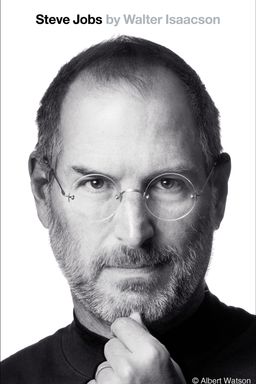
Steve Jobs cover

Steve Jobs

by Walter Isaacson

Dive into the riveting journey of Steve Jobs, the mastermind behind Apple''s meteoric rise. From his early explorations in spirituality and LSD to his iconic tech innovations, Jobs''s story is one of relentless ambition, groundbreaking creativity, and complex personal battles. Discover how his visionary leadership and quest for perfection changed the world forever.

Identity, Craft, and Destiny

If you want to understand Steve Jobs, start with the emotional contradiction that defines him: abandoned and then chosen. He learned early that he was adopted by Paul and Clara Jobs, and that his birth parents, Joanne Schieble and Abdulfattah Jandali, had given him up. That dual narrative—discarded yet special—creates a deep lifelong drive: prove worth, control destiny, seek perfection. Walter Isaacson portrays this paradox as the seed that germinates every major decision Jobs makes—from product design to relationships.

Adoption and Psychological Tension

You learn that being both “chosen” and “abandoned” made Jobs alternately arrogant and insecure. Friends like Andy Hertzfeld said it was like working with someone “full of broken glass.” This tension forged his need to dominate and perfect what he could control—his work, his products, his company. Jobs’s magnetic but volatile personality came directly from this early wound: it made him capable of visionary leadership and ruthless cruelty.

Craftsmanship and the Garage

Paul Jobs taught young Steve that true craftsmanship meant even unseen parts should be perfect—the back of a cabinet had to look as good as the front. That lesson shaped Apple’s obsession with detail: from the beauty of circuit layouts to packaging design. Growing up in Silicon Valley surrounded by engineers, Jobs learned tinkering and design as a way of thinking. Eichler houses—clean, democratic modernism—inspired Jobs’s belief that elegant design belongs to everyone.

Spiritual Minimalism and Aesthetic Discipline

At Reed College, Jobs encountered Zen philosophy and calligraphy—experiences that cemented his devotion to simplicity and intuition. He studied Shunryu Suzuki, practiced Zen with Kobun Chino, and sought purity through design, diet and direct experience. Calligraphy taught him balance, proportion and grace—later visible in the Macintosh keyboard typography and system fonts. Zen focused his intuition: he trusted instinct over analysis, believing beauty emerges from eliminating excess.

Core Insight

Jobs’s identity fused emotional drive, craftsmanship and spirituality into a single operating philosophy: control what you create, simplify fiercely, and treat design as moral expression.

(Note: Isaacson connects this trio—adoption, craft, Zen—to Jobs’s later mantra “simplicity is the ultimate sophistication.” You can trace that line directly from childhood workshops to the iPod unboxing experience.)


The Two Steves and Apple’s Birth

Apple began with chemistry between opposites: Steve Wozniak, the humble engineering genius, and Steve Jobs, the ambitious marketing visionary. Their collaboration created a pattern Apple never abandoned—technical brilliance fused with human-centered presentation.

The Blue Box and Entrepreneurial Lessons

Before Apple, Wozniak built a “blue box” to hack phone systems. Jobs recognized a product and sold it. Together they made a hundred devices. This minor, illegal experiment taught them business fundamentals: prototype, iterate, sell. Engineering meets narrative—a formula repeated with Apple’s later products.

Homebrew Club and Apple I

At the Homebrew Computer Club, Woz sketched a personal computer inspired by the Altair; Jobs saw a market. They sold 50 Apple I boards to Paul Terrell’s Byte Shop. Jobs sold his VW van and Woz his calculator—actions that symbolize Silicon Valley’s ethos of risk. Their garage became Apple’s first assembly line. It was pure youth, idealism and hustle.

Apple II and Scaling Genius

With the Apple II, Wozniak engineered elegant circuitry; Jobs demanded a molded plastic case, color graphics and sleek design. Jerry Manock shaped the case; Rod Holt developed the innovative power supply. Mike Markkula’s investment provided structure. The result was a consumer-ready product—functional, beautiful, and profitable. Woz wanted openness; Jobs demanded control. That tension launched Apple’s unique brand of perfectionism.

Key Lesson

Innovation requires both invention and storytelling. Wozniak built; Jobs convinced the world to care.

(Parenthetical note: Today’s Silicon Valley pairs often mimic the Jobs–Wozniak duality—engineering talent partnered with visionary charm—but few achieve the same fusion of artistry and commerce.)


Design as Strategy

Jobs turned aesthetics into business advantage. Part design school, part philosophy seminar, Apple became the company that treated clarity as power. For Jobs, design wasn’t superficial—it was moral. People deserved tools that felt humane.

Roots in Bauhaus and Reed Calligraphy

Jobs inherited modernist taste from Eichler housing and Reed calligraphy. From Bauhaus ideology he learned: function defines form; simplicity reveals truth. Designers like Dieter Rams and Braun’s products became models of quiet elegance. Susan Kare’s icons, Rob Janoff’s logo, and Esslinger’s “Snow White” language translated that philosophy into recognizable Apple aesthetics.

Design Coherence: Hardware to Storefront

Jobs insisted every touchpoint—from circuit boards to typography—must align with Apple’s language of simplicity. Packaging should delight; internal components should look artistic. The Mac team signed inside every case—a ritual of pride and craft reminiscent of artisans signing paintings. Apple’s later stores continued that continuity: stone floors from Florence, glass staircases, minimalist layouts that echoed product design.

Simplicity as Sophistication

Jobs’s mantra “simplicity is the ultimate sophistication” meant rigorous subtraction. Build a coherent system: hardware, software and packaging should speak one visual language. That clarity made Apple products universally approachable. Simplicity wasn’t a style—it was discipline through which complexity became invisible.

Design Insight

Jobs shows that design, when consistent and morally intended, becomes a business strategy that differentiates not by specs but by feeling.

(Comparison note: like Dieter Rams or Jon Ive, Jobs believed restraint breeds emotional impact. Minimalism was not trend—it was spiritual clarity applied to commerce.)


Vision, Conflict, and Early Crises

Apple’s adolescent years reveal Jobs’s paradoxical leadership—his power to inspire and to alienate. From Xerox PARC’s GUI acquisition to the Macintosh launch and his 1985 ouster, you see charisma colliding with management reality.

The Xerox PARC Revelation

Jobs’s visit to Xerox PARC exposed him to graphical interfaces, mice and WYSIWYG editing. He didn’t copy; he transformed prototypes into usable products. Apple improved Xerox’s three-button mouse into a cheap one-button version, added overlapping windows and friendly icons. Picasso’s quote—“good artists copy, great artists steal”—becomes metaphor for Jobs’s ability to translate research into magic.

Field of Distortion and Team Culture

Bud Tribble’s “reality distortion field” described Jobs’s power to bend perception—convincing teams impossible goals were achievable. Under pressure, engineers like Bill Atkinson delivered innovations quickly. Yet the same intensity caused emotional scars: burnout, humiliation, departures. Jobs inspired miracles and misery within the same breath.

Marketing Genius and the '1984' Spectacle

Jobs transformed the Macintosh debut into cultural theatre. The Ridley Scott “1984” ad and the Flint Center’s “Hello Macintosh” moment fused technology with mythology. Marketing became art—linking product to revolution. That brilliance also taught caution: myth outpaced machine; early Macs lacked memory and speed, showing that narrative must match substance.

Fall from the Throne

Conflict with John Sculley and the board climaxed in Jobs’s 1985 ouster. His creative zeal became seen as destructive. Missed sales targets and managerial chaos invited intervention. When Jobs tried a coup, Sculley gathered executive votes; Jobs lost and wept. The young rebel was expelled from his own Eden—a painful but pivotal education.

(Note: The lesson mirrors other founder stories—when vision collides with governance, boards back stability. Jobs would later master politics and return able to balance control and scale.)


NeXT and Pixar: Reinvention Through Creation

After Apple, Jobs refused retreat. He built NeXT and bought Pixar—ventures that exposed his perfectionism, resilience and capacity to merge art with technology. Both endeavors show him learning from failure and rediscovering his ideal of integrated creativity.

NeXT: Perfection and Industrial Reality

NeXT embodied elegance—a black magnesium cube, custom chips, and a $100,000 Paul Rand logo. Jobs demanded flawless molds and spent fortunes on precision. Yet economics crushed the dream: overpriced, delayed, niche-bound. His aesthetic obsession turned into manufacturing burden. Still, NeXTSTEP’s software—UNIX-based and object-oriented—became Apple’s future foundation, proving that even failed ventures leave technical seeds.

Pixar: Technology Meets Story

Jobs bought Pixar’s Lucasfilm division, funding hardware, software and animation. He kept the creative team alive through Lasseter’s shorts—Luxo Jr., Tin Toy—which won Oscars and industry credibility. Pixar’s partnership with Disney (CAPS system, later Toy Story) shows Jobs learning patience and collaboration. He funded art even when business faltered; by 1995 Pixar’s IPO and Toy Story triumph made him billionaire again.

Insight

Jobs’s setbacks at NeXT taught operational humility; Pixar taught emotional intelligence. Together they rewired his leadership for Apple's second era.

(Parenthetical note: Unlike many exiled founders, Jobs used exile as laboratory—testing integration across hardware, software and storytelling, knowledge he later applied to digital media and design ecosystems.)


Rebuilding Apple and Design Renaissance

When Jobs returned to Apple in 1996, he turned crisis into clarity. He combined NeXTSTEP’s OS with Apple’s brand to recreate its soul. The next decade became a design renaissance—iMac, iPod, iPhone—fueled by radical simplicity and integration.

Strategic Reset and 'Think Different'

Jobs cut Apple’s bloated product line to four core machines and launched the “Think Different” campaign—a manifesto celebrating rebels like Einstein and Gandhi. This reestablished Apple’s personality: not specs but spirit. Simplification restored focus and profitability.

Design Partnership: Jobs and Ive

With Jony Ive, Jobs reinvented the aesthetic language through the iMac’s translucent Bondi-blue shell. He later pursued material mastery—anodized aluminum, glass—and demanded perfect seams. Every curve told a story of precision. From packaging to Apple Stores, design became Apple’s religion.

Digital Hub and Music Revolution

Jobs conceived of the Mac as the digital hub—organizing photos, videos, and music. The iPod and iTunes embodied seamless integration: simple device, sophisticated software. Then came negotiation miracles—convincing Warner and Universal to sell songs at $0.99, with FairPlay DRM. He offered both legal clarity and ease. Within six days, Apple sold a million songs. He even persuaded artists directly—Bono, Dylan, U2—to join. Ownership replaced piracy.

Design Obsession and Material Craft

Jobs contacted Corning to revive Gorilla Glass; he demanded invisible screws and magnetic covers. Each decision reflected belief that material quality communicates human values. Craftsmanship became Apple’s moral compass again.

(Note: Jobs’s second tenure demonstrated maturity—same perfectionism, tempered by focus. He proved that simplicity scales when partnered with disciplined execution and strategic storytelling.)


Integration, Ecosystems, and Rivalries

Jobs’s later career shows integration as strategy and conflict. From the App Store to clashes with Google, he defended Apple’s closed, controlled universe against open systems.

Integrated System Advantage

Jobs designed experiences—hardware, software, retail—as one organism. FairPlay DRM, the App Store, iCloud: each reinforced control and coherence. Integration ensured quality and profitability: Apple earned hardware margins and content revenue. That consistency made it distinctive—an intentional walled garden.

App Store and Controlled Creativity

Launching in 2008, the App Store gave developers instant access but kept Apple as gatekeeper. The 30% fee and strict vetting prevented chaos and malware but provoked censorship debates. Yet the model revolutionized software distribution: billions of downloads and a global developer economy.

Open vs Closed: The Google Feud

Jobs perceived Android as betrayal—Eric Schmidt’s participation on Apple’s board made it personal. He declared “thermonuclear war” on Android’s copied features. Apple defended polish; Google promoted openness. Philosophically, it was design purity versus democratic scale—a battle that defined modern computing ecosystems.

Strategic Takeaway

Jobs taught that owning the end-to-end experience creates trust and profitability—even if competitors win scale through openness.

(Parenthetical note: History repeats the Apple–Microsoft duel: vertical integration vs horizontal licensing. Jobs again chose control, betting users would pay for coherence.)


Mortality and Legacy

In his final years, Jobs faced cancer and contemplated legacy. He shifted from builder to mentor, ensuring Apple could thrive beyond him. His mortality clarified his mission: beauty and meaning over longevity.

Illness and Personal Discipline

Diagnosed in 2003 with neuroendocrine pancreatic cancer, Jobs delayed surgery for alternative therapies—a choice friends regretted. After a Whipple procedure and later liver transplant (2009), he managed secrecy about his condition. His illness deepened reflection: time became currency; innovation had to serve life, not ego.

Succession and Continuity

Jobs mentored Tim Cook to ensure stability. Cook’s operational brilliance balanced Jobs’s vision. In August 2011, Jobs resigned as CEO but remained chairman. His farewell demonstrated humility and planning: Apple would endure not as monument but as living organism.

Cultural Impact and Reflection

Jobs’s Stanford address captures his philosophy: remember death to focus on what matters. He used mortality as creative lens—every product should outlast the maker. His legacy parallels Edison or Ford: he redefined industries and aesthetics. Apple’s design-led culture, retail model and app economy became global standards.

Final Insight

Jobs’s awareness of death sharpened his genius. By confronting finitude, he built things designed to last beyond him.

(Note: Isaacson closes by linking Jobs’s story to a universal lesson—the search for meaning transforms craft into legacy.)

Dig Deeper

Get personalized prompts to apply these lessons to your life and deepen your understanding.

Go Deeper

Get the Full Experience

Download Insight Books for AI-powered reflections, quizzes, and more.