
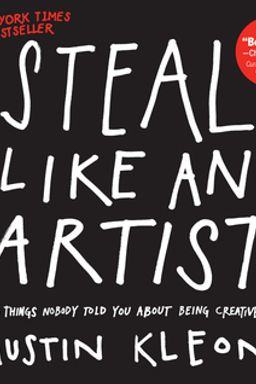
Steal Like an Artist cover

Steal Like an Artist

by Austin Kleon

Steal Like an Artist reveals that creativity thrives on borrowed ideas, teaching artists to transform inspiration into unique creations. Embrace imitation, maintain hobbies, and share your work online to build a successful artistic career.

Steal Like an Artist: Creativity Through Influence

Have you ever stared at a blank page and thought, “I have to come up with something completely original”? In Steal Like an Artist, Austin Kleon argues that this mindset is actually what suffocates creativity. His playful manifesto turns the terrifying myth of originality on its head. Creativity, he insists, doesn’t come from nowhere—it’s built on what came before. The secret isn’t to avoid influence but to embrace it consciously and creatively.

Kleon writes for anyone who wants to make something—whether you’re an artist, writer, designer, or coder. He argues that the best creative work doesn’t happen by genius in isolation but by selective theft: finding the best ideas around you, internalizing them, and remixing them into something that bears your signature. In this view, to “steal like an artist” means to curate your influences and make them work together in a way that only you can.

The Myth of Originality

At the book’s core is a simple, liberating truth: nothing is original. Every artist, from Picasso to Bowie, has borrowed from others. Kleon draws on sources like T. S. Eliot (“immature poets imitate; mature poets steal”) and the Bible (“there is nothing new under the sun”) to underscore this. To create is to rearrange, reinterpret, and remix. The musician and technologist Brian Eno calls this “scenius”—a collective form of genius that emerges from a community of creators building on one another.

Once you abandon the demand for total originality, Kleon says, you free yourself to play. Instead of trying to make something from nothing, you can engage the world with curiosity and intent, searching for ideas worth stealing. When you look through this lens, the world becomes an abundant source of material.

Influence as Identity

Kleon compares your creative identity to a genetic tree. Just as you inherit traits from your parents, your style grows from the influences you choose to study, love, and internalize. You can’t choose where you come from, he says, but you can choose your creative ancestors. The novelist Jonathan Lethem notes that what we call “originality” is often just undiscovered influence. In that sense, to build your creative DNA is to be deliberate about the ideas you feed yourself.

The artist’s job is that of a collector—someone who selects and organizes the most meaningful artifacts. The more generous your input of great art, music, and stories, the richer your output becomes. As Kleon’s mother told him, “Garbage in, garbage out.” So he encourages readers to build a “swipe file,” a personal archive of images, quotes, and ideas that inspire you. This isn’t theft but nourishment—it’s your reservoir of raw material.

Make Before You Know

One of Kleon’s most counterintuitive lessons is: don’t wait until you “find yourself” to start creating. He warns against the paralyzing perfectionism of impostor syndrome—the fear that you’re not ready, qualified, or talented enough. Everyone, he emphasizes, starts out as an amateur. The only way to discover who you are is through the act of making. In the beginning, you’ll imitate your heroes because that’s how skill develops. But through imperfect imitation, your unique style emerges—because, as he puts it, “our failure to copy perfectly is our fingerprint.”

He extends this point into practical advice: fake it until you make it. Wear the costume, act the role, pretend to be the artist you wish to become. Not deception—practice. As you copy and remix your influences, you’ll gradually bridge the gap between imitation and authenticity. Conan O’Brien’s story illustrates this: he tried to emulate his idol David Letterman and, failing to do so, became uniquely Conan. Our shortcomings, Kleon says, are often where our originality hides.

Practical Creativity in a Connected World

Beyond philosophy, Kleon offers a modern creative roadmap. He urges readers to build habits that make work possible: create side projects for play, share your process online, and surround yourself with people who inspire you. He reminds us that geography is no longer a barrier—your creative community can be global. And in this networked world, kindness and generosity matter as much as talent. Be nice, he says. The world (and the Internet) is a small town.

At the same time, he insists on the value of ordinary, stable routines. Creativity depends on energy and focus, not chaos and caffeine. Be boring so you can make extraordinary work. Budget well, keep a job, limit distractions. His advice echoes Gustave Flaubert’s maxim: “Be regular and orderly in your life so that you may be violent and original in your work.”

Ultimately, Steal Like an Artist is a permission slip. It tells you that you already have the ingredients you need to make meaningful work because inspiration is everywhere. Your job isn’t to avoid influence—it’s to remix it consciously, to draw from what moves you, and to keep making things until your own voice emerges. In Kleon’s world, creativity isn’t about originality at all—it’s about transformation.


Nothing Is Original

Austin Kleon’s first principle of creativity is one of radical honesty: everything is a remix. Artists, he argues, are not inventors of something from nothing; they are curators, remixers, and reinterpreters of what already exists. “Every artist gets asked where they get their ideas,” he writes. “The honest artist answers, ‘I steal them.’”

The Genealogy of Ideas

Just as we inherit traits from our parents, your creative identity grows from the thinkers, creators, and influences you absorb. You’re essentially the sum of what you choose to love. Kleon calls on us to pick our influences mindfully. German writer Goethe said, “We are shaped and fashioned by what we love.” That makes your artistic diet as important as your creative output: garbage in, garbage out.

Rather than striving to invent, focus on collecting. Collecting, Kleon says, is different from hoarding—it’s a disciplined process of curation. You collect selectively: things that genuinely inspire you, not everything that crosses your path. He even suggests maintaining a swipe file or “morgue file,” a place to store the pieces, quotes, and images that stir your imagination. Later, those fragments can return in your work, transformed and reanimated.

Influence vs. Plagiarism

Kleon is careful to distinguish between theft and stealing like an artist. Plagiarism is lazy; artistic theft is generative. You steal not to copy, but to understand how something works. It’s comparable to a mechanic taking apart a car engine. You study your heroes’ work closely—then, when you reassemble the parts, you make something new.

T.S. Eliot, Picasso, and even David Bowie all embraced this worldview. As Elliott said, “Good poets weld their theft into a whole of feeling which is unique.” In this light, imitation is the training ground for innovation. Musician Brian Eno echoes this when he describes creativity as “making something that does not yet exist by putting together things that suggest a new thing.”

Your Creative Family Tree

To cultivate your influences, Kleon offers a practical method: find one artist you love, study them deeply, then discover whom they loved, and study them too. This process builds your personal creative family tree. As you move up the branches, you learn the lineage of ideas and become, in a sense, part of that family. Then comes the most important step: start your own branch. Your work continues the creative conversation, and over time, others will branch off from you.

Once you shift your perspective in this way, the world opens up. Every painting, film, or sentence becomes a potential teacher. Your only task is to collect, adapt, and contribute in return. As filmmaker Jim Jarmusch put it: “Steal from anywhere that resonates with you. Select only things that speak directly to your soul. If you do this, your work will be authentic.”

So instead of fearing imitation, Kleon urges you to embrace it as the beginning of your creative evolution. You don’t become great by denying your influences—you become great by honoring them and pushing them forward.


Start Before You’re Ready

We often wait to begin a creative project until we feel “qualified.” Austin Kleon demolishes this excuse. In his view, you don’t find yourself and then create—you create and then find yourself. Every artist, he insists, begins as an amateur. Waiting for perfect clarity is just another form of procrastination. The act of making, not the act of planning, reveals who you really are as a creator.

Impostor Syndrome and Creative Fear

Most creative people, Kleon says, wrestle with “impostor syndrome”—that uneasy feeling that you’re a fraud and your abilities are exaggerated. The truth is liberating: everyone feels this way. Nobody fully knows what they’re doing; they just start. The sooner you accept that uncertainty never disappears, the sooner you can make progress. Pretend you know what you’re doing until one day you realize you’ve become the thing you’re pretending to be.

Fake It Till You Make It

Kleon redefines this cliché in two productive ways. First, pretend to be the person you wish to be—a filmmaker, designer, novelist—and the act of pretending will push you to act accordingly. Second, pretend to make something even before you think you can. Action breeds confidence. He recalls Patti Smith’s memoir Just Kids, where she and photographer Robert Mapplethorpe “pretended” to be artists long before fame. They dressed the part, lived the lifestyle, and eventually, they became exactly what they imagined.

Even copying is a form of practice. The designer Yohji Yamamoto said, “Start copying what you love. At the end of the copy, you’ll find yourself.” We mimic not to replicate, but to understand. Painters copy old masters, and musicians learn others’ songs before writing their own. Imitation is a bridge, not a destination.

From Imitation to Emulation

Eventually, imitation gives way to emulation. You stop copying the surface and start thinking like your heroes. You study their process, their philosophy, their worldview. Kleon notes that Kobe Bryant’s basketball moves were all borrowed—from Michael Jordan, Hakeem Olajuwon, and others—but when Bryant found his own rhythm, those borrowed moves transformed into something uniquely his. Likewise, Conan O’Brien tried to be like David Letterman but became Conan O’Brien. It’s your imperfect copying that defines your style.

The act of copying forces you to confront your limits—where your hand, eye, or voice diverges from those of your heroes. That divergence is where your originality lives. As Francis Ford Coppola once told film students, “We want you to steal from us, because you can’t steal—you will put it in your own voice.”

So stop waiting for clarity. Begin anywhere. You’ll learn faster by doing than by theorizing. The path to your true voice runs straight through imitation, play, and imperfection.


Write the Book You Want to Read

When Kleon was ten, he loved Jurassic Park so much that he wrote his own sequel—long before Hollywood released a disappointing one. Without realizing it, he was writing fan fiction, driven by his desire to see the story continue. This playful act becomes a central creative lesson: don’t ask “What should I make?” Ask, “What do I wish existed?”

From Consumer to Creator

We’re all fans of something. The art that resonates most deeply with us leaves behind a kind of creative hunger. Kleon urges you to turn that hunger into fuel. Instead of “writing what you know,” he says, you should “write what you like.” You already have the taste—now use it to guide your output. As musician Brian Eno once said, “I wanted to hear music that had not yet happened.” Your creative calling is often hiding inside your fascination as a fan.

Play With Possibility

Creativity begins when you ask “what if?” What if your favorite band made an album together with your favorite writer? What if your favorite movie continued where it stopped? Kleon compares this act of imagining to brainstorming sequels and collaborations that never existed. Bradford Cox, a member of the band Deerhunter, used to record entire “fake versions” of albums he anticipated—just to hear what they might sound like. Those recordings became his own original songs.

Making Is Storytelling

Kleon extends this advice beyond art: “Whenever you’re at a loss for what to do next, ask: What would make a better story?” Life itself is a creative act. When you make decisions that lead to a better story, you generate experiences that in turn feed your art. This iterative loop—making, living, remaking—is the essence of creativity.

So the next time inspiration feels distant, stop hunting for originality. Look inward to the work that moves you most. What gap does it leave? What sequel would you love to see? The pieces you crave as an audience member are the ones you’re meant to create.


Use Your Hands

In our digital era, it’s easy to equate “creating” with typing, clicking, or swiping. Austin Kleon argues this disconnection from the physical world is killing our creativity. Real inspiration, he says, doesn’t come from screens—it comes from your body. Use your hands.

Analog Before Digital

Kleon describes how he structures his workspace with two stations: an analog desk and a digital desk. The analog desk holds paper, pens, scissors, and tape—no electronics allowed. This is where new ideas are born, messy and tactile. The digital desk, where his computer lives, is for editing and publishing. By moving between the two, he maintains creative balance: generating raw material through play, then refining it through technology.

His own artistic practice reflects this. In Newspaper Blackout, he created poems by erasing words from newspaper articles with a marker. The process engaged all his senses—feeling the paper, smelling the ink, hearing the squeak of the pen. That sensual engagement transformed writing from labor into play.

Bodies Inform Brains

Creativity, Kleon argues, isn’t just mental. “Our nerves aren’t a one-way street,” he says. When you move your body—walking, sketching, cutting shapes—you awaken new connections in your mind. The simple act of going through the motions can spark ideas. Sitting still in front of a glowing screen doesn’t. Edward Tufte once said, “In the digital age, don’t forget to use your digits.”

Kleon encourages every creator to play with materials: cut, paste, doodle, reassemble. Even non-artists benefit from approaching creative problems physically—using sticky notes on a wall, sketching on index cards, or handwriting initial drafts before typing. Your hands, not your keyboard, are your original creative devices.

So step away from the screen. Grab a pen, a notebook, or a piece of cardboard. Creativity thrives when you reintroduce friction between thought and touch—it’s the resistance of the real world that sharpens good ideas.


Do Good Work and Share It

Kleon’s mantra for becoming known is disarmingly simple: do good work and share it with people. There’s no shortcut, no viral hack—just consistent effort and generosity. The Internet, he reminds us, has made sharing easier than ever, turning obscurity into opportunity.

The Gift of Obscurity

When you’re unknown, you’re free. You can experiment, fail, and learn without judgment. Use that time, Kleon says, to make the best work you can. Once you’re in the spotlight, mistakes have public consequences—but in obscurity, you can grow in peace. Think of this as your creative apprenticeship period.

The Power of Sharing

The second step—sharing—used to require luck and gatekeepers. Now, the Internet lets you publish directly. But don’t just share finished work; share your process. Show sketches, drafts, ideas-in-progress. Invite people into your creative journey. Kleon points to artists like Bob Ross or Martha Stewart, who built trust by giving away knowledge. Generosity, he says, is magnetic.

Sharing also keeps you accountable. Because most blogs and feeds display posts in reverse-chronological order, you’re only as good as your last one. That constant nudge keeps your practice alive. When in doubt, “fill the container”—post something thoughtful, even a small observation. The act of sharing creates momentum.

The Balance of Openness

Worried about oversharing? Kleon recommends a simple rule: share dots, not connections. You can offer glimpses of your process without explaining every secret. The point isn’t to expose yourself completely but to give others something to connect with. As Howard Aiken put it, “Don’t worry about people stealing your ideas. If your ideas are any good, you’ll have to ram them down people’s throats.”

So while talent matters, visibility and generosity amplify it. If you consistently make good things and show them to the world, your audience—and your opportunities—will find you.


Creativity Loves Constraints

In a world of infinite options, Austin Kleon delivers one of the book’s most counterintuitive lessons: creative freedom grows from limitation. The idea that “you can do anything” sounds empowering but is actually paralyzing. Real artists, he argues, thrive within boundaries—they make rules that focus their imagination.

The Paradox of Limitation

Kleon explains that constraints—whether time, money, or materials—fuel innovation. When Dr. Seuss’s editor challenged him to write a story using only fifty words, he responded with Green Eggs and Ham, one of the most beloved children’s books ever. Jack White of The White Stripes uses cheap instruments to force creativity. By narrowing the field of possibility, they focus their energy on inventive solutions.

Make With What You Have

The key is to stop making excuses. Don’t wait for more time or better tools. Make something anyway. Write a song on your lunch break. Paint with one color. Record a video on your phone. Constraints sharpen ingenuity. Saúl Steinberg once said, “What we respond to in any work of art is the artist’s struggle against limitations.” That struggle—visible or invisible—becomes part of the work’s beauty.

Subtraction as Strategy

Kleon’s final lesson—“Creativity is subtraction”—is his plea for focus. In both art and life, knowing what to leave out is as important as knowing what to include. Limitations force choices, and choices define style. The minimalist design movement (and thinkers like Scott McCloud in comics or Dieter Rams in design) echo this principle: clarity arises when you strip away excess.

If abundance overwhelms you, impose structure. Choose fewer tools, fewer goals, fewer distractions. The tighter the frame, the more vibrant the picture inside it becomes. When you accept limits as creative partners, not obstacles, you unlock your most inventive work.

Dig Deeper

Get personalized prompts to apply these lessons to your life and deepen your understanding.

Go Deeper

Get the Full Experience

Download Insight Books for AI-powered reflections, quizzes, and more.