
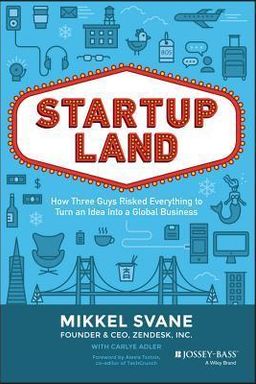
Startupland cover

Startupland

by Mikkel Svane

Startupland chronicles Zendesk''s transformation from a small Danish start-up to a global powerhouse. Mikkel Svane shares valuable lessons on team-building, investor selection, and navigating the U.S. start-up scene, offering practical advice for aspiring entrepreneurs.

Building Something from Nothing: The True Journey Through Startupland

Have you ever wondered what it really takes to build an idea into a global company—one that starts with three friends in a loft and ends up on the New York Stock Exchange? In Startupland: How Three Guys Risked Everything to Turn an Idea Into a Global Business, Mikkel Svane, the cofounder and CEO of Zendesk, pulls back the curtain on startup mythology. His story isn’t about overnight success; it’s about perseverance, humility, luck, and the uncomfortable truth that building something great usually means falling apart and putting yourself back together again—over and over.

Svane’s central argument is that the startup journey isn’t linear, logical, or glamorous. It’s not the highlight reel Silicon Valley often sells. Instead, it’s deeply human: fraught with self-doubt, sleepless nights, arguments among founders, and the daily emotional labor of balancing audacious dreams with harsh realities. The goal, Svane insists, isn’t just to make money or chase fame—it’s to find meaning in the act of creating something people love and to do it without losing your soul along the way.

The Unromantic Birth of an Idea

The story begins not in Silicon Valley but in Copenhagen, a place better known for bicycles and social welfare than for startups. Svane and his friends, Alexander Aghassipour and Morten Primdahl, were in their mid-thirties, working as consultants, and restless. They feared becoming “butt-cheek consultants”—safe, ordinary, and forgettable. Out of this dissatisfaction came a deceptively simple idea: to reinvent customer service software. It was an unsexy, overlooked part of the tech world, riddled with clunky systems and soulless interfaces. But they wanted to make it beautiful, simple, and human.

What set them apart wasn’t technical genius but their obsession with design and empathy. They believed software should make people’s work lives easier and more pleasant. That belief—rooted in humility, not hubris—became the DNA of Zendesk. Their mantra, “Love your help desk,” wasn’t a marketing line—it was a rejection of the cold, bureaucratic systems that dominated business software.

The Slow Burn: Risk, Rejection, and Resilience

The early years were brutal. The trio worked out of a Copenhagen loft with little money and no safety net. They maxed out credit cards, leaned on side gigs, and even borrowed from friends and family. They launched the product in 2007, long before “SaaS” (Software as a Service) became a buzzword. For months, no one cared. Investors in Denmark were skeptical. When they finally found a local angel investor, his intentions proved toxic. They turned down his money, valuing integrity over short-term survival—a choice that echoed one of Svane’s key lessons: never compromise your values for someone else’s version of success.

Things turned around when a thoughtful German investor, Christoph Janz, saw potential in Zendesk’s simplicity. His small seed investment gave them room to breathe. Soon Zendesk had customers from all over the world, including Silicon Valley darlings like Twitter and Dropbox. But success brought its own problems: scaling the infrastructure, moving across continents, and learning how to lead. As Svane puts it, “Building a product is one thing. Building a company is something else entirely.”

Crossing Oceans: Faith and Fear in Going Global

By 2009, Svane knew that if Zendesk wanted to play in the big leagues, it had to move to America. So he uprooted his wife and three children and moved to Boston—then San Francisco. The move was both exhilarating and terrifying. In vivid scenes, Svane describes struggling with cultural shocks, expensive apartments, locked bathroom doors he couldn’t open, and his wife’s illness in an unfamiliar country. These aren’t metaphors—they’re reminders that startups are built by humans with families and flaws, not just founders chasing unicorn dreams.

In the United States, they faced a new set of lessons: how to hire Americans accustomed to self-promotion (unlike modest Danes), how to build an inclusive culture, and how to survive scaling chaos. A now-famous example: when a server bug threatened to destroy their entire database, CTO Morten fixed it live, breaking every engineering rule in existence. It was reckless—and it saved the company.

Growing Up: From Startup to Institution

Once settled in San Francisco, Zendesk matured. It hired executives, raised venture funding from top firms like CRV and Benchmark, and expanded into markets worldwide. But with growth came painful lessons in communication, leadership, and humility. When a 2010 pricing change backfired, customers revolted publicly. The backlash nearly destroyed their reputation overnight. Instead of hiding, Svane published an open letter titled “Sorry. We Messed Up.” That act of transparency—owning mistakes with empathy—became one of Zendesk’s defining moments.

From there, the company grew into a billion-dollar enterprise, went public on the New York Stock Exchange in 2014, and redefined customer service for the digital age. But the book doesn’t end with celebration. It ends with reflection. Svane insists that the true prize isn’t the IPO or valuation—it’s waking up every day to work on something meaningful with people you trust.

Why It Matters

At its core, Startupland is not a how-to manual—it’s a how-it-feels memoir. It’s about the emotional reality of entrepreneurship: how love, friendship, and anxiety coexist in the pressure cooker of creation. Svane argues that successful startups balance Zen-like simplicity with relentless persistence. He shows that empathy—for customers, employees, and partners—is not a buzzword but a strategy. And he reminds you that the most meaningful success story is not about conquering the market—it’s about building something that survives and matters.

“Luck plays a role, but persistence is everything. The biggest thing we built wasn’t Zendesk—it was ourselves.”


Boring Is Beautiful: Finding Gold in the Mundane

Mikkel Svane’s breakthrough insight was that brilliance often hides in boredom. When everyone else chases flashy ideas, real opportunity lies in the things no one wants to touch. He, Alex Aghassipour, and Morten Primdahl didn’t start with an app for social media or entertainment—they chose customer service software, perhaps the least glamorous corner of tech. But that “boring” choice became their biggest advantage.

Reimagining Customer Service

Traditional enterprise software was clunky, expensive, and soul-crushing. Installing it required servers, consultants, and months of work. Zendesk flipped that model: you could sign up online, use it instantly, and pay with a credit card. They turned a corporate product into something simple and delightful. In doing so, they democratized software access, giving small companies the same tools as big corporations.

Like Amazon making online shopping accessible or Square simplifying payments, Zendesk made help desks human. Its brand—anchored by the “Laughing Buddha” logo and the tagline “Love your help desk”—signaled that business software didn’t have to be sterile.

The Danish Design Ethos

Being Scandinavian shaped their aesthetic philosophy. Danish design emphasizes functionality, minimalism, and beauty. They applied those same principles to software: fewer buttons, cleaner interfaces, and more empathy for the end user. In a world dominated by complex enterprise tools, this was radical. As Basecamp’s creators (whom Svane admired) had shown, elegance beats complexity.

Svane points out that “boring industries” are ripe for change precisely because insiders have stopped seeing their problems. Startups that can introduce simplicity, emotion, and beauty into neglected spaces often create huge value. That’s why Zendesk’s tagline—though whimsical—captured a revolution in thinking: work should feel good, not grind you down.

“Sexy happens when you make mundane things easy and humane.”

Zendesk’s early success with companies like Twitter and Scribd proved the point: even small teams could offer world-class support if given intuitive tools. The founders validated a core truth: you don’t need a glamorous idea—you need to make something people truly love using.


When Friends Found a Startup: The Human Factor

Building a company with friends sounds romantic—until you’re living it. Svane writes candidly about the rollercoaster of cofounder dynamics. He, Alex, and Morten respected and infuriated each other in equal measure. Their dynamic resembled a marriage, complete with late-night arguments, storming out, and reconciling for the company’s sake.

Different Strengths, Shared Vision

Each brought contrasting skills: Morten, the perfectionist CTO who architected flawless infrastructure; Alex, the artistic designer obsessed with details; and Svane, the impatient marketer who pushed to get things done. That tension fueled balance—until it didn’t. Cultural clashes arose over everything from office spaces to investor negotiations. But Svane learned that disagreement isn’t failure—it’s creative combustion if managed with respect.

When venture capitalists entered the picture, those tensions intensified. Alex feared losing control, Morten demanded security, and Svane pressed for speed. They nearly split over whether to accept their first VC deal. Walking away hurt—but it saved their integrity. Later, when CRV’s Devdutt Yellurkar reappeared to invest under better terms, their unity paid off.

Lessons in Emotional Equity

Svane reminds readers that cofounders must invest as much emotional capital as financial. You’ll argue, disappoint, and still need to show up. Transparency isn’t optional; it’s survival. He compares managing a startup to raising a child: “Our baby united us—even if we didn’t like parenting together.”

His takeaway: friendship can endure only if professional honesty comes first. It’s better to have uncomfortable conversations early than to harbor resentment later. Trust, once broken, is nearly irreparable in startups where every decision counts. This realism runs counter to the Hollywood myth of harmonious visionary teams—it’s more human and infinitely more useful.


Culture Shock and Customer Love: Moving West

When Zendesk moved from Copenhagen to San Francisco, Svane didn’t just relocate a company; he transplanted an entire culture. The book paints their move west as a modern pioneer tale—equal parts adventure and anxiety. For Svane’s family, it meant new schools, language barriers, and endless uncertainty. For the company, it meant competing in the heart of global tech.

Learning the American Way

In Denmark, humility is a virtue. In Silicon Valley, self-promotion is survival. That cultural clash led to hiring mishaps. Candidates could “sell themselves” so well that the Danish founders took their boasts literally, later realizing some skills were oversold. They adapted by hiring for attitude rather than resumes—people who were curious, humble, and adventurous.

Their hiring philosophy became legendary: hire travelers (adventurous minds), athletes (multitaskers), and people unoffended by strong language or chaos. That approach built a diverse, resilient culture—one that thrived in the messy energy of startups. It also aligned with Zendesk’s product philosophy: software built by empathetic humans, for empathetic humans.

Customer Support as a Love Language

Zendesk’s internal rule was simple: “Love your customers.” Every employee, from marketing to engineering, had to spend their first week answering support tickets. The logic was profound—if you start your relationship with real customers, you’ll never forget who you serve. They even discovered quirky tactics, like emailing customers with deliberate typos to sound human, or Michael Hansen’s alter ego “Jennifer,” whose friendly tone improved conversion rates.

“It doesn’t matter what you talk about with your trial customers. What matters is that you talk.”

In a time when automation tempted companies to dehumanize service, Zendesk redefined support as relationship-building. This obsession with authenticity—not efficiency—became the cornerstone of their customer loyalty and shaped their brand’s global voice.


Failure, Feedback, and the Power of Saying Sorry

In 2010, Zendesk faced its first public crisis. After announcing a price increase, customers revolted. Angry messages flooded their forums. Competitors piled on. TechCrunch published a headline that stung: “Zendesk Raises Prices, Pisses Off Customers.” It was a startup’s worst nightmare—a massacre in broad daylight.

The Anatomy of a Backlash

Zendesk thought customers would appreciate new features justifying higher prices. Instead, people felt betrayed. The issue wasn’t money—it was trust. They felt blindsided. Svane realized they’d broken the sacred bond between company and customer: listening. Rather than defend themselves, he took full responsibility, publishing a heartfelt open letter titled, “Sorry. We Messed Up.”

The apology worked because it was sincere. They reversed the price change and publicly admitted failure. What could have become a fatal blow instead deepened customer loyalty. Svane’s takeaway: relationships aren’t maintained by being perfect—they’re built on humility and repair. In the customer economy, empathy is not a luxury; it’s your survival tool.

Lessons in Emotional Intelligence

From this crisis emerged a set of principles that guided Zendesk’s culture:

  • Never overestimate your importance in customers’ lives; they let you in—you must earn that right continually.
  • Be transparent; people trust honest flaws more than polished façades.
  • Empower employees to act like humans, not scripts.

This episode reframed Svane’s leadership philosophy. He saw customer relationships as mirrors of human ones: fragile, emotional, and worth protecting. In many ways, Startupland teaches that the ability to say “we were wrong” might be a company’s greatest competitive edge.


From Startup to Grown-Up Company

After surviving its early chaos, Zendesk matured from scrappy startup to professional organization. The shift demanded new skills, especially for a founder team used to doing everything. Svane describes this transition as awkward but necessary—the move from building a product to building processes, culture, and leadership.

Hiring People Who Outshine You

Svane recalls hiring Adrian McDermott, a seasoned engineer who had taken companies through IPOs. Adrian’s expertise dwarfed Svane’s own, which both humbled and liberated him. “When you hire someone smarter than you,” Svane writes, “your job shifts from managing to collaborating.” Allowing professionals to lead became key to Zendesk’s later scalability.

He also learned that onboarding mattered as much as hiring. Early hires like Amanda Kleha, their first marketer, arrived to find no computer, no process, and no clarity. These comedic missteps underscored the difference between passion and professionalism. Over time, systematic onboarding and supportive culture replaced chaos, without killing creativity.

Scaling Without Losing Soul

Even as they expanded globally, Zendesk tried to maintain humility and humor. Their offices had playfulness without excess—no slides or nap pods, just personality. The founders had learned not to overinvest in vanity. As Svane jokes, “Some startups have $100 million in office leases. Don’t spend more than 10 percent of your revenue on office space—or better, just 1.”

“Sometimes finding perfection means finding the middle ground.”

Zendesk’s maturity didn’t mean losing its startup innocence. It meant learning how to sustain its values of empathy and simplicity at scale—a crucial lesson for any organization growing beyond its founders.


Losing Innocence: Competing, Evolving, and Staying Real

By the time Zendesk became a recognized leader, new competitors surfaced—many backed by powerful investors. Svane admits that he was blindsided by Silicon Valley’s politics: rival startups making bold claims, investor “families” promoting favorites, and media hype shaping perception. His naïve belief in “meritocracy” faded as he realized success depended on narrative as much as product.

Shifting the Strategy

Zendesk initially prided itself on self-service sales: customers signed up online with no sales reps involved. But Svane noticed potential clients walking away because they wanted a human conversation. The team pivoted, cautiously building a sales force—a once-taboo move. This shift from idealism to pragmatism mirrored Zendesk’s coming of age. It showed that principles matter, but flexibility wins.

Embedding in the Community

When Zendesk moved its HQ to San Francisco’s gritty Tenderloin district, they signed a Community Benefits Agreement with the city. Staff volunteered locally, supported small businesses, and treated the neighborhood as part of their story. Rather than build a walled startup utopia, they chose integration—demonstrating how companies can grow responsibly.

This phase also tested empathy internally. Replacing their beloved CFO Rick with a new executive, Alan Black, ahead of the IPO nearly broke trust. Svane handled it poorly and admits regret—a rare act of vulnerability in business writing. His honesty underscores the book’s deeper thesis: leadership is both a privilege and an ongoing moral test.


Going Public Without Losing Perspective

Zendesk’s 2014 IPO marked the end of one journey and the start of another. The process was grueling: endless roadshows, investor meetings, and the anxiety of pricing shares in a volatile market. Svane describes it as “two weeks of living in a parallel universe” where every word matters and fatigue is constant.

The Road Show Marathon

He recounts traveling across the U.S. with CFO Alan Black in private jets, pitching to pension funds and hedge funds. Each meeting wasn’t just about numbers—it was about human connection. Investors wanted to see authenticity as much as profitability. Twitter’s CEO Dick Costolo gave Svane one piece of advice: “Don’t go out drinking during your roadshow.” It became gospel—discipline over indulgence.

When the company finally priced its shares at $9, valuing Zendesk around $700 million, Svane emphasized long-term trust over short-term valuation. By the end of day one, shares jumped nearly 50%. Yet the triumph was quiet. He returned home, put his kids to bed, and drove them to school the next morning. “Some things stay the same,” he writes—an anchor of humility amidst celebration.

Meaning Beyond Money

The IPO wasn’t the story’s climax but a reflection point. It reaffirmed Zendesk’s belief that business can be both empathetic and effective. Employees owned 25% of the company; the founders remained grateful, not self-congratulatory. Svane ends by cautioning future entrepreneurs: success changes your job, not who you are. What endures is purpose, relationships, and the quiet pride of building something meaningful together.

Dig Deeper

Get personalized prompts to apply these lessons to your life and deepen your understanding.

Go Deeper

Get the Full Experience

Download Insight Books for AI-powered reflections, quizzes, and more.