
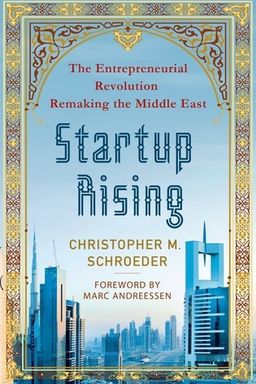
Startup Rising cover

Startup Rising

by Christopher M Schroeder

Startup Rising reveals the quiet revolution reshaping the Middle East as a burgeoning hub of tech entrepreneurship. Through compelling narratives, discover how young innovators are overcoming political challenges to establish a vibrant economic future.

Light and Darkness: A Hardboiled Search for Redemption

What does redemption look like for someone who’s committed unforgivable acts? In Like A Light in the Black, Frank Christopher Schroeder drags us deep into the moral swamps of crime and conscience through the life of Lennart “Kissinger” de Luca—a professional assassin wrestling with guilt, loyalty, and an obsession with finding meaning in a corrupt world. Schroeder’s novel is part noir thriller, part existential meditation. It asks: can a man who’s lived in darkness ever truly walk toward the light?

At its core, this story of violence and philosophy pits self-deception against self-awareness. Kissinger, once a meticulous hitman bound by an ethical code, comes to face the collapse of everything that gave his life structure: his brother’s moral downfall, his mentor’s betrayal, his own moral decay. Forced into isolation, he turns inward—interrogating not only his past crimes, but humanity’s collective sickness in an era consumed by greed and moral decay. Through hard-hitting dialogue, heavy metal metaphors, and spiritual encounters with a reverend who embodies conscience itself, Schroeder builds a neo-noir parable about responsibility, forgiveness, and the futility of escape.

A Noir World of Moral Mirrors

The novel plays like a fusion of Crime and Punishment and Sin City. The streets are soaked in vice and cynicism, and the men who run them—Princelow, Feinstein, the FBI Agent Smith—are reflections of the same moral disease. They all manipulate, betray, or rationalize evil in the name of necessity. Kissinger recognizes this disease because he is its carrier. His moral code—no children, no revenge hits, no women—allows him to delude himself that he’s a “principled” killer. But Schroeder isn’t fooled, and neither is Kissinger by the end. The novel’s insight is that humans will justify almost anything if it preserves their sense of order.

Kissinger’s story moves from urban violence to philosophical exile. Each act—the hits, the betrayals, the bizarre systems he devises to hide crimes (“the Potpourri” of mixed DNA)—serves as a metaphor for the chaos under civilization’s skin. The U.S., in the book’s later chapters, appears morally bankrupt and spiritually hollow, with bureaucracies and gangsters equally corrupted by the pursuit of power. Schroeder paints Kissinger not merely as a criminal, but as an observer of a world gone mad.

Thematic Contrasts: Faith, Guilt, and the Search for Meaning

Running throughout the novel is Kissinger’s strange companionship with Reverend Isiah Cunningham, a preacher who offers him glimpses of grace in a nihilistic world. In each meeting—from bar conversations to eerie encounters on park benches—the reverend becomes a mirror for Kissinger’s soul. Through him, Schroeder stages debates about evil, free will, and divine order. Cunningham claims that evil is not an external force but an expression of human imbalance—echoing moral philosophers like Augustine or even modern psychologists who see evil as disconnection from empathy.

Yet Kissinger resists salvation. His intelligence and idealism twist into arrogance and despair. When he lashes out, Schroeder makes us feel that he’s not just angry at others but at a universe that won’t give him a clear answer. His spiritual exhaustion embodies modern man’s dilemma: we no longer believe in sin, but we can’t stop feeling damned.

A Redemption Writ in Hellfire

The final sections of the book—his confrontation with Princelow, his near-death in the storm, and his symbolic “fall” through collapsing structures—serve as a literal and figurative cleansing. Only in ruin does Kissinger achieve acceptance. By “saying the words,” a recurring religious motif, he opens himself to a kind of grace—ambiguous, perhaps hallucinatory, but deeply human. In his last moments, as biblical passages merge with rock lyrics, Schroeder closes the noir circle: darkness and light are not opposites but mirrors.

This tension—between punishment and redemption, realism and transcendence—turns Like A Light in the Black into more than a crime story. It’s a philosophical journey disguised as hardboiled pulp, suggesting that every man must eventually face the violence he creates—and that the hardest target to confront is oneself.


The Code of a Killer

At the center of Kissinger’s identity is his codex—a moral rulebook that he follows to claim that his killings are “ethical.” He avoids harming innocents, women, and children, believing that this self-imposed boundary separates him from sociopathic criminals. Yet Schroeder dismantles this illusion piece by piece. Through Kissinger’s reflections in prison and his eventual breakdown, we see how the codex becomes another layer of self-deception.

Honor Among Killers

When the book opens, Kissinger justifies murder as a “professional service.” Like the samurai-bound code Wattanabe once drilled into him, his work is guided by precision, loyalty, and self-control. His discipline is what gives him power—but also what numbs him. Each carefully executed crime, each ritualized routine, strips away another piece of his humanity. Over time the codex evolves from an ethical compass to a prison. It lets him feel superior to “the herd,” those ordinary people he despises for their hypocrisy. The irony, Schroeder suggests, is that Kissinger himself becomes what he condemns: a coward hiding behind rationalizations.

The Collapse of Moral Illusion

When Kissinger kills his brother Rico, the codex falls apart. The act isn’t a “clean” hit—it’s personal, emotional, and devastating. For years his code kept him from acknowledging feeling, but this confrontation forces him to admit the full horror of what he’s done. His suicide mission against Princelow later is both revenge and penance, a desperate attempt to reimpose structure on the chaos. In this light, Schroeder’s message resembles Dostoevsky’s insight in Crime and Punishment: morality detached from empathy becomes meaningless logic.

“He could justify anything—so long as he called it work. But no codex can cleanse blood.”

By the time Kissinger seeks redemption, his discipline has twisted into spiritual rigor mortis. The same precision that once made him a master assassin now makes it nearly impossible to forgive himself. His code kept him alive; it also kept him from being human. Schroeder invites you to ask: what personal creeds do you live by—and what might they be hiding?


Brothers in Blood and Fate

Rico and Kissinger’s relationship lies at the beating heart of Schroeder’s story. Two brothers, bonded by shared trauma and training, become reflections of each other’s destinies: one consumed by vengeance, the other by guilt. Their story isn’t just crime fiction—it’s a parable of human duality, reminiscent of biblical Cain and Abel, or perhaps a modern echo of yin and yang.

A Brotherhood of Violence

Raised by the enigmatic Wattanabe, a Japanese mentor who taught them martial discipline and a psychic anticipation technique called Sa’orté, they were conditioned to kill without hesitation. Their relationship is built on trust forged in violence—but also rivalry. When Rico is imprisoned, tortured, and infected with HIV through the machinations of ganglord Princelow and FBI manipulation, he turns vengeful. Kissinger’s failure to protect him becomes the emotional fuse of the novel.

Mirror Images of Lost Humanity

Rico’s transformation into an unrestrained avenger mirrors Kissinger’s internal rot. They represent the two sides of moral collapse: passionate destruction and stoic detachment. Their final confrontation—when Kissinger kills Rico to save Stella—is the ultimate tragedy. It’s the death of family, of faith, and of any illusion that violence can yield justice. Kissinger’s remorse afterward drives him into literal and spiritual exile in the Louisiana swamps. The brothers’ story encapsulates Schroeder’s central theme: the greatest battles are fought within families—and within ourselves.

(In tone and structure, their dynamic recalls the psychological fatalism of Hemingway’s The Killers and the mentor-trauma dynamic seen in Leon: The Professional—except here, intimacy leads to annihilation.)


The System: How Evil Organizes

Schroeder introduces a chillingly bureaucratic concept called The System—a method of orchestrating contract killings across cities so that no single assassin has a traceable motive, means, and opportunity. Developed by Kissinger and his mentor Feinstein, this mechanism turns murder into a self-replicating supply chain, protected by human weakness and inter-agency rivalry. It’s capitalism meets carnage.

Crime as an Industry

The brilliance of The System lies in its mimicry of legitimate enterprise. Cities swap killers like corporate departments outsourcing work. Interconnected but compartmentalized, the assassins operate through anonymous middlemen (“facilitators” like Jimmy Jazz). The FBI’s inability to connect the dots arises from institutions valuing turf more than truth—a dark parallel to real-world systemic dysfunction (as seen in espionage literature like John le Carré’s).

A Mirror of Society’s Hypocrisy

When Agent Smith uses The System’s structure for his own ends—owning Kissinger’s freedom as leverage—the line between cop and criminal vanishes. Everyone becomes entangled. Schroeder uses this plotline to show how organizations perpetuate evil “logically.” It’s not ideology but inertia that sustains corruption. The System continues because it works—and because it reflects how power in the real world operates: distributed responsibility ensures no one feels guilty.

By creating The System, Kissinger perfected his own trap. Every structure built on lies—whether criminal or corporate—eventually simplifies evil to “procedure.”


Women, Love, and the Ghost of Stella

Stella, the district attorney and Kissinger’s former lover, plays a subtle but pivotal role in the novel’s moral landscape. She represents the path not taken—the alternate reality in which Kissinger could have lived a normal life. Yet her marriage to Agent Smith seals her transformation into both a symbol of justice and a reminder of betrayal.

Love and Possession

When Kissinger learns that Stella married the very FBI agent who once tortured him with imprisonment, jealousy ignites an older rage: his hatred of manipulation. Stella’s presence in the story—especially when she verifies Smith’s story about Rico—becomes the inflection point where emotion overrides logic. Love, for Kissinger, is just another battlefield. Yet their meeting at the Trump Plaza in Atlantic City is one of the novel’s calmest, most human moments. Neither forgiveness nor romance returns, only an acceptance that happiness is possible for someone else.

The Feminine as Redemption

Schroeder doesn’t reduce Stella to a damsel or seductress. She is conscience personified—the moral center orbiting the chaos of male violence. Kissinger’s decision to save her from Rico, even at the cost of his last bond, defines his humanity. In noir tradition (think of Chandler’s The Big Sleep or Hammett’s Red Harvest), women often embody unattainable grace. Stella’s silence at the end—her calm “Yes” when asked if she’s happy—is both a benediction and a final door closing.


Faith, the Preacher, and the Seven Bowls

Isiah Cunningham, the itinerant preacher who crosses Kissinger’s path like an apparition, acts as the novel’s spiritual anchor. Where everyone else manipulates, he confronts. His recurring appearances read like moral interventions in a sinner’s journey. Each dialogue with Kissinger resets the philosophical tempo: cold nihilism meets fierce faith.

Philosophy as Salvation

Cunningham debates theology in street slang, weaving biblical apocalypse with social critique. He reframes Revelation’s “seven bowls of wrath” as metaphors for humanity’s slow decay: pollution, greed, moral paralysis, spiritual blindness. His image of society as a rabbit frozen before a slow-moving snake—a world dying without realizing it—captures Schroeder’s overarching criticism of modern inertia. Kissinger counters with cynicism, seeing mankind as its own plague. Their exchanges transform sermons into street philosophy, echoing Camus’ absurdist rebellion against meaninglessness.

Saying the Words

Cunningham’s final advice—“You have to say the words”—marks the novel’s spiritual climax. It’s not doctrinal faith but conscious surrender: the acceptance that redemption requires acknowledgment. In the finale, trapped under rubble and murmuring those “words,” Kissinger embodies every sinner’s last hope: that truth spoken in darkness might summon a spark of light.

“Coincidence,” the preacher says, “is a concept of the hopeless.”

Schroeder thus recasts faith not as superstition but as courage—the willingness to see meaning beyond despair.


The Fall and the Storm

The climax in San Francisco, amid earthquakes and storms, merges natural disaster with spiritual reckoning. The setting is apocalyptic: lightning, thunder, collapsing buildings—the perfect stage for Kissinger’s final duel with Princelow and his inner demons. Nature itself becomes the judgment scene.

When Kissinger and Agent Smith confront Princelow, their alliance between killer and cop reaches its terminal contradiction. The FBI, criminal empires, and divine wrath all converge in a purging chaos. Kissinger’s confrontation isn’t just vengeance—it’s confession through violence. Princelow’s death, and Smith’s escape to rejoin his family, frame Kissinger’s martyrdom: the sinner trading his life so others may go free.

As the roof caves in, the preacher’s voice returns—whether hallucinated or heavenly—and Kissinger finally obeys: he “says the words.” In doing so, he achieves the only redemption available in Schroeder’s universe: acceptance, not absolution. The storm washes him into myth. The light in the black.


Society as the True Villain

While the story centers on violence and redemption, it also serves as a wide-angle social critique. Through Kissinger’s reflections and rants, Schroeder dissects late-capitalist decay—the world of corporate greed, bureaucratic cowardice, and moral emptiness. The assassins and agents are merely exaggerated forms of everyday corruption.

The Modern Swamp

Kissinger’s exile in the Louisiana bayou functions both literally and symbolically. The swamp isn’t just punishment—it’s the modern world in miniature: stagnant, poisonous, yet teeming with hidden life. As he confesses, “I have got out of the swamp, but the swamp has yet to get out of me.” That realization applies to society at large. Schroeder portrays humanity as a species suffocating in its own moral sewage—what he calls “growth to death.”

The Void of Modern Man

Echoing philosophers like Nietzsche and Kierkegaard, Schroeder suggests that faith and meaning crumbled when materialism became the new religion. The book’s repeated metaphors—the zombie tourist, the snake and rabbit—show humans paralyzed by consumption and fear, watching their own extinction like spectacle. Kissinger’s despair is ours: a world that substitutes adrenaline for purpose, manipulation for connection.

In confronting society’s corruption, Schroeder doesn’t moralize; he dramatizes. You finish the novel realizing that Kissinger’s personal hell isn’t exceptional—it’s prophetic.

Dig Deeper

Get personalized prompts to apply these lessons to your life and deepen your understanding.

Go Deeper

Get the Full Experience

Download Insight Books for AI-powered reflections, quizzes, and more.