
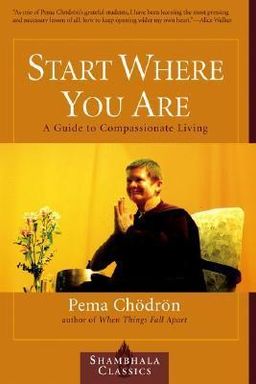
Start Where You Are cover

Start Where You Are

by Pema Chodron

Start Where You Are is a transformative guide to compassionate living. Pema Chodron offers profound insights into embracing weaknesses, practicing meditation, and finding joy in the present. Discover how to confront inner demons and cultivate strength through compassion, leading to a more meaningful and serene life.

Awakening the Heart Through Compassionate Living

What if your greatest obstacles—your anger, jealousy, fear, and pain—were actually your greatest teachers? In Start Where You Are: A Guide to Compassionate Living, Buddhist teacher Pema Chödrön argues that genuine compassion and courage arise not from avoiding the messiness of life but from turning toward it. She contends that instead of trying to fix or improve ourselves, we can awaken our inherent wisdom by meeting our suffering with curiosity and gentleness. The book offers a practical approach to living with an open heart, even in a world that often feels chaotic or painful.

At its core, this work is about cultivating bodhichitta—the awakened heart or enlightened mind within every person. Drawing on the ancient Tibetan lojong (mind training) teachings, Chödrön lays out a path through fifty-nine slogans that serve as daily reminders to practice mindfulness, patience, and compassion. She weaves together vivid stories, practical meditation techniques, and intimate guidance to show how inner transformation can be achieved in the midst of ordinary life.

Starting Where We Are

The central lesson—“start where you are”—sounds disarmingly simple. But it’s also radical. It invites you to stop waiting for the perfect circumstances: the moment when you’re calmer, wiser, or more spiritual. You begin exactly as you are now—mess and all. Whether you feel depressed, addicted, resentful, or afraid, those feelings themselves become the raw material for awakening compassion. By embracing them rather than resisting them, you cultivate acceptance and tenderness. Instead of trying to transcend human frailty, Chödrön teaches, we learn to make peace with it.

The Practices That Open the Heart

Chödrön introduces three main practices that make up this compassionate path. The first is shamatha-vipashyana meditation—resting the mind on the breath and returning to it gently whenever thoughts wander. This simple act of labeling thoughts as “thinking” cultivates awareness and kindness toward yourself. The second practice is tonglen—“sending and taking.” In tonglen, you consciously breathe in the pain of yourself and others and breathe out compassion and relief. Finally, the third practice centers on contemplating and working with the lojong slogans, brief pith instructions designed to rewire your habitual reactions to discomfort, fear, and confusion. Through these methods, Chödrön explains, we begin to see that compassion is not an ideal but a skill that grows with consistent practice.

Using Pain as a Path to Compassion

A major theme of the book is the idea that pain, rather than being avoided, can become a gateway to connection. Chödrön insists that our own woundedness—what she calls the “soft spot”—is not a weakness but the heart of love itself. By learning to stay present with pain—anger, jealousy, loss—we uncover our shared humanity with others. This is the essence of empathy: realizing that the suffering you feel is not unique, and that everyone is struggling in their own way. In this way, compassion grows naturally, replacing judgment or indifference with kinship.

Living the Teachings in Everyday Life

Throughout the book, Chödrön emphasizes the importance of practice “on the spot”—in traffic, at work, during family conflicts. Drawing inspiration from her teacher Chögyam Trungpa and classic texts like The Great Path of Awakening, she shows how Buddhist wisdom can be applied moment by moment. You’re invited to work with your mind whenever frustration, fear, or joy arises. Whether you’re confronting grief, addiction, or daily irritation, these challenges become reminders to wake up. As she writes, true compassion doesn’t come from fixing others but from realizing your deep connection to all beings. In doing so, you discover that there’s “no escape and no problem,” because every experience—especially the difficult ones—is an opportunity to open your heart wider.


No Escape, No Problem: Meeting Life as It Is

From the very beginning, Pema Chödrön disarms a common assumption: that spiritual growth means escaping pain. Her first chapter, “No Escape, No Problem,” declares that we already have everything we need. The idea that we must fix or improve ourselves is, she says, a form of resistance—a subtle way of rejecting our present experience. The practice is not to transcend suffering but to make friends with it. She invokes the vivid metaphor that our true nature—the warmth and brilliance of the sun—is always shining, even when it’s obscured by clouds. Instead of chasing sunlight, we learn to sit in the storm and trust that the brightness is still there.

Facing Pain Without Fleeing

The reason we often fail to connect deeply with ourselves or others, Chödrön explains, is avoidance. We close off from fear or shame, splitting away from the parts of ourselves we dislike. When these painful emotions arise, our instinct is to escape—through distraction, blame, or numbing habits. The invitation here is to hold your seat—to stay with your direct experience rather than abandoning it. Paradoxically, the more we face discomfort, the more courage and clarity we gain. By meeting our own pain fully, we can finally recognize the pain of others as not separate from our own. Compassion grows where avoidance once lived.

The Golden Key of Meditation

Chödrön describes shamatha-vipashyana meditation as the “golden key” to self-knowledge. Sitting upright, eyes open, and paying gentle attention to the outbreath, you begin to notice how thoughts arise and dissolve. When distraction comes, label it simply: “thinking.” The point isn’t to erase thoughts but to meet them with friendliness. Even in the chaos of your mind, you can relate to yourself with honesty, humor, and kindness. This awareness is the ground of compassion. (In Jon Kabat-Zinn’s mindfulness work, a similar principle applies: through nonjudgmental attention, we cultivate presence and healing.)

The Practice of Lojong

Chödrön then introduces the lojong (mind-training) teachings, structured around fifty-nine slogans that reorient the mind toward openness. Their aim is to reverse our habitual patterns—approaching pain with curiosity, and joy with generosity. One core motto is “Gain and victory to others, loss and defeat to myself.” On first reading, it sounds masochistic, but in fact it points to the truth that protecting yourself from pain only shrinks your world. Defeat, in Buddhist practice, is the moment vulnerability breaks the armor around the heart. That openness, though tender and raw, is where bodhichitta—the awakened heart—comes alive. “No escape” becomes “no problem” because you discover that nothing needs to be resisted or fixed; everything can be used to awaken compassion.


Regard All Dharmas as Dreams

In her chapter “No Big Deal,” Chödrön invites us to lighten up by seeing the world differently. The first lojong slogan, “Regard all dharmas as dreams,” reminds us that everything we experience—success and loss, pleasure and pain—is fleeting and insubstantial. This is not to say that life is meaningless but that it’s tender and temporary. Seeing life as a dream softens our grip on perfection and control. It helps us approach emotions with humor and gentleness, recognizing that they, too, are passing clouds in an open sky.

Softening Through Bodhichitta

At the heart of this teaching is bodhichitta, the “soft spot” of compassion within us. Chödrön describes it as tender and vulnerable—“tinged with sadness,” what she calls the genuine heart of sadness. This sadness isn’t weakness; it’s the recognition of our shared fragility. She distinguishes between relative bodhichitta (our emotional compassion for others) and absolute bodhichitta (our understanding of emptiness or openness). Both are essential; together they make compassion both tender and wise.

Stop Making Such a Big Deal

The antidote to anxiety is not more control but relaxation. Through meditation, we learn the art of not making such a big deal of everything. Every thought—whether praise or self-criticism—is just “thinking.” Chödrön jokes that we can label these thoughts as if “touching bubbles with a feather.” This mindfulness disarms perfectionism and self-hatred. The lesson parallels Eckhart Tolle’s notion of “watching the thinker”: freedom arises when you stop taking your mental chatter so seriously. By cultivating humor, gentleness, and curiosity, you allow joy and equanimity to emerge naturally.

Practicing Gentleness in Daily Life

Gentleness is not passivity—it’s grounded courage. Lightening up allows us to reconnect with our innate warmth and creativity. As Chödrön says, even the simple act of softening your shoulders and relaxing your breath in meditation can shift your relationship with life. The world becomes less something to conquer and more something to relate to. And when you forget this—and you will—you simply start again. No big deal.


Turning Poison into Medicine

Few teachings are as transformative as “Three objects, three poisons, and three seeds of virtue.” Here, Chödrön tackles the Buddhist understanding of the three poisons: passion (craving), aggression (aversion), and ignorance (denial). Rather than labeling these emotions as bad, she reframes them as vital energy that can be transmuted into wisdom. Just as the mythical peacock uses poison to color its brilliant feathers, you can use your poisons to awaken compassion. Your pain is not a flaw—it’s the very material of enlightenment.

The Three Poisons in Daily Life

Everyday triggers—from an irritating coworker to an unfinished chore—provoke one of these three reactions. Something pleasant sparks craving (“I need more of that”), something unpleasant fuels aversion (“I want to get away”), and something neutral invites ignorance (“I don’t care”). When these emotions arise, we usually act out or repress them. Both habits, Chödrön explains, strengthen ego’s armor. The third way is to neither indulge nor reject these feelings—to simply hold your seat and feel the energy beneath the story. Beneath rage or desire, you’ll find tenderness: the wounded heart longing for connection.

From Reaction to Awareness

Just as in cognitive behavioral therapy (CBT), awareness breaks the cycle of reactivity. When you can calmly observe your cravings, aversions, and denials, you transform them into “seeds of virtue.” Anger becomes clarity, desire becomes appreciation, ignorance becomes openness. The key is to train gently, without moralizing. “Whenever Mortimer walks by and you feel jealous,” Chödrön jokes, “that’s your moment of practice.” Life continually provides opportunities to see your poisons, and each encounter is a chance to soften.

Holding the Wound Tenderly

Central to this transformation is tenderness toward your own pain. Instead of blaming others (“Drive all blames into Juan”), you turn inward to feel the rawness beneath your reaction. This does not mean self-blame; it means meeting your suffering with compassion. By breathing in discomfort rather than fleeing it, you recondition the mind to face difficulty with openness. That’s the alchemy at the heart of Chödrön’s teaching: when you stop turning away, the poison becomes medicine.


Tonglen: The Practice of Taking and Sending

At the heart of Chödrön’s method lies the meditation of tonglen—literally “sending and taking.” This ancient Tibetan practice reverses our habitual self-protection by training us to breathe in what is painful and breathe out what is healing. It may sound counterintuitive—who wants to breathe in suffering?—but that’s precisely the point. By doing so, we connect with the universal nature of pain and break the illusion of separation.

Four Stages of Practice

Tonglen unfolds in four stages. First is flashing openness—a brief moment of spacious awareness, resting in the natural clarity of mind. Second, you visualize breathing in dense, hot darkness—the weight of suffering—and breathing out brightness and relief. Third, focus on one real person’s pain: a sick friend, a grieving stranger, or even yourself. Finally, expand outward, sending your compassion to all who share that experience. As Chödrön notes, you can begin with someone you love, then extend to those who are neutral, and finally to those you resent. Compassion must start with ourselves before it can extend authentically to others.

Practical Examples

Consider a moment of anger: Mortimer says something hurtful, and fury rises in your chest. Instead of striking back or repressing it, you breathe in the hot, heavy tone of anger, acknowledging its full power. Then breathe out cool spaciousness—the wish that all beings suffering from anger find peace. What begins as personal gradually becomes universal. Inhaling suffering and exhaling compassion becomes second nature, transforming conflict into connection.

Start Where You Are

The key slogan—“Begin the sequence of sending and taking with yourself”—underscores that tonglen begins with self-compassion. When you can hold your own fear, jealousy, or grief tenderly, you realize that others feel exactly as you do. This shared pain becomes shared humanity. The practice dissolves boundaries and nurtures kinship with all life. Over time, tonglen turns your soft spot into strength: you become fearless not because pain disappears, but because your heart learns to stay open through it all.


Transforming Mishaps into the Path of Awakening

“When the world is filled with evil, transform all mishaps into the path of bodhi.” This lojong slogan captures one of Chödrön’s most liberating insights: everything that happens—even tragedy or injustice—can awaken compassion. Instead of seeing painful events as interruptions, we can treat them as invitations to wake up. This mindset transforms ordinary frustration into spiritual practice and turns life itself into the monastery.

From Blame to Bravery

Chödrön observes how easily we blame others for our suffering—our partners, parents, governments. But as she puts it, “As long as we hate the enemy, both we and the world suffer.” Her story of Sioux elder Gerald Red Elk illustrates this: filled with hatred over injustices, he turned to alcohol until realizing that hatred was poisoning him, not his oppressors. Compassionate action arises only when blame transforms into responsibility. This is what it means to become a “gentle warrior”: facing pain directly, with an unguarded heart.

The Logic of Ego

Underlying our reactivity is what Chödrön calls “ego’s room”—a metaphor for the cramped space where we try to control life. Ego is not a sin but a misunderstanding—it’s what happens when we mistake our ever-changing experiences for a fixed self. The practice is to “open the door,” little by little, letting in the smells, sounds, and people we’ve been avoiding. This gradual exposure trains us to be more curious than afraid. As she often quotes from the Native American story of Ishi, the last Yahi Indian: “My life has taught me to be more curious than afraid.”

Courage in Chaos

When the world seems filled with suffering, it helps to remember that difficulty is the path, not the obstacle. Chödrön contrasts blaming with bravery: the moment you stop running from pain, you stop adding aggression to the world. Whether it’s dealing with injustice, loss, or personal betrayal, every challenge becomes an invitation to soften your heart and strengthen your compassion. In modern psychological terms, this is energy transformation—the moment when reactivity becomes mindfulness, and mindfulness becomes love.


Gratitude for Everyone: The Radical Practice of Acceptance

One of Chödrön’s most provocative slogans says simply: “Be grateful to everyone.” At first glance, it feels impossible—how can you be grateful to people who anger or hurt you? But the teaching reframes gratitude as awareness. Every “troublemaker” in your life exposes a part of yourself you’ve rejected. As she puts it, “When you’ve met your match, you’ve found your teacher.”

Enemies as Teachers

The people who irritate you most—your “Juans and Juanitas”—are mirrors for your disowned qualities. If someone seems arrogant, maybe they reflect your own pride or insecurity. In Buddhist terms, these relationships ripen old karma, giving you a chance to see and soften your patterns. Instead of resenting them, you can thank them for revealing your blind spots. Chödrön illustrates this through the story of Atisha, a revered monk who deliberately brought along a difficult tea boy because the boy’s irritability kept him alert and humble.

From Resistance to Curiosity

Practicing gratitude doesn’t mean enduring abuse or pretending everything is fine. It means seeing each situation as a lesson in awareness. Chödrön relates this to Gurdjieff’s idea of the “irritating person” who wakes us from mechanical living. The “Bengali tea boy” in our own lives forces us to notice where our patience ends and where compassion must begin. Gratitude, then, is a training in curiosity—it’s about opening, not approving.

The Power of Openness

Ultimately, “Be grateful to everyone” means recognizing the interdependence of all life. Every encounter—pleasant or painful—shows you where you’re still clinging. By welcoming the full range of experience, you stop fighting reality. As Chödrön writes, “When the resistance is gone, so are the demons.” Gratitude becomes not a moral duty but a survival skill—a way of staying open to the world instead of closing your heart.


Abandon Any Hope of Fruition

This slogan, one of the most arresting in the book, invites a radical release: “Abandon any hope of fruition.” In a culture addicted to self-improvement, Chödrön declares that the spiritual path is not about reaching a perfected future version of yourself. The obsession with progress—becoming calmer, kinder, more enlightened—only strengthens the ego’s grip. True transformation begins when you stop trying to “get somewhere” and turn toward the immediacy of now.

The Trap of Self-Improvement

Many of us treat meditation and mindfulness as projects of self-betterment, as if we were home renovation sites. But as Chödrön points out, “As long as you’re wishing for things to change, they never will.” The idea of some future “fruit” keeps us running from the present moment—the only place awakening can occur. This perspective echoes Jon Kabat-Zinn’s definition of mindfulness as “paying attention in the present moment, on purpose, nonjudgmentally.” Hope for fruition is still another form of grasping.

Buddha With a Pimple

Chödrön uses humor to deflate our perfectionism. “If you feel jealous,” she writes, “that’s jealous Buddha. If you’re angry, that’s angry Buddha. If you have indigestion, that’s Buddha with heartburn.” In other words, enlightenment is not something “out there” to gain—it’s already manifesting through everything, even our imperfections. The moment you abandon the fantasy of a flawless self, you awaken to the sacredness of imperfection itself.

No Escape, No Problem—Revisited

Abandoning hope of fruition doesn’t mean stagnation. It means engaging with life without expectation. When you stop waiting for happiness, you find freedom in the messiness. This is what Chödrön calls “the wisdom of no escape.” The perfect time to awaken isn’t after you fix your life—it’s now, in the height you are, the weight you are, the fear and confusion you are. Life becomes less of a self-improvement project and more of a love affair with reality itself.


Training Wholeheartedly: Living With an Open Heart

Chödrön closes with a call to action: “Train wholeheartedly.” It’s both a command and a blessing—to live and die with an open heart. This wholeheartedness means bringing the teachings into every moment, not as performance but as participation in life. The final chapters—“High-Stakes Practice” and “Train Wholeheartedly”—remind us that compassion is not theoretical; it’s something we practice when the stakes are high: in relationships, conflict, illness, and loss.

The Three Principal Causes

To sustain this path, Chödrön outlines three supports: a teacher who mirrors your blind spots, teachings and practices that guide you, and the recognition of your precious human birth—the rare opportunity to awaken while alive. These foundations keep you grounded as you navigate the “big squeeze,” those moments when ideals and reality collide. Rather than seeking harmony, you develop patience, curiosity, and humor—the heart qualities that keep you from collapsing into despair or arrogance.

The Big Squeeze

Every practitioner faces the “big squeeze”—that space between aspiration and actuality where life feels impossible. Whether raising children, meditating, or engaging in social action, you’ll often find yourself caught between wanting to help and not knowing how. The challenge is to stay present in that uncertainty. Patience, Chödrön says, is learned not in peace but in chaos. True practice begins when you “hold your seat” in the midst of contradiction, when you can be both big and small at the same time.

Living and Dying Wholeheartedly

Ultimately, “train wholeheartedly” means giving yourself fully to this human journey. Chödrön compares it to learning to fly—you can’t soar while clinging to the nest. To live and die wholeheartedly is to let go of the stories that keep you safe, to meet life moment by moment with vulnerability and courage. The result is not constant bliss but genuine freedom—the freedom to love this world, broken and beautiful, exactly as it is.

Dig Deeper

Get personalized prompts to apply these lessons to your life and deepen your understanding.

Go Deeper

Get the Full Experience

Download Insight Books for AI-powered reflections, quizzes, and more.