
Idea 1
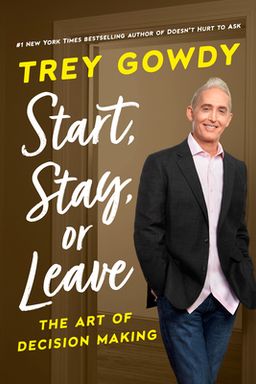
The Art of Decision Making: Designing a Life You Choose
What if every major crossroad in your life—starting a new job, staying in a relationship, or walking away from it—could be distilled into three simple questions: Should I start? Should I stay? Or should I leave? In Start, Stay, or Leave: The Art of Decision Making, Trey Gowdy applies a lifetime of legal argument, courtroom thinking, and congressional introspection to teach you how to craft a life guided by intentional, conscious decisions rather than reaction or fear.
Gowdy contends that the quality of our lives is determined not by luck or circumstance but by the decisions we make continuously—often quietly, sometimes dramatically. Each act of starting, staying, or leaving determines how we build and define a well-lived life. But most people, he argues, make decisions passively, letting other people define success, pressure them into paths not their own, or paralyze them with the fear of failure.
Defining a Life on Your Own Terms
At its heart, the book’s message is profoundly personal: stop letting others define your path. Gowdy begins with a self-reflection from his own wedding day when a well-meaning pastor predicted he’d end up as governor of South Carolina. For decades, that seemingly harmless statement shaped Gowdy’s ambitions, career decisions, and self-worth. He chased titles instead of meaning, until realizing that the only standard that matters is the one you define for yourself. The book emerges from this awakening—an attempt to pass on lessons learned through both success and regret.
Three Questions that Guide All Decisions
Gowdy organizes his philosophy into three recurring questions that form the spine of this book: when to start, when to stay, and when to leave. Each represents a season of life. Starting demands courage and clarity; staying requires endurance and purpose; leaving calls for humility and self-awareness. Taken together, these questions help you design your own moral and emotional compass for decision making.
He explains that these decisions are cyclical rather than linear—every start leads to a stay, and every stay ultimately demands a consideration of when to leave. Like chapters in a courtroom case, each carries evidence and argument that shape your eventual verdict: the closing argument of your life.
Why Decisions Matter More Than Circumstances
The thread running through Start, Stay, or Leave is responsibility. Gowdy insists that while life gives us randomness, what we make of it depends on choices. The jobs we take, the towns we live in, and the people we love are products of decisions—not fate. Drawing from his transitions from prosecutor to congressman to television journalist, he demonstrates that every stage required deliberate departures and courageous starts. In this way, decisions act like invisible architecture shaping a life of both meaning and memory.
Lessons from the Courtroom and the Classroom
Using courtroom analogies—closing arguments, evidence, witnesses—Gowdy invites readers to treat life with the same rigor as a trial. Starting at the end forces clarity: where do you want the jury of your family, friends, and conscience to find you at your final verdict? Staying teaches commitment and character. Leaving, meanwhile, demands discernment to know when pursuit becomes self-harm. Like Daniel Kahneman’s focus on “thinking slow” or Annie Duke’s perspective on quitting from Quit, Gowdy bridges logic and emotion into a balanced method for life’s verdicts.
Why It Matters
At the book’s core, decision making becomes the art of conscious living—naming what success means for you, cultivating courage against fear, and learning to leave when seasons end. With humor, humility, and stories drawn from his years as a prosecutor and father, Gowdy urges readers to make choices that align their external success with internal peace. He concludes that life is a series of closing arguments, each built from the evidence of how you treat others, what you stand for, and how bravely you decide. In that way, Start, Stay, or Leave isn’t a manual for lawyers or leaders—it’s a reflection for anyone trying to write the final paragraph of their own story with integrity.