
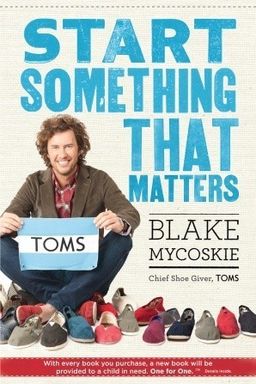
Start Something That Matters cover

Start Something That Matters

by Blake Mycoskie

Start Something That Matters offers engaging, practical advice for aspiring entrepreneurs. Learn to overcome fears, utilize limited resources creatively, and craft compelling narratives to build a meaningful, successful business that resonates with customers and communities.

Start Something That Matters: Building Meaning Through Enterprise

What if your work could change lives—not only yours, but those of people across the world? In Start Something That Matters, Blake Mycoskie contends that success is no longer just about accumulating wealth or status. Real success, he argues, involves creating a venture that aligns purpose with profit—one that gives back as much as it earns. Through stories from his own journey founding TOMS Shoes, as well as examples of socially conscious entrepreneurs, Mycoskie reveals how anyone can start something that truly matters, even with limited resources.

A New Definition of Success

Mycoskie invites you to reconsider what it means to succeed. Drawing from his experience transitioning from serial entrepreneurship to social enterprise, he argues that fulfillment comes when we blend business with a higher purpose. He believes we can live and work on our own terms—earning a living while improving the world around us. That conviction became the foundation of his celebrated One for One model: for every pair of TOMS shoes sold, the company gives another pair to a child in need. (In contrast to purely philanthropic nonprofits, TOMS sustains giving through its commercial success.)

Success, then, is multidimensional: financial viability ensures sustainability, while giving creates connection, meaning, and legacy. By redefining success, Mycoskie empowers readers to see business not as opposition to altruism, but as a powerful force for good—a movement embraced by what he calls “conscious capitalism.”

Why This Model Matters Today

Mycoskie wrote the book in response to a shift he observed among younger entrepreneurs and consumers. People crave purpose, not just paychecks. With global awareness expanding through social media and cross-cultural exchange, the old capitalist model—profit before people—no longer fits our interconnected world. Instead, Mycoskie champions enterprises that engage supporters rather than mere customers. Supporters, he explains, identify with your story and mission; they spread your message with enthusiasm. This change reflects broader trends described elsewhere, such as in John Mackey’s Conscious Capitalism and Muhammad Yunus’s Building Social Business: capitalism can sustain compassion when it includes a social dimension.

Six Core Principles for Creating Meaningful Ventures

Throughout the book, Mycoskie distills his experience—and those of other entrepreneurs—into six key traits for launching and sustaining a mission-driven company:

  • Find your story: Authentic stories connect emotionally, bridging business and humanity.
  • Face your fears: Courage transforms obstacles into opportunities for growth.
  • Be resourceful without resources: Creativity flourishes under constraint.
  • Keep it simple: Focus on clear goals, uncluttered designs, and easy messages.
  • Build trust: Transparency and humility attract lasting loyalty.
  • Giving is good business: Generosity fuels engagement and sustainable profit.

Each principle forms a chapter anchored in vivid stories—of TOMS’ growth and of other innovators like Method’s founders Adam Lowry and Eric Ryan, or Zappos CEO Tony Hsieh—demonstrating how simple ideas combined with compassion can transform entire industries.

Why Personal Purpose Powers Global Change

Ultimately, Start Something That Matters reminds you that meaningful work begins with personal passion. Mycoskie frequently asks readers reflective questions: What would you do if money didn’t dictate your choices? What problems move you enough to address them? He recounts his own transformation—from a vacationer in Argentina spotting shoeless children to the founder of a global movement—to show how awareness turns into action. When your story and mission intertwine, purpose empowers perseverance through inevitable fears and failures.

“You don’t have to compartmentalize your ambitions—personal, professional, philanthropic. They can converge.”

That convergence, says Mycoskie, creates a life filled with meaning. His point isn’t that everyone should start a business—it’s that we should all start something purposeful, whether in our jobs, communities, or creative pursuits. By merging compassion with smart entrepreneurship, this book lays out a practical invitation: live your story, share it courageously, and build a better world while building yourself.


Find Your Story

Stories sell more than products—and they connect better than facts. Blake Mycoskie argues that your story is your most powerful resource, no matter your industry or startup budget. Without a memorable narrative, even solid products fade in the noise of modern advertising. But when your story evokes emotion, it transforms customers into lifelong supporters.

How Story Creates Identity

From ancient parables to branding today, humans understand the world through stories. Mycoskie shows that the TOMS story—a vacation in Argentina, shoeless children, and a simple idea to give back—wasn’t just marketing. It was a mission people could believe in. When he met a traveler wearing TOMS at an airport who passionately retold his own company’s origin back to him, he realized that shared stories create belonging. Customers become advocates who feel part of a movement, not mere buyers.

Authenticity Over Advertising

Traditional advertising, epitomized by Mad Men slogans, relies on facts and repetition. But, as Mycoskie cites from Carnegie Mellon research, narratives trigger empathy and drive action. When people read a single story—like that of a girl named Rokia in a charity letter—they donated twice as much as those who read statistics. Similarly, brands like Subway saw explosive success not through calorie counts but through Jared Fogle’s authentic transformation story. Real experiences amplify credibility and emotion far better than data points.

(Note: Seth Godin’s All Marketers Are Liars echoes this idea: people remember stories, not statistics. They want narratives aligning with their values.)

Sharing Your Passion, Not a Pitch

Mycoskie encourages you to articulate your passion first. Ask yourself: What problem do I care about solving? What community do I belong to or identify with? He notes Bert Beveridge, founder of Tito’s Vodka, succeeded in a crowded marketplace because his product carried a local story—Texan pride, crafted authenticity—something the established global brands couldn’t replicate. Once you pinpoint your passions, you build a mission that feels personal—then tell that story at every opportunity, from elevator pitches to social media posts.

Building Supporters, Not Just Customers

When your story resonates, those who buy in become vocal ambassadors. TOMS found supporters everywhere: university students organized barefoot walks (One Day Without Shoes), while Ralph Lauren and Vogue partnered purely to share the inspiring narrative. These supporters come because they share your values, not because of discounts or ad pressure. Mycoskie’s mantra—“Supporters beat customers every time”—captures the heart of today’s social business ethos. A great story gives others permission to belong to something meaningful, and that connection builds a movement around your purpose.


Face Your Fears

Everyone experiences fear—the uncertainty that surfaces when we step outside comfort zones. Blake Mycoskie urges you not to avoid fear, but to face it, interpret it, and act anyway. Success, he argues, emerges not from eradicating fear but from mastering it as fuel. To prove this, he shares stories ranging from his mother Pam’s self-published bestseller to entrepreneurs who dared when logic said wait.

Fear as an Ally

Fear’s physiological roots are survival mechanisms, but in modern life, Mycoskie explains, it appears as hesitation to take smart risks—starting a venture, leaving a stable job, or pitching an audacious idea. Using his mother’s example, he shows how facing fear repeatedly builds self-confidence. Pam Mycoskie risked financial ruin twice to publish Butter Busters; despite setbacks, she persevered and sold over 1.4 million copies. Her resilience wasn’t ignorance of fear—it was commitment to purpose stronger than anxiety.

Turning Fear Into Focus

Mycoskie advocates transforming fear into strategic awareness. Instead of dwelling on dread, write fears down and objectively analyze worst-case scenarios. On one side of a page, list potential failures; on the other, list what you’ll learn even if things go wrong. This reframing makes fear manageable. (Tim Ferriss similarly suggests defining worst-case outcomes to reduce paralysis.) Mycoskie also emphasizes starting small—TOMS began with 250 shoes, not thousands. Incremental steps deflate fear while yielding momentum.

Learning From Those Who Risk

He profiles VeeV founders Courtney and Carter Reum, who left high-paying Wall Street jobs to start a sustainable spirits company. They feared failure, but focusing on lessons instead of losses kept them moving. Each mistake became practice rather than punishment—a concept Mycoskie calls “analysis paralysis cure.” Likewise, fear of imperfect timing can stall dreams, but Mycoskie quotes Ferriss: “Conditions are never perfect. Someday is a disease.” Waiting eliminates action; acting corrects course along the way.

Cultivating Confidence Through Connection

To endure fear, surround yourself with positive collaborators and mentors. Interns, Mycoskie notes, bring fearless enthusiasm untainted by doubt. Reading biographies—of Richard Branson, Yvon Chouinard, or Howard Schultz—also reveals that fear is universal among achievers. Immerse yourself in others’ courage, and let their examples remind you that failure is just a stage before success. Facing fear transforms not only your ventures, but your perspective: once you live your story authentically, fear becomes a sign you’re on the right path.


Be Resourceful Without Resources

What if the best thing that could happen to your new idea is not getting funded? Blake Mycoskie argues that scarcity sharpens creativity. In the early days of TOMS, resource constraints forced innovation—from interns packing shoes in his apartment to homemade booths at trade shows. He discovered that necessity breeds invention—and culture.

Bootstrapping Creativity

Running TOMS out of his Venice apartment, Mycoskie learned that frugality encourages teamwork. With interns instead of employees and borrowed furniture instead of offices, everyone shared equal footing. This “garage culture,” he explains, is the birthplace of ingenuity—from Apple’s garage origins to Ben & Jerry’s repurposed gas station. Extreme constraints align teams, reduce bureaucracy, and make problem-solving personal.

The Case Against Comfort

Mycoskie warns that overfunded startups, like Pets.com or Webvan, often fail because abundance discourages focus. Venture investor Mike Maples echoes this: too much money can be toxic. When every dollar matters, you make decisions based on results, not assumptions. Tight resources instill habits that endure—efficiency, lean budgets, and creative partnerships. Even later, as TOMS prospered, the company maintained this bootstrap ethos to avoid complacency.

Resourcefulness Creates Connection

Scarcity often fosters generosity. Unable to buy everything they needed, early TOMS sought free support—an approach Mycoskie dubbed “frugal magic.” Borrowed offices, free lunches (“frunches”), and creative titles like “Chief Shoe Giver” built goodwill while engaging others in the mission. This ingenuity established TOMS as relatable and fun, inspiring interns and partners alike to contribute enthusiastically.

Sean Carasso’s Falling Whistles, born from five dollars and bunk beds, illustrates this principle: frugality as freedom. Limited resources ensured every dollar aligned with purpose, strengthening the organization’s resilience. According to Mycoskie, when you spend less than you make, you’re always profitable—not just financially, but morally and creatively.

Leveraging Free Tools and Collaboration

Modern entrepreneurs have unprecedented access to cost-free tools—social media, open software, and community networks. Mycoskie highlights platforms like Twitter, 99designs, and LegalZoom as equalizers that let startups compete with giants at minimal cost. The lesson is simple: don’t wait for money to start; use what you have to test ideas fast. As he puts it, “Not having resources makes you better at everything.” Frugality creates flexibility, authenticity, and, ultimately, staying power.


Keep It Simple

Complexity kills clarity. Blake Mycoskie learned early that simple ideas endure, while complicated ones confuse. The alpargata shoe—the humble Argentine slip-on—embodied that truth. By keeping its design minimal and its purpose universal, TOMS built a business model people instantly understood: “Buy one, give one.” Mycoskie shows how simplicity in design, mission, and communication drives success.

Designing for Clarity

TOMS’ greatest strength lay in simplicity of product. With few components and endless customization potential, the shoe became both an aesthetic and emotional canvas. The Style Your Sole program, where fans decorate shoes to personalize their giving, proves simplicity invites creativity. Likewise, brands like Google (a clean interface with fewer than 28 words) and Apple’s iPod succeed by removing clutter, not adding features.

Simplifying Your Mission

Mycoskie references companies like SendABall—sisters who built a million-dollar business by mailing simple bouncy balls with handwritten messages. Their success exemplifies clarity: one product, one function, one emotion—joy. Similarly, nonprofits such as Heifer International or DonorsChoose thrive through concise missions people can instantly understand. When your message fits in one sentence, others can relay it confidently, strengthening brand virality.

Simplicity in Life and Work

Simplicity isn’t only a business strategy—it’s a lifestyle. Mycoskie moved onto a boat and shed possessions to reduce mental clutter, discovering clarity breeds creativity. He urges readers to eliminate unnecessary complexity, schedule intentionally, and focus energy on what matters most. (Tim Ferriss’s 80/20 rule for eliminating nonessential tasks parallels this mindset.) When life becomes simpler, purpose becomes visible.

“The easier it is for someone to understand who you are, the easier it is for them to spread the word.”

To keep it simple, distill your idea into one sentence and your life into core values. Complexity clouds communication; simplicity invites action. Whether in business or daily living, focus isn’t found through addition but subtraction—removing everything that doesn’t matter so the meaningful can shine.


Build Trust

Trust is the foundation of sustainable success. Without it, no product, cause, or leader can last. Blake Mycoskie describes trust as both internal—the faith between team members—and external—the faith customers place in your brand. In Start Something That Matters, he explores how organizations like Zappos and charity: water make integrity their core infrastructure.

Trust Starts Within

Internally, TOMS learned trust through servant leadership: empowering employees rather than commanding them. Mycoskie and mentors like Bill Hewlett and Robert Greenleaf champion transparent communication and humility. By admitting mistakes—the Airstream shoe flop, slick soles fiasco—TOMS built credibility. Owning errors publicly reassured partners that the company valued honesty over perfection.

Servant Leadership and Culture

Servant leaders serve their teams first. Mycoskie abandoned the “rock-star CEO” ideal, urging leaders to help colleagues succeed. Candice Wolfswinkel (“Shoe Glue”) and Jill DiIorio illustrate this by supporting their teams rather than dictating commands. This model transforms organizations into communities. As Mycoskie writes, “A leader can create a company, but a community creates a movement.”

External Trust and Transparency

Outside the company, credibility means matching words with deeds. When Tylenol faced catastrophe in 1982, Johnson & Johnson regained trust through transparency and product recall—a model Mycoskie admires. Charity: water’s founder Scott Harrison reinforces this principle, publicly mapping each donated well via GPS to prove accountability. This kind of radical honesty inspires giving and long-term loyalty.

Why Trust Multiplies Value

Trust, once established, becomes exponential currency. TOMS volunteers invited customers to join global Shoe Drops, creating firsthand experience of their mission. Partners like AT&T and Nordstrom collaborated because they trusted the brand’s integrity. As Mycoskie concludes, transparency isn’t just moral—it’s profitable. In a world skeptical of marketing spin, building genuine trust is the ultimate competitive advantage.


Giving Is Good Business

Can giving away your product be the smartest business decision you ever make? Blake Mycoskie proves it can. Through TOMS’ One for One model, he demonstrates that generosity not only uplifts communities—it builds customer enthusiasm, employee morale, and brand partnerships that multiply impact.

The Economics of Generosity

Initially, critics called TOMS unsustainable—a for-profit company that gives away goods? Yet Mycoskie discovered that giving drives growth. Each shoe donation fueled press coverage, brand loyalty, and authenticity competitors couldn’t imitate. When Vogue featured forty-dollar TOMS next to $400 designer heels, the difference wasn’t fashion; it was purpose. Customers felt part of a global mission, which translated into sales and social impact.

Creating Shared Value

Mycoskie highlights Lauren Bush’s FEED Projects, whose bags fund school meals worldwide, and corporate initiatives like Pepsi’s Refresh Project. These examples demonstrate Michael Porter’s “shared value” principle—businesses prosper when communities prosper. Giving uses profit to generate empathy, closing the gap between commerce and conscience. Employees find deeper meaning, reducing turnover. Partners—from Ralph Lauren to Microsoft—collaborate willingly because generosity aligns with their brand stories.

How Giving Builds Culture

Within TOMS, philanthropy created unity. Shoe Drops reminded staff that mission mattered; even interns saw direct impact. Mycoskie also cites corporate programs like Timberland’s paid volunteering and Home Depot’s playground builds as proof that service inspires innovation. When companies live their values, employees share pride and customers trust their intentions.

“Giving doesn’t weaken your business—it strengthens its soul.”

Mycoskie urges readers not to wait until retirement or success to give. Start now—whether through microloans (Kiva), charitable partnerships, or integrating sharing into your core product. Giving activates gratitude that sustains success. In doing so, you transform capitalism from competition into collaboration—and build a world where profit and purpose thrive together.


The Final Step: Start Now

The best time to begin is now. In the final section, Blake Mycoskie calls readers to action: stop waiting for perfect conditions and start something that matters today. He shares the story of Tyler Eltringham, founder of OneShot, who applied TOMS’ One for One concept to global health by providing meningitis vaccinations. Tyler was a college freshman with limited experience—but he took the first step nonetheless.

From Inspiration to Action

Like many readers, Tyler first encountered TOMS as a customer. Seeing how buying shoes could help kids in Argentina ignited his imagination. He asked: Could my generation link health and social business? His answer became OneShot—a nonprofit providing a vaccine to a student in Africa for each shot given at U.S. colleges. Despite fear, limited funds, and skepticism, he launched the project, won seed funding, and proved passion can bridge expertise gaps.

The Power of the First Step

Mycoskie likens taking action to “tying your shoes before the run.” Beginning, however small, dismantles hesitation. If you wait for clarity, opportunities pass; if you act, clarity unfolds through experience. He reminds readers that TOMS started as a journal sketch, not a global brand. Big movements often begin with tiny decisions—emailing a contact, buying materials, or volunteering for a cause.

Purpose Beyond Profit

The goal of starting something that matters isn’t grandiosity—it’s contribution. Even helping one person counts. Mycoskie quotes the poem that opens his book: “To know even one life has breathed easier because you have lived—this is to have succeeded.” Whether through a startup, art, or community service, each effort ripples outward. Letters from readers, he says, give him greater joy than profit reports because they show how purpose inspires purpose.

By the end, he shifts his own focus: not from building TOMS, but from empowering others. Like Gandhi’s maxim, “Be the change you want to see,” this call makes the book not merely a memoir but a movement. The message is simple yet profound: stop dreaming, start doing. Once you take the first step, the world—and your life—will transform.

Dig Deeper

Get personalized prompts to apply these lessons to your life and deepen your understanding.

Go Deeper

Get the Full Experience

Download Insight Books for AI-powered reflections, quizzes, and more.