
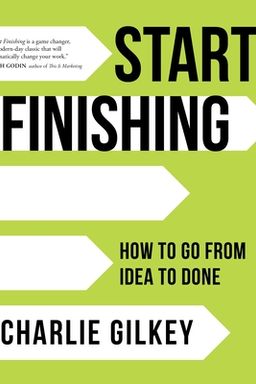
Start Finishing cover

Start Finishing

by Charlie Gilkey

Start Finishing by Charlie Gilkey is a practical guide that helps you turn your ideas into completed projects. With actionable steps, it teaches you to select the right ideas, cultivate essential qualities, and overcome challenges, ultimately leading to personal and professional growth.

From Idea to Done: The Power of Finishing

When was the last time you worked on something that truly mattered—something that made you feel alive, purposeful, and proud—but somehow never finished? In Start Finishing: How to Go from Idea to Done, Charlie Gilkey argues that our most meaningful work doesn’t stall because we lack talent or drive—it stalls because we haven’t learned how to turn inspired ideas into structured, completed projects. The problem isn’t starting; it’s finishing. And finishing, Gilkey insists, is a skill anyone can learn.

Drawing from his background as a philosopher, military officer, and productivity strategist, Gilkey shows that fulfillment comes not from busyness but from doing your best work consistently and bringing it to completion. He believes that finishing is both an act of personal growth and world-building—it’s how ideas become impact. The gap between vision and reality, what he calls the “air sandwich,” can be bridged through intention, courage, discipline, and community.

Why Finishing Matters More Than Starting

According to Gilkey, most of us suffer from a kind of creative paralysis. We’re “busy” yet feel incomplete because our talents are scattered across half-finished projects and notebook scribbles marked for “someday.” But as he reminds us, someday never arrives on its own. Finishing is the act that transforms good intentions into tangible accomplishments. Your happiness, he writes, depends not on how many ideas you generate but on how many you finish and share with the world.

He frames this as doing your “best work”—the projects that uniquely express your gifts and enrich others. Best work isn’t limited to your job; it might be raising your kids, starting a community initiative, writing a novel, or repairing a broken system. Whatever form it takes, it demands courage to shine a light on your unique contribution to the world. Moreover, Gilkey emphasizes that best work is both sacred and practical—sacred because only you can give it, and practical because focusing on it organizes the rest of your life.

The Core Promise: Thriving Through Action

Gilkey builds his philosophy on an ancient truth: we thrive by doing. From Aristotle to the Dalai Lama, sages have reminded us that fulfillment (or “eudaimonia”) comes through purposeful action. But meaningful action doesn’t happen by chance—it requires clarity and structure. Gilkey helps you identify what projects matter most, transform them into achievable plans, and integrate them into your schedule so they don’t get buried under the busyness of everyday life. His framework blends philosophical wisdom with pragmatic tools borrowed from project management, behavioral psychology, and creativity research (similar to approaches found in Cal Newport’s Deep Work and James Clear’s Atomic Habits).

Three Phases to Transform Ideas Into Reality

The book is structured in three parts. First, you must clear the decks: identify your “best work” and the hidden obstacles that prevent it. This requires recognizing that everything—from parenting to volunteering—is a project drawing on the same limited resources of time, energy, and attention. Second, you learn how to plan your project: turning ideas into SMART goals, creating space in your schedule, mapping steps, and preparing for drag points (the friction of reality). Finally, you work the plan: weaving your best work into your daily life, building momentum, and finishing strong with reflection and renewal.

This process is neither linear nor rigid—it’s cyclical. Each finished project unlocks the next. With each success, you become better at starting and finishing, and more confident in your creative power. The goal is not to do everything perfectly, but to finish something meaningful and use that momentum to fuel the next transformation.

Finishing as Self-Transformation

Finishing, Gilkey reminds us, changes not just what you make but who you become. Each project is a bridge between your current self and future self—it’s both a mirror of who you are and a map to who you’re becoming. As you move from “someday” to “today,” you develop virtues that define thriving humans: discipline, awareness, courage, and integrity. You also unlearn harmful cultural patterns—like equating constant busyness with worth—and replace them with habits that sustain meaning and fulfillment.

Ultimately, Start Finishing is both a productivity guide and a philosophy of purpose. It teaches that your unfinished projects are unfinished versions of yourself—and by finishing them, you finish pieces of your own becoming. This isn’t about hustling harder; it’s about working smarter, deeper, and truer to what really matters. The world doesn’t need more ideas; it needs your finished work. So, as Gilkey says, stop waiting for someday—start finishing today.


Turning Ideas into Actionable Projects

We don’t do ideas; we do projects. That’s Gilkey’s mantra, and it’s how he cuts through the illusion that thinking about something equals progress. A project, he explains, is anything that requires time, energy, and attention to complete—whether it’s organizing your garage or launching a business. When you start labeling your goals as projects, you realize how overloaded your life already is and why important ideas keep getting sidelined.

Why “Someday” Never Comes

Gilkey starts by exposing the “Someday Myth.” We often tell ourselves that someday, when things calm down—when work slows, the kids grow up, or we have more money—we’ll finally focus on what matters most. But he insists that someday is a phantom. The only day we ever have is today, and waiting for perfect circumstances is how dreams evaporate. Your life isn’t a rehearsal, and each day spent stuck in busywork is a day stolen from your best work.

By redefining “work,” Gilkey broadens the scope beyond careers. Raising a child, learning piano, or advocating for your community are all projects demanding the same finite resources as your job. Recognizing these overlapping commitments brings clarity—you can’t do everything, but you can consciously choose what gets your focus.

The Three-to-Five-Year Project World

Gilkey encourages readers to view life itself as a series of three-to-five-year projects. Over that span, major changes inevitably occur—careers evolve, families shift, priorities transform. Thinking this way relieves the pressure of making lifelong decisions and reframes each period as an intentional experiment. Whether it’s starting a company or moving across the country, each project is both a mirror of your current reality and a bridge to your next stage of growth.

Projects Are Mirrors and Bridges

Projects, Gilkey says, are mirrors because they reveal what’s really going on in your inner and outer world—your strengths, fears, values, and priorities. They are also bridges because through them, you create the world your soul wants to inhabit. As you take a project from start to finish, you not only change what exists outside you but also who you are inside. The more you finish, the more capable and aligned you become.

Managing Your “Ands”

For multitalented “Renaissance souls,” narrowing focus can feel suffocating. Gilkey reassures readers that you don’t have to abandon parts of yourself. Instead, you learn to choose the right combinations of projects that honor your multiple “ands.” You might be a teacher and a musician, a manager and a community activist. What matters is prioritizing which “and” gets attention now and which can wait. You’re not betraying your diverse identity; you’re sequencing it into coherence.

By converting ideas into projects, you create a concrete pathway for change. Projects make meaning tangible. They allow you to practice thriving—not just think about it. Each finished project becomes proof that you can turn vision into reality, one completed bridge at a time.


Overcoming the “Air Sandwich”

Why do so many of us feel disconnected between our big dreams and daily actions? Gilkey calls this gap the “air sandwich.” On one slice of bread sit your vision, goals, and ideals. On the other slice are your daily tasks, meetings, and routines. In between is a lot of air—a void filled with frustration and unmet potential. The air sandwich is where good intentions go to suffocate.

Five Hidden Obstacles

Gilkey identifies five culprits that fill this unproductive gap:

  • Competing priorities—You’re herding too many “squirrelly goats” in different directions, trying to satisfy conflicting roles and values.
  • Head trash—The inner critic and self-limiting stories that convince you you’re not capable or worthy.
  • No realistic plan—Dreaming without strategy traps you in wishful thinking rather than practical progress.
  • Too few resources—Believing you don’t have enough time or money to start delays action indefinitely.
  • Poor team alignment—Miscommunication or mismatched expectations with people around you drains energy.

Each element alone can derail progress, but together they form a web that chokes your momentum. Gilkey shows that solving the air sandwich requires more than tools—it requires cultivating five core personal practices.

The IABCD Keys: Your Tools for Thriving

Intentionality, Awareness, Boundaries, Courage, and Discipline—abbreviated as IABCD—are the five keys that unlock progress. They parallel Aristotle’s virtues and modern psychology’s character strengths:

  • Intention—Begin with clarity about why something matters. Without direction, energy scatters.
  • Awareness—Know yourself—your energy rhythms, emotions, and triggers. Awareness precedes change.
  • Boundaries—Say no to things that displace your best work. Boundaries are not barriers; they are commitments to meaning.
  • Courage—Act despite fear. Each bold step trains your “courage muscle.”
  • Discipline—Create habits that make finishing inevitable. As James Clear says, “Discipline creates freedom.”

Applying the Keys

Gilkey pairs each obstacle with the key that best counteracts it—discipline aligns competing priorities, courage challenges head trash, and boundaries protect your time. As you practice IABCD, you transform foggy aspiration into focused execution. It’s not one-time work; it’s a lifelong habit of linking your vision to reality.

By mastering the IABCD framework, you stop floating in the air sandwich and start building bridges between who you are and what you do each day. Each intentional act closes the gap—and over time, it closes the distance between the life you have and the life you want.


Choosing an Idea That Really Matters

Before you can finish, you have to pick something worth finishing. Sounds simple, but this is where many people stall. In Chapter 3, Gilkey explores why it’s so hard to commit to one idea and how emotional resistance—what he calls “thrashing”—reveals what truly matters to you.

Thrashing: A Sign of Significance

Thrashing is the flailing, anxious dance we do around work that scares us. You research endlessly, reorganize your desk, or start over for the tenth time—not realizing that you’re avoiding fear, not the project. The more an idea matters, the more you thrash. That’s a feature, not a flaw. Recognizing thrashing as a sign of importance transforms frustration into guidance—it tells you you’re on the right path.

Creative Constipation and the Cost of Avoidance

Ignoring your best work leads to “creative constipation.” You absorb endless inspiration but never release anything, and eventually, you feel toxic and resentful—toward yourself and others who are doing the work you’re avoiding. Gilkey draws a stark choice: channel your energy into creation or self-destruction. The same force that fuels your creativity can just as easily implode your wellbeing if left blocked (a perspective echoing Steven Pressfield’s The War of Art).

Made to Slay Dragons

“There be dragons” on the path to your best work—but Gilkey insists you were built to slay them. Humanity’s superpower has always been creativity and resilience. Every fear is a dragon guarding treasure, and facing it is what differentiates purposeful work from busywork. When you feel resistance, it’s a sign that something meaningful is at stake.

The Gift of Failure and the Grace of Displacement

Failure, he argues, is feedback. Each misstep reveals what truly matters and where you’re out of alignment. Likewise, displacement—the truth that every action replaces countless others—forces you to choose. You can’t do it all. Recognizing the finite nature of time helps you prioritize what’s truly worth your energy. He even invites readers to count how many “five-year projects” they might have left in life—an exercise that can be both sobering and clarifying.

Letting Go to Trade Up

To start something great, you must release the merely good. Gilkey encourages you to literally list your current projects and decide which to keep, which to defer, and which to drop. Burning the list, he says, can be a cathartic way to reclaim creative energy. Choosing one project doesn’t mean losing others; it means committing to finishing one now so the rest can have their turn. As Buddhist teacher Susan Piver reminds readers in her interview, “Sometimes the wisdom is telling you to stop.” Picking fewer but truer projects is how you stop thrashing and start thriving.


Planning and Building Your Project

Once you’ve chosen what matters most, you must turn that idea into a structured plan. Gilkey’s chapters on planning are some of the most practical in the book, merging his military precision with creative empathy. He guides you to define SMART goals, calibrate effort, build your team, and make real space for deep work.

SMART Goals with Soul

Gilkey adapts the classic SMART framework—Simple, Meaningful, Actionable, Realistic, Trackable—into a form that works for creative projects. A goal like “Write chapter one by June 1” beats “Work on my book someday.” Simplicity eliminates confusion; meaning keeps you motivated; realism prevents burnout. He pairs this with the “three levels of success”: small (minimum viable completion), moderate (expected success), and epic (stretching for greatness). Not everything needs to be epic—progress compounds when you stack smaller wins.

No Date, No Finish

If a project has no start or finish date, it lives in “someday.” Putting a date on it creates gravity. Start dates matter just as much as deadlines; they mark commitment and help you confront displacement. Every project competes for your finite focus blocks, so Gilkey teaches you to intentionally schedule start and end times. Commitment, not convenience, fuels completion.

The Success Pack

No hero finishes alone. Gilkey’s “Success Pack” consists of four roles: Guides (mentors showing the way), Peers (fellow travelers sharing the journey), Supporters (helpers who enable your work), and Beneficiaries (the people who will benefit from your finished project). Each project deserves a small circle of three to five people in each group. This social structure replaces isolation with accountability and joy—proof that finishing is communal, not solitary.

Making Space and Structuring Time

Gilkey’s Project Pyramid breaks large goals into nested chunks—from yearly down to fifteen-minute slices. His Five Projects Rule caps how many active projects you can pursue per time scale. And his Weekly Block Planner divides your schedule into Focus (creative work), Social (meetings), Admin, and Recovery blocks. These tools stop overwhelm by revealing the real cost of each commitment and protect your best work from busywork overload.

Together, these strategies create a sustainable architecture for finishing. Planning isn’t bureaucracy—it’s compassion for your future self. When you make space intentionally, you turn chaos into a canvas for creativity.


Facing Drag Points and Resistance

Even the best plans encounter drag—resistance from both reality and your inner world. In Chapter 7, Gilkey identifies how hidden “no-win scenarios,” other people’s priorities, and derailers can slow your progress, and how awareness and courage help you stay airborne.

No-Win Scenarios

Sometimes we self-sabotage because deep down we’ve written impossible scripts. You might fear that success will alienate loved ones (“The Success Will Wreck My Relationships” tale), believe you must choose between virtue and ambition (“The Success vs. Virtue” myth), or doubt you can repeat past achievements (“The What If I Can’t Do It Again?” trap). Each is a mental trap limiting your growth.

Gilkey suggests unpacking these fears through boundaries and honesty. Redefine success in ways that expand virtue rather than conflict with it and surround yourself with models who embody integrity and ambition (as Jeff Goins and Seth Godin describe in their features). When you see success as service, not selfishness, it becomes a path to deeper connection.

Managing Other People’s Priorities (OPP)

Much of your drag comes from adopting other people’s expectations—your boss’s urgency, your family’s comfort, your culture’s noise. OPP rarely disappears, but you can align or limit it. Say “yes and when” to manage expectations, or weave OPP into your project so others benefit from its success. Otherwise, the cost of constant accommodation is your own creative depletion.

Derailers and Naysayers

Derailers are often well-meaning people whose “help” distracts or discourages you; naysayers actively resist your forward motion. Gilkey’s strategy: clarify intentions, negotiate boundaries, limit exposure, and refocus on your “yaysayers.” Jeffrey Davis adds that curiosity and wonder can disarm derailers—ask them clarifying questions instead of reacting defensively. You can’t eliminate all resistance, but you can decide who gets a vote versus who gets a voice.

Drag is a sign you’re moving fast enough to matter. Pilots expect turbulence; creators should too. Learning to navigate drag points with clarity and courage turns resistance from an enemy into a teacher on the path to mastery.


Momentum, Focus, and Daily Flow

Finishing isn’t just about the big breakthroughs—it’s about what happens every day. In the book’s third section, Gilkey shows how to sustain momentum through habits, block planning, and mindful scheduling that integrates creativity into real life.

Momentum Planning and the 5/10/15 Split

Momentum planning is Gilkey’s layered approach to continuous calibration: weekly reviews, monthly goals, and short daily check-ins. The “5/10/15 Split” organizes your rhythm—five active projects total, ten minutes reviewing your plan in the morning, fifteen minutes celebrating wins and adjusting at day’s end. This ritual keeps projects moving while warding off overwhelm, similar to David Allen’s Getting Things Done yet more humane and creative.

Becoming Friends with Time

Instead of fighting time, Gilkey encourages making peace with its constraints. He introduces block-based scheduling: Focus Blocks (deep work), Social Blocks (collaboration), Admin Blocks (light work), and Recovery Blocks (rest). Three Focus Blocks per week, he says, are enough to change your creative life. The rest should support—not sabotage—those sacred hours.

He also urges tailoring your schedule to your chronotype—whether you’re a morning lark, midday emu, or night owl (building on Daniel Pink’s When). Aligning your natural energy rhythms with your focus time multiplies productivity without burnout.

Taming Frogs, Cascades, and Distractions

We all have “frogs”—those dreaded tasks we avoid. Swallowing a frog first thing in the morning lowers your “dread-to-work ratio.” Left undone, small frogs grow warts (and hair). Gilkey’s humor aside, his point is serious: discipline is emotional hygiene. Likewise, he warns against project “cascades” (one delay causing another) and “tarpits” (stalled projects that get harder to lift). By limiting your active projects and resetting weekly, you prevent these slow-motion disasters.

Momentum planning turns chaos into choreography. It’s not about speed; it’s about steady forward motion. By combining structure with self-compassion, you build a creative rhythm that lasts far beyond a single project.


Finishing Strong and Starting Anew

How you finish affects who you become next. In the final chapter, Gilkey reframes endings not as closure but as renewal. Finishing a project releases energy, reshapes identity, and prepares the ground for what’s next. “Before success, start finishing,” he writes. “After success, start finishing again.”

Celebrate Your Victories

Gilkey urges readers to run a Victory Lap—publicly or privately honoring your completed work. Celebration isn’t vanity; it’s gratitude. It acknowledges your growth and invites your community to share in it. Success, he reminds us, belongs to the whole village that supported you—from mentors to baristas who kept your coffee hot.

Transition Gracefully

After the high of finishing, there’s often a void. You’ve poured weeks or years of energy into a project, and suddenly the daily ritual vanishes. Gilkey calls for intentional transition time—a space to rest, reflect, and reset before leaping into the next thing. Use it for what he playfully calls CAT work: Clean up, Archive, and Trash. This includes decluttering your workspace, organizing files, and replenishing neglected relationships.

Review and Reinvest

Gilkey borrows the Army’s “After-Action Review” method to help you learn from each project. Ask: What went well? What challenged me? What will I do differently next time? This transforms every finished project into a stepping stone for greater mastery. Small lessons compounded over time yield exponential growth.

Finally, each completion unlocks new doors—skills, allies, opportunities. You’ve earned new GATES (Genius, Affinities, Talents, Expertise, Strengths) and may discover new communities and callings. The work completes you even as you complete it.

Finishing strong isn’t about perfection but presence. Take your victory lap. Do your CAT work. Reflect and rest. Then, when the next spark beckons, begin again—because a thriving life is nothing more than a string of meaningful projects, finished one after another, with heart.

Dig Deeper

Get personalized prompts to apply these lessons to your life and deepen your understanding.

Go Deeper

Get the Full Experience

Download Insight Books for AI-powered reflections, quizzes, and more.